

Summary
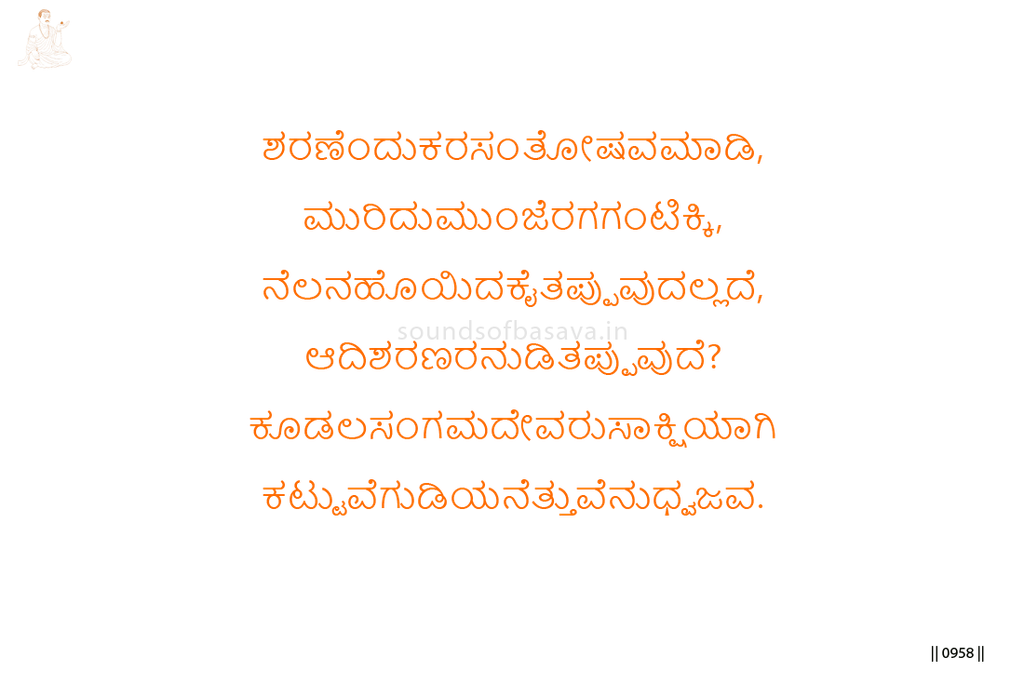
Basavanna distinguishes between temporary lapses in practice and the deeper current of awakened realization. The hand may falter, the discipline may weaken, and embodied limitation may appear. Yet the utterance of the ancient Sharanas does not fail merely because outward continuity is interrupted.
With Kudalasangama Deva as witness, the Sharana no longer needs religious display. A temple need not be built for proclamation, and a banner need not be raised for public recognition. When the inner witness is present, realization rests in abiding, not in outward announcement.
Imagery & Symbolic Relevance
The first image is the joy of being a Sharana. This joy is not a public identity or social claim. It is inward contentment arising from participation in Kudalasangama Deva’s presence.
The second image is the hand that falters. The hand represents embodied practice and effort. It may slip, weaken, or lose continuity, yet such lapse does not erase the deeper awakening already received.
The third image is the word of the ancient Sharanas. Basavanna asks whether that word can fail. The implied answer is no. The ancient Sharana-utterance stands deeper than the weakness of the hand.
The fourth image is Kudalasangama Deva as witness. The Sharana does not depend on society, institution, or outward recognition to prove realization. The Divine witness is enough.
The fifth image is building a temple. A temple is a visible center of worship, but Basavanna asks why such outward establishment is needed when the inward presence is already known.
The final image is raising a banner. A banner publicly proclaims allegiance. Here, Basavanna refuses the need for proclamation. The realized Sharana does not advertise what Kudalasangama Deva already witnesses within.
Lingayoga
In Lingayoga, this vachana teaches that inward realization must not be confused with outward display. Practice may sometimes falter, but the deeper question is whether awareness remains rooted in Kudalasangama Deva.
For Sharana Sthala, the practice-point is humility without proclamation. The Sharana does not build a spiritual identity through visible signs, public declarations, temple-making, or banner-raising. The true measure is abiding before the Divine witness.
Editorial Commentary
This vachana should not be read as a rejection of temples or symbols in themselves. Basavanna’s concern is the need for display after inward recognition has arisen. The hand may falter, but the awakened current does not fail. When Kudalasangama Deva is witness, outer proclamation becomes secondary.
Related Vachana
Supporting Vachana
Pranalingi Sthala Vachana 815 — When the Body Falls Silent in Awareness
Pranalingi Vachana 815 supports this teaching by turning attention from outer display to the inward shrine where Kudalasangama Deva is held. There, the body gathers into stillness, speech quiets, and awareness centers around the inner sacred presence rather than yogic display. This prepares Vachana 1359 directly. In Vachana 815, the sacred center is inwardly held; in Vachana 1359, the Sharana no longer needs to build a temple or raise a banner for recognition, because Kudalasangama Deva Himself stands as witness.
Advancing Vachana
Aikya Sthala Vachana 1361 — Through Countless States
Aikya Vachana 1361 advances this teaching by carrying inward realization beyond outward proclamation into direct knowing. In Sharana Vachana 1359, the banner need not be raised because the Divine witness is already present within. In Aikya Vachana 1361, after passing through peace, turmoil, discipline, countless states, vachanas, Achara, and Vichara, Basavanna says that only when the Sharana of Goheshvara was shown did he truly know Kudalasangama Deva. Thus the Sharana-stage freedom from public display advances into Aikya as direct certainty born of lived passage and revealed recognition.
