Poetic Rendering

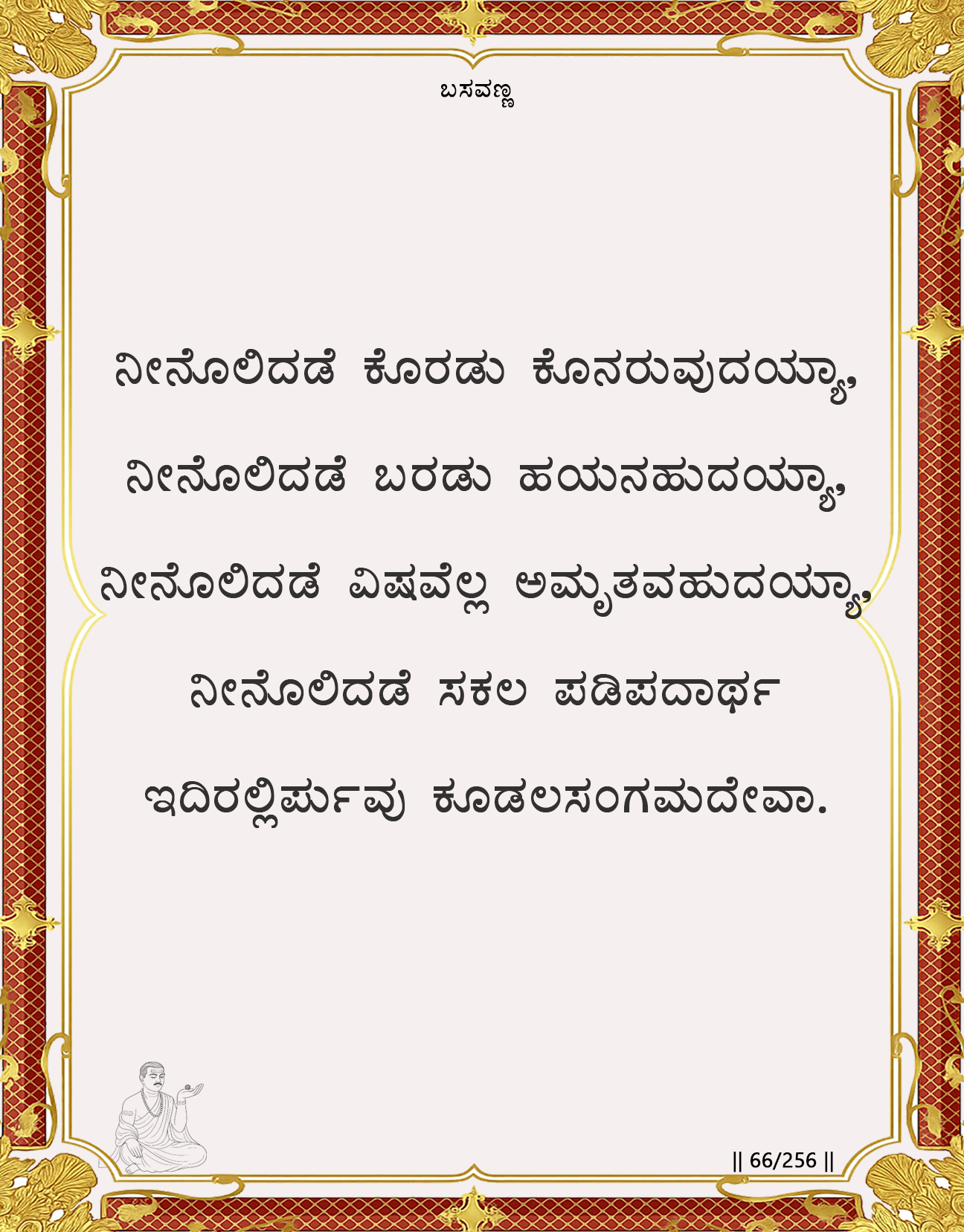
When Your grace stirs within, O Lord,
even the driest koradu wood
breaks open into leaf and life.
When Your grace stirs within,
a barren cow gives milk,
and the bitterest poison
turns to immortal nectar.
When Your grace stirs within,
the whole world seems to rise
in generosity and abundance.
Such is the fullness that dawns
in the one embraced
by Koodalasangamadeva.
Basavanna teaches that when inner grace awakens, even the most lifeless or hostile conditions transform. Dry wood sprouts, barren cows yield milk, poison itself becomes nectar. This is not about external miracles, but the profound shift that occurs when the Divine is realized within. Once grace fills the seeker’s heart, the entire world appears supportive and abundant, because perception itself has been transformed. In this inner completeness granted by Koodalasangamadeva, nothing feels lacking, and all existence reflects the touch of the Divine.
Spiritual Context
Core Spiritual Principle: Grace as Alchemical Agency. Grace (prasada) is not a passive blessing but the active, transformative energy of the Divine (Shakti) entering human consciousness. It operates as a spiritual alchemy, turning the lead of base perception into the gold of divine vision (divya drishti), where the essence of all things is seen as Shiva.
Cosmic Reality Perspective: From the non-dual view, everything is already a manifestation of Shiva-Shakti. “Dry wood” and “nectar” are both forms of the Divine. The “poison” is Shiva in his fierce aspect (Rudra). Grace is the removal of the veil of ignorance (avidya) that prevents us from experiencing this truth. When the veil drops, the world is not changed; it is seen correctly for the first time, in its essential, blissful nature (sarvam Shivamayam).
Historical Reality (Anubhava Mantapa Context): This vachana served to validate and explain the transformative experiences of the Sharanas. Individuals from “barren” or “poisonous” social backgrounds (lower castes, women) were blossoming into poets, mystics, and leaders. This was not a social accident but the visible fruit of inner grace. It gave a theological framework for their radical empowerment and flourishing against all societal odds.
Interpretation
“The driest koradu wood breaks open…” Koradu wood is proverbial for its dryness and resistance. This symbolizes the most hardened, cynical, or hopeless aspect of the human heart. Grace can penetrate and revitalize even this.
“Barren cow gives milk… poison turns to nectar.” These are symbols of unexpected fruition and the transmutation of suffering. The “milk” is spiritual nourishment for oneself and others. The “poison” represents past karma, traumatic experiences, or personal flaws. In the crucible of grace, these are not erased but transformed into the very source of wisdom and strength (amrita).
“The whole world seems to rise in generosity and abundance.” This is the key: the world seems to change. The shift is in the perceiver. A consciousness filled with grace projects benevolence onto its surroundings, engages with life cooperatively, and thus attracts corresponding experiences. It is the state of purnatva (fullness) that sees the universe as a mirror of its own completeness.
Practical Implications: The seeker’s effort is to make oneself receptive to grace through surrender and sincere practice, not to manufacture these transformations. The sign of grace’s presence is a growing sense of inner fertility, resilience, and a benevolent view of life’s challenges.
The Cosmic Reality
Anga (Human Dimension): The Anga is the field (kshetra) where the alchemy occurs. It is the “dead wood” awaiting the rain of grace, the “barren cow” awaiting the divine touch to become a source of sustenance.
Linga (Divine Principle): The Linga is the source of the alchemical agent grace itself. It is the sun that causes the bloom, the vital principle that yields the milk, the consciousness that transmutes poison. Jangama (Dynamic Interaction): Jangama is the pouring of grace from
Linga into Anga. It is the “stirring within,” the moment of ignition. It is also the ongoing life of the transformed individual, who now interacts with the world as a conduit of this grace, making the “dead wood” of their environment bloom through their presence
Shata Sthala
Primary Sthala: Prasadi. This vachana is the definitive exposition of the Prasadi stage. The individual has moved beyond the struggle of practice (sadhana) and has become a vessel for divine energy. Their life is characterized by these miraculous transformations, which are not willed but received and witnessed.
Supporting Sthala: Aikya. The profound transformation described is sustainable only because the recipient is moving into or abiding in Aikya. The separateness that once experienced barrenness and poison is dissolving into the unity that perceives only the divine essence, and thus lives in a constant state of “fullness.”
Practical Integration
Arivu (Awareness Practices): Practice seeing the potential for grace in every obstacle. When faced with a “dry” situation (difficulty, failure) or “poison” (hurt, anger), consciously invite grace to “stir within.” Ask, “How can this be transformed into nectar? What life can bloom from this?”
Achara (Personal Discipline): The discipline is one of receptivity and gratitude. Cultivate a heart that is soft and open to receive, rather than hard and defensive. Keep a journal of moments where barrenness turned to fruitfulness, acknowledging them as touches of grace.
Kayaka (Sacred Action): Let your work be an act of “giving milk” nourishing others from the abundance you have received. Use the “nectar” of your transformed perspective (wisdom, compassion) to benefit your community.
Dasoha (Communal Offering): Be an agent of this alchemy for others. See the potential for bloom in the “dry wood” of people around you. Offer the grace of unconditional acceptance and faith, which can be the catalyst for their own inner transformation.
Modern Application
“The Psychology of Scarcity and Cynicism.” Modern conditioning fosters a perception of lack, competition, and threat. We see the world as barren, others as competitors, and challenges as poisons. This leads to anxiety, burnout, and isolation.
This vachana is a prescription for a paradigm shift from scarcity to sacred abundance. It teaches that our core state is one of fullness (purnatva). When we connect to that through grace (surrender, meditation, devotion), our perception of life changes from hostile to supportive. It is the key to resilience, creativity, and finding meaning and opportunity in the midst of difficulty.
Essence
The desert you feared held only thirst
now cracks to show a spring.
The wound you hid, a seeping curse,
now seals, a wisdom-ring.
Not a single thread of fate was moved,
but by the Light within, reproved.
The eye, once cleared, at last beholds
the world as grace itself unfolds.
This vachana describes the Observer Effect in Spiritual Perception. In quantum physics, the act of observation changes the state of the observed. Here, the “observation” is the gaze of grace-activated consciousness. When consciousness is rooted in the fullness of the Divine (Linga), its very observation of the world “collapses” the world’s apparent state of barrenness or hostility into its underlying state of divine abundance and benevolence. The world reveals its true nature to the purified perceiver.
Imagine wearing red-tinted glasses. The world looks red, hostile, and dry. This is the ego’s perception. Grace is the act of removing the glasses. Suddenly, the world is revealed in its true, vibrant colors. The “dead wood” was always a living tree; you just couldn’t see it. Basavanna says grace is the removal of the tinted glasses of separation.
This speaks to our deepest hope for redemption and renewal the belief that no matter how broken, stuck, or poisoned we feel, there is a force that can heal and transform us from within. It confirms that our essence is not the dead wood, but the latent life within it, and that a connection to the Divine is the sunlight that awakens it. It is the promise that no condition is hopeless.

Views: 15