Poetic Rendering

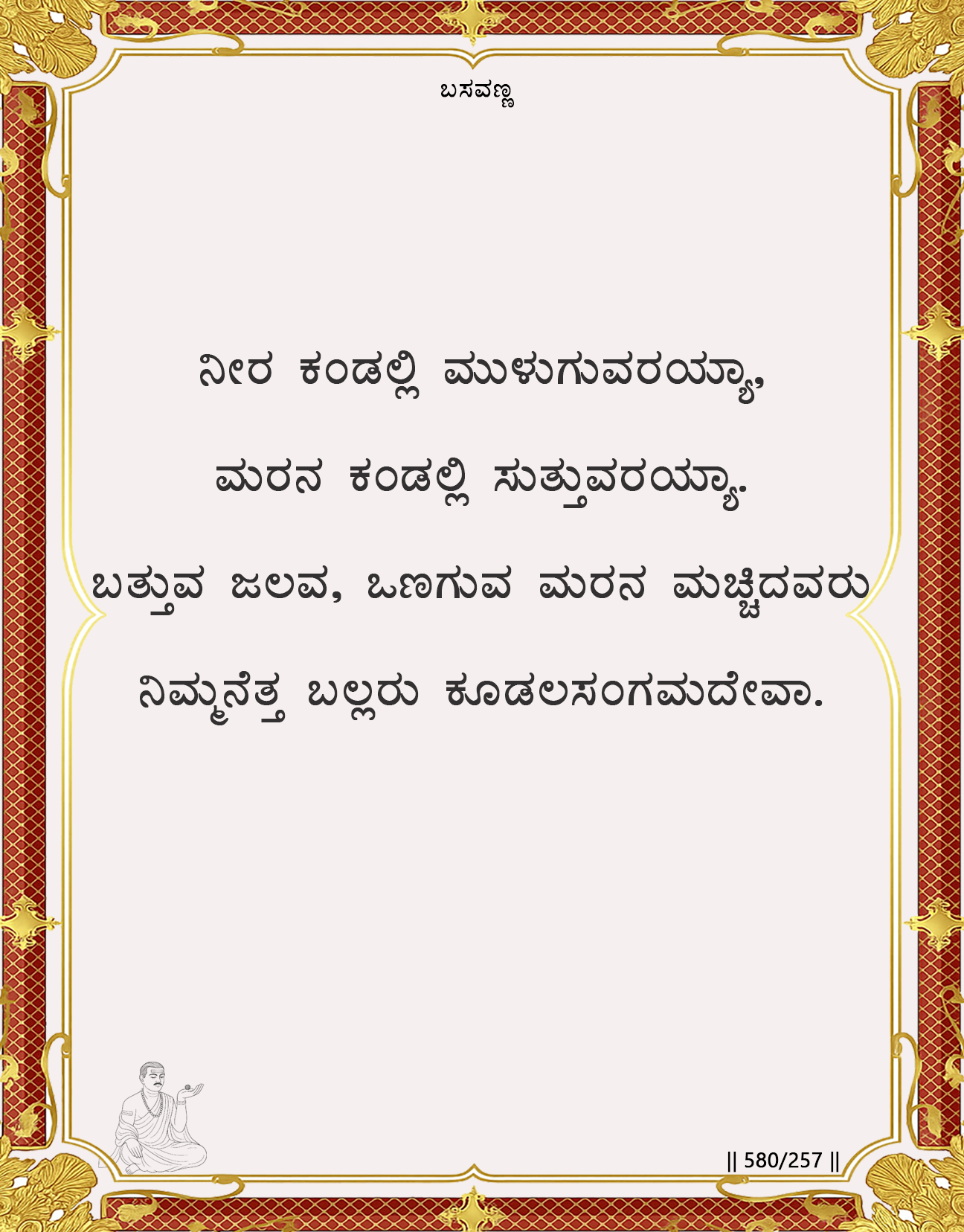
They plunge into water simply
because they see the water;
they circle the sacred tree
only because others circle it.
But when the riverbed cracks dry,
and the holy tree itself withers
when the very symbols they cling to vanish
where will they search for the Lord
they never sought within?
Those who praise without knowing,
who imitate without awakening
how shall they behold
the deathless One,
O Koodalasangamadeva?
Basavanna questions devotion that depends entirely on external objects sacred rivers, trees, or ritual habits followed merely because others do. Since these outer supports are temporary, he asks: when they disappear, where will the seeker turn? True realization cannot arise from imitation or borrowed faith. Only those who seek the Divine within, beyond fleeting forms, can recognize the eternal presence of Koodalasangamadeva. This vachana urges a shift from ritualistic dependence to inner awareness and direct experience.
Spiritual Context
Core Spiritual Principle: The Impermanence of Symbols vs. The Permanence of the Signified. A spiritual symbol (river, tree) is a means, not the end. When the means is mistaken for the end, spirituality becomes idolatrythe worship of the container instead of the content. True spirituality transfers one’s anchoring from the perishable symbol to the imperishable reality it points toward.
Cosmic Reality Perspective: In non-dual terms, all forms rivers, trees, rituals are transient expressions (nama-rupa) of the formless, eternal Shiva. To be attached to the expression is to be trapped in maya (the realm of change). Liberation involves using the form as a pointer to transcend all form and realize the formless substratum (nirguna).
Historical Reality (Anubhava Mantapa Context): This is a direct challenge to the Brahminical pilgrimage economy and ritual orthodoxy. It democratizes access to the Divine: you don’t need to travel to the Ganges; you need to journey within. It also critiques herd mentality in religion, encouraging the individual, experiential quest (anubhava-marga) that was the hallmark of the Sharanas, over blind adherence to priestly directives.
Interpretation
“Simply because they see the water… only because others circle it.” This identifies two errors: 1) Literal-mindedness: confusing the symbolic vehicle (purifying water) with the spiritual state (inner purity). 2) Social Conformity: practicing religion as a cultural performance, devoid of personal understanding or transformation.
“When the riverbed cracks dry, and the holy tree itself withers…” This exposes the ultimate vulnerability of a faith based on externals. Climate change, war, or simply the passage of time can destroy the most sacred sites. A spirituality that cannot survive this is not spirituality but attachment.
“Where will they search for the Lord they never sought within?” This is the pivotal, rhetorical question. It implies the answer: Nowhere. It forces the listener to confront the location of their search. If God is only “out there,” God can be lost. If God is discovered within, God is inseparable.
Practical Implications: Every external ritual must be constantly re-consecrated as a mirror for inner work. Bathing becomes a metaphor for washing the mind; circling a tree becomes a metaphor for centering one’s consciousness. The value is in the inner movement the ritual inspires, not the ritual itself.
The Cosmic Reality
Anga (Human Dimension): The Anga, in ignorance, is externally oriented. It seeks to manipulate the external world (through ritual) to gain an internal state (peace, purity). This is an inverted approach.
Linga (Divine Principle): The Linga is the ever-present, internal reality. It is the “water” of consciousness that never dries up and the “tree” of life that never withers. It is the deathless substrate.
Jangama (Dynamic Interaction): Jangama is the reorientation of the Anga’s seeking. It is the turning of attention 180 degrees from the outer object to the inner subject. This turning is the essential spiritual act, without which all ritual is empty motion.
Shata Sthala
Primary Sthala: Bhakta. This vachana serves as a crucial corrective within the Bhakta stage. The Bhakta’s devotion is valid, but it must mature from devotion to forms (saguna) to devotion to the formless principle (nirguna) that animates them. Otherwise, devotion remains superficial and fragile.
Supporting Sthala: Sharana. The vachana points the Bhakta toward the next stage: becoming a Sharana. The Sharana is defined by having taken refuge in the Linga as the innermost Self. This internalization is the solution to the dilemma posed it makes one’s spirituality independent of all external conditions.
Practical Integration
Arivu (Awareness Practices): Use external rituals as triggers for mindfulness. When you see water, let it remind you of the flow of consciousness within. When you see a tree, let it remind you of your rootedness in being. In this way, the whole world becomes a prompt to turn inward.
Achara (Personal Discipline): The discipline is to question your own motivations. Ask: “Am I doing this because it’s customary, or because it genuinely connects me to the Divine within? What is the inner equivalent of this outer action?”
Kayaka (Sacred Action): Let your primary work be the cultivation of the inner “tirtha” (sacred ford). Your most important duty is to clean the inner river of your mind so the Linga can be clearly reflected there.
Dasoha (Communal Offering): Guide others from empty ritual to meaningful practice. In community gatherings, emphasize the inner significance of shared ceremonies, preventing them from devolving into mere social habit.
Modern Application
“Consumptive Spirituality and Identity-Based Faith.” The modern seeker often “consumes” spiritual experiences visiting sacred sites, adopting exotic rituals, following trends as a form of identity building, without deep internalization. Faith is often tied to institutions, leaders, or ideologies that can fail or disappoint, leading to a crisis of faith.
This vachana is an antidote to spiritual materialism and religious fragility. It teaches how to build a faith that is crisis-proof because it is based on one’s own direct experience of the interior divine, not on external authorities, places, or practices. It fosters spiritual self-reliance and a faith that can withstand the drying up of any external “river.”
Essence
You built your shrine upon the sand,
and called the rising tide your god.
You danced around a dying tree,
and prayed to branches, leaves, and sod.
But when the sea draws back its hand,
and when the fallen timber rots,
your cries will echo, lost and dim,
for you never learned to worship Him
in the temple that forgets not
the silent, steadfast heart you’ve got.
This vachana illustrates the Spiritual Fallacy of Misplaced Concreteness. It’s the error of taking a useful abstraction (a sacred symbol) and treating it as the concrete reality itself. In doing so, one confuses the map for the territory. Basavanna’s teaching is to use the map to navigate to the territory (the inner experience), and then to dwell in the territory, free from dependency on the map.
Imagine you have a photograph of a loved one. You cherish it, talk to it, carry it with you. But if the photo is lost or damaged, you do not lose your love for the person, because the love resides in your heart, not in the paper. Basavanna says most religious practice is mourning the lost photograph while forgetting the living person who dwells within your own being.
This addresses the human tendency to seek security in the tangible, the visible, and the socially approved. We want a God we can see and rituals we can perform. This vachana challenges that comfort zone, pointing toward the terrifying but ultimately liberating truth that real security and divinity are found in the intangible, invisible ground of our own awareness. It calls for the courage to make that inward journey.

Views: 15