Poetic Rendering
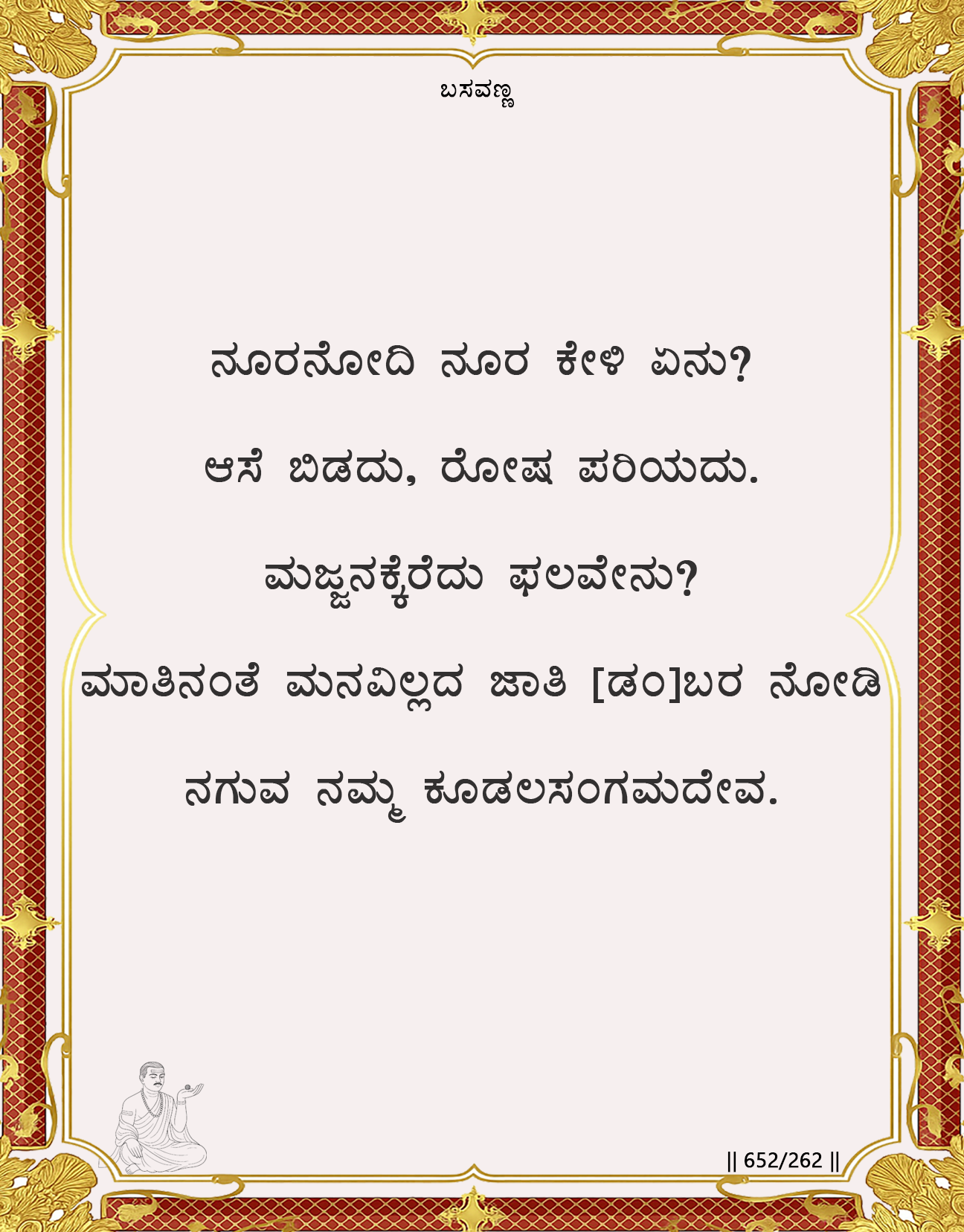
What use, O man,
in reading a hundred scriptures,
if a single grain of greed still roots in your heart?
What use in hearing a thousand discourses,
if one spark of anger can
still consume your peace?
You wander to sacred rivers,
you plunge into holy waters again and again,
yet return home with the same unwashed mind.
The dust of your desire clings tighter than ever,
and you think yourself
pure because your skin shines wet!
Those who parade their faith,
who wear holiness like a
garland of borrowed flowers,
my Lord of Koodalasangama laughs at them
a laughter deep, compassionate,
yet piercing for
He knows: water cannot
cleanse what the heart refuses to release.
This vachana is Basavanna’s incisive critique of performative spirituality and the accumulation of religious merit without inner transformation. He challenges the very economy of conventional religion, where rituals, pilgrimages, and scriptural knowledge are seen as currency to purchase purity or divine favor. Basavanna redirects the seeker’s effort from the external to the internal, asserting that the only pilgrimage that matters is the journey into one’s own heart to uproot the weeds of greed, anger, and desire. The divine laughter he describes is not one of ridicule, but the compassionate, sobering response of truth itself to self-deception, meant to shock the seeker into authentic self-awareness.
Spiritual Context
Core Spiritual Principle: The Priority of Being over Doing. Spiritual attainment is measured by the qualitative state of consciousness (bhava), not the quantitative accumulation of religious acts (kriya). A mountain of rituals is worthless if the fundamental orientation of the heart remains selfish, angry, or attached. Transformation must precede, or at least accompany, transaction.
Cosmic Reality Perspective: This vachana presents the non-dual view on purification. In reality, nothing is inherently pure or impure; these are attributes of the perceiving consciousness. Greed and anger are contractions of consciousness, creating a sense of separation. Pilgrimages that don’t address this contraction merely reinforce the ego’s spiritual self-image. The Divine “laughter” is the sound of reality itself, which is whole and free, observing the antics of the divided self trying to become what it already is through effort in the wrong direction.
Historical Reality (Anubhava Mantapa Context): This was a foundational polemic against the Brahminical ritual industry and the caste-based notion of purity. It dismantled the authority of priests as necessary intermediaries for purification. It empowered common people by stating that the real work was accessible to all, right where they were: the work of self-mastery. It also protected the Lingayoga movement from falling into the same empty ritualism it criticized.
Interpretation
“A single grain of greed… one spark of anger…” This establishes the principle of the weakest link. The spiritual edifice is only as strong as the consciousness that builds it. A subtle vice can undermine the entire structure of piety.
“The dust of your desire clings tighter than ever…” This reveals the perverse effect of misguided practice: it can actually strengthen the ego (“I am a pious pilgrim”) and make the core impurities more adhesive, as they are now hidden under layers of spiritual achievement.
“My Lord… laughs at them a laughter deep, compassionate, yet piercing.” This is not the laughter of contempt but of a physician at a patient who insists on treating a headache by polishing their shoes. It is the sound of absurdity being recognized. It is compassionate because it seeks to heal; it is piercing because it must break through denial.
Practical Implications: Spiritual audit must focus on character traits, not checklists of practices. The question shifts from “How many scriptures did I read?” to “Is my greed diminishing? Is my patience growing?”
The Cosmic Reality
Anga (Human Dimension): The Anga is the “unwashed mind.” It is the locus of the problem. All external journeys are projections of the Anga’s desire to fix itself without engaging in the uncomfortable inner surgery.
Linga (Divine Principle): The Linga is the ever-pure mirror and the source of the liberating laughter. It is the standard of pristine consciousness against which the “dust” of desire is visible. Its laughter is the vibration that shakes loose false identities.
Jangama (Dynamic Interaction): True Jangama is the internal process of letting the divine laughter reverberate within, dislodging pretensions. It is the shift from “plunging into water” to allowing the water of awareness to penetrate and dissolve the “grain of greed.”
Shata Sthala
Primary Sthala: Bhakta. The vachana directly addresses the Bhakta at risk of spiritual materialism. It warns that devotion (bhakti) must mature into transformative love, not remain a collection of pious habits. The laughter is the grace that pushes the Bhakta to the next level.
Supporting Sthala: Sharana. The one who heeds this teaching begins the true journey of a Sharana: taking refuge in the process of inner purification itself, guided by the Linga within, not by social approval or ritual scorekeeping.
Practical Integration
Arivu (Awareness Practices): Practice watching impulses of greed and anger as they arise. See them as “dust” or “sparks” in the field of awareness. Do not justify them with your spiritual resume. Simply see them clearly this seeing is the beginning of cleansing.
Achara (Personal Discipline): Institute a “vice fast.” Periodically, give up a subtle mental vice (like complaining, seeking approval, or subtle greed) with more rigor than you would give up a physical indulgence. This is the true vrata (austerity).
Kayaka (Sacred Action): Let your daily work be your pilgrimage. Approach your tasks as the sacred ground where greed must be transformed into generosity, and anger into patience. The “holy water” is your mindful attention poured onto your duty.
Dasoha (Communal Offering): Create a community culture that values authenticity over piety. Praise acts of humble integrity more than displays of scriptural knowledge. Let the community’s collective “laughter” be a gentle, corrective mirror for self-deception, encouraging real growth.
Modern Application
“Spiritual Consumerism and Virtue Signaling.” The modern seeker often collects workshops, teacher lineages, and exotic practices like badges, while core personality flaws remain untouched. On social media, we perform our righteousness, our mindfulness, our activism often becoming more judgmental and attached in the process.
This vachana is the ultimate detox for spiritual ego. It calls for a ruthless, compassionate honesty with oneself. It asks: “Am I using spirituality to decorate my ego or to dismantle it?” It redirects resources time, money, energy from external accumulation to internal excavation, promising that the liberation found within one purified heart outweighs all the pilgrimages in the world.
Essence
You sailed the seven sacred seas,
and scaled the scripture-mountain tall.
You charted every holy breeze,
yet brought back such a cargo small:
A heart still heavy, sharp, and tight,
that feared the dark and clutched the light.
The Lord who sees the core, not crust,
can only shake His head, and laugh
until you learn to turn the key
on the only shrine that sets you free.
This vachana describes the Spiritual Fallacy of Displacement. The human psyche, to avoid the anxiety of confronting its shadow (greed, anger), displaces its effort onto a safer, symbolic arena (rituals, pilgrimages). This is a spiritual defense mechanism. The Divine laughter is the therapeutic intervention that points out the displacement, forcing the ego to confront the authentic site of the problem. Real spirituality is the cessation of this displacement, bringing the full force of seeking to bear directly on the contractions of consciousness itself.
Imagine your soul is a garden overrun with weeds (vices). Instead of pulling the weeds, you spend all your time painting the fence, installing fancy sprinklers, and reading books about famous gardens. The divine laughter is the moment you realize you’ve been tending everything except the garden itself. Basavanna says: Put down the paintbrush. Pick up the trowel. Start weeding. This speaks to our universal capacity for self-avoidance and the comfort of external measures. We prefer the tangible ritual over the intangible inner work. The vachana validates the feeling of emptiness that follows grand gestures devoid of inner change. It offers the difficult but dignifying truth: you are the sacred site. The work is here. The reward authentic peace is also here.

Views: 5