

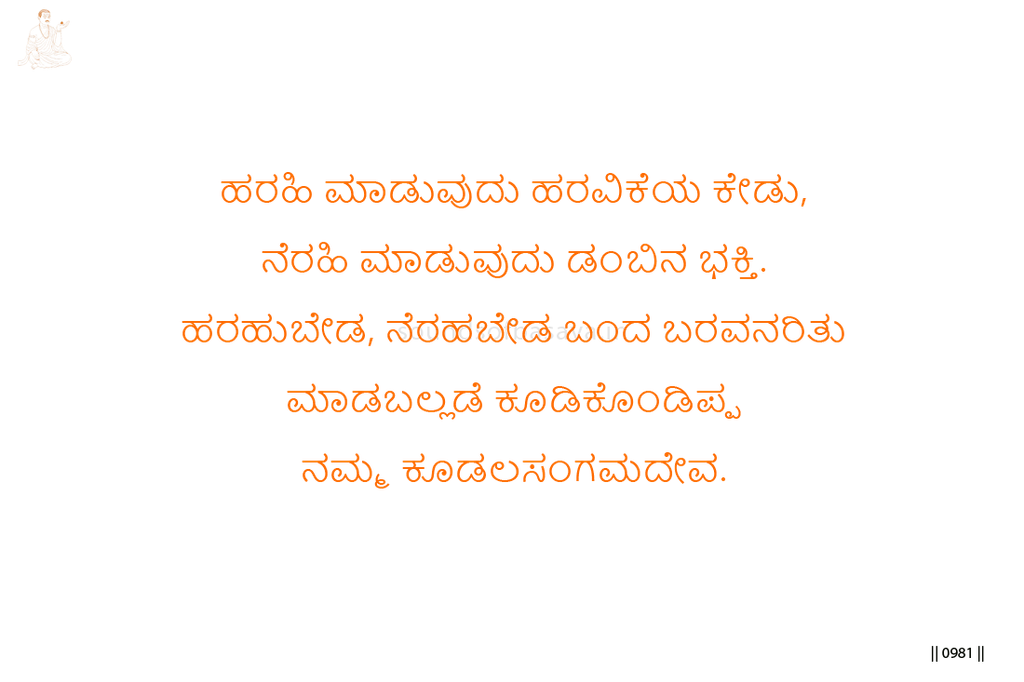
In this vachana, Basavanna redirects the seeker from outward preoccupation to inward vigilance. He warns against meddling in the affairs of others or judging their spiritual progress, calling such concerns distractions that dissipate one’s energy and clarity. The only meaningful inquiry, he teaches, is the state of one’s own receptivity to divine grace the living relationship with Koodalasangamadeva. This is not self-centeredness but profound self-responsibility. One’s spiritual “burden” is the work of purification, sincerity, and sincerity of longing required to make oneself a vessel for grace. The vachana affirms that a single, unwavering yearning for the Divine becomes both the seeker’s discipline and refuge. Through this focused inner fire, the path becomes clear, and the heart becomes ready for realization.
Spiritual Context
Core Spiritual Principle: The Economy of Spiritual Attention (Citta Ekagrata). Consciousness is a limited resource. Wasting it on judging others’ paths or carrying their karmic drama (which is not yours to resolve) drains the energy needed for your own liberation. The path is intensely personal and subjective. The only work you can do is on yourself; the only state you can know is your own. This is the essence of atmavichara (self-inquiry) within the Lingayoga tradition.
Cosmic Reality Perspective: From the non-dual view, the “other” whose burden you shoulder is an illusion of separation. Your compulsive focus on “them” is a diversion created by the ego to avoid the terrifying/clarifying void of looking solely at “I.” The question “Has grace touched me?” is the sword that cuts through this diversion. It confronts the seeker with the fundamental binary: either you are abiding in the awareness of the Divine (union) or you are identified with the seeking ego (separation). There is no third, distracted option.
Historical Reality (Anubhava Mantapa Context): In a vibrant, debating community like the Anubhava Mantapa, the temptation to critique others’ understanding, compete in piety, or get entangled in others’ spiritual dramas was high. This vachana served as a vital rule of sadhana, keeping each individual’s focus on their own transformative work. It prevented the community from becoming a theater of spiritual politics and ensured that collective energy was directed inward, toward genuine realization, not outward in judgment.
Interpretation
“Is your own not weighty enough?” The “burden” is the karma and vasanas (latent tendencies) you are born to work through. Trying to fix others is often an avoidance of this difficult, inner work.
“Has His glance still pass me by?” This frames grace as an active, dynamic relationship. It’s not a static possession but a current of consciousness. The question keeps the seeker in a state of dynamic humility and alert receptivity, preventing spiritual complacency.
“In this longing itself lies your shelter…” This is the key insight. The focused longing (viraha) is not a problem to be solved but the solution itself. It purifies desire, centers the mind, and creates an inner magnetic pull toward the Divine. It is the discipline (achara) and the refuge (sharanagati).
Practical Implications: Spiritual practice involves a constant vigilance over one’s mental content. When the mind wanders into judging or worrying about others’ spiritual lives, one must gently but firmly return it to the core question: “Where do I stand with the Divine right now?”
The Cosmic Reality
Anga (Human Dimension): The Anga is the locus of the inquiry. Its entire purpose is to become conscious of its own state in relation to the Linga. All other engagements are secondary to this primary function.
Linga (Divine Principle): The Linga is the reference point, the “glance” that is either recognized or missed. It is the absolute against which the Anga measures its own relative consciousness.
Jangama (Dynamic Interaction): Jangama is the living current of this inquiry. It is the Anga’s persistent turning toward the Linga with the question, “Are you here?” This turning is the relationship; it is the path in motion.
Shata Sthala
Primary Sthala: Bhakta. The intense, personal longing described is the hallmark of the Bhakta stage. This vachana refines that longing, stripping it of all extraneous objects until only the pure, binary question of connection to the Beloved remains.
Supporting Sthala: Sharana. This unwavering self-inquiry is the engine that drives one to become a Sharana. When the question becomes all-consuming, the logical conclusion is total surrender, taking refuge in the very source one is questioning.
Practical Integration
Arivu (Awareness Practices): Make the vachana’s core question a mindfulness mantra. Throughout the day, inwardly ask: “In this moment, am I touched by grace or passing it by?” Use it to check your state are you agitated, judgmental, fearful (passing by), or peaceful, compassionate, present (touched)?
Achara (Personal Discipline): The discipline is to practice “spiritual containment.” Refrain from giving unsolicited spiritual advice, diagnosing others’ flaws, or engaging in gossip about community matters. Direct that energy into journaling or reflection on your own state.
Kayaka (Sacred Action): Perform your duties without an eye on how others are performing theirs. Let your work be an offering that answers the question of grace through the quality of your attention and integrity, not through comparison.
Dasoha (Communal Offering): The best service to the community is to do your own inner work so thoroughly that you become a stable, non-judgmental presence. Offer support by holding space for others’ journeys without taking on their burdens, empowering them to ask their own core question.
Modern Application
“The Age of Curated Lives and Performative Spirituality.” We are constantly measuring ourselves against the curated spiritual or material “progress” of others online and offline. We offer unsolicited opinions, engage in ideological policing, and are obsessed with others’ paths, leading to anxiety, envy, and a scattered mind devoid of its own center.
This vachana is an antidote to comparison and spiritual distraction. It is a call to digital and mental detox. It teaches that your only real business is your own consciousness. By committing to this single, profound inquiry, you withdraw from the exhausting economy of judgment and step into the liberating economy of direct, personal transformation. Your inner life becomes your sole project, and in that focus, you find unparalleled peace and purpose.
Essence
The world’s a market of should and blame,
where minds trade burdens, play a game.
I leave that noisy, crowded street
to sit in silence, stark and neat,
with just one candle’s worth of light,
to ask my heart, throughout the night:
“Does that great Love look back at me?”
That question is my only key.
That waiting is my only home.
I’ll bear no other’s weight to roam.
This vachana outlines the Principle of Spiritual Focal Length. Consciousness is like a lens. When focused on the “other” (external burdens, others’ paths), the image is scattered, the energy diffuse, and the subject (the self) remains blurry and unresolved. Basavanna commands a radical shortening of the focal length: focus the lens exclusively on the interface between the self and the Divine. This brings the true subjectthe state of one’s own soulinto razor-sharp clarity. The “aching concern” is the adjustment mechanism. In this focused state, the heat of inquiry burns away obscurations, and the light of grace can finally imprint itself on the sensitized plate of the heart.
Imagine you are in a dark forest (the world of distraction) trying to read a delicate, crucial map (the path to God) by moonlight. If you keep turning to comment on the trees others are stuck behind or trying to hold their maps for them, you’ll never see your own. Basavanna says: Stop. Cup your hands around your own map. Block out all other light. Let your eyes adjust to the one moonbeam falling on the one line you need to follow. That intense, personal looking is your only task. It is your light and your path.
This speaks to our deep anxiety about our own worthiness and our defensive habit of focusing on others’ flaws to avoid our own. It addresses the exhaustion of living in constant comparison. The vachana offers the profound relief of letting go of the impossible burden of fixing the world and accepting the challenging, but possible, burden of transforming oneself. It promises that in this focused, responsible solitude, we find not loneliness, but the most intimate company of all.

Views: 0