Poetic Rendering
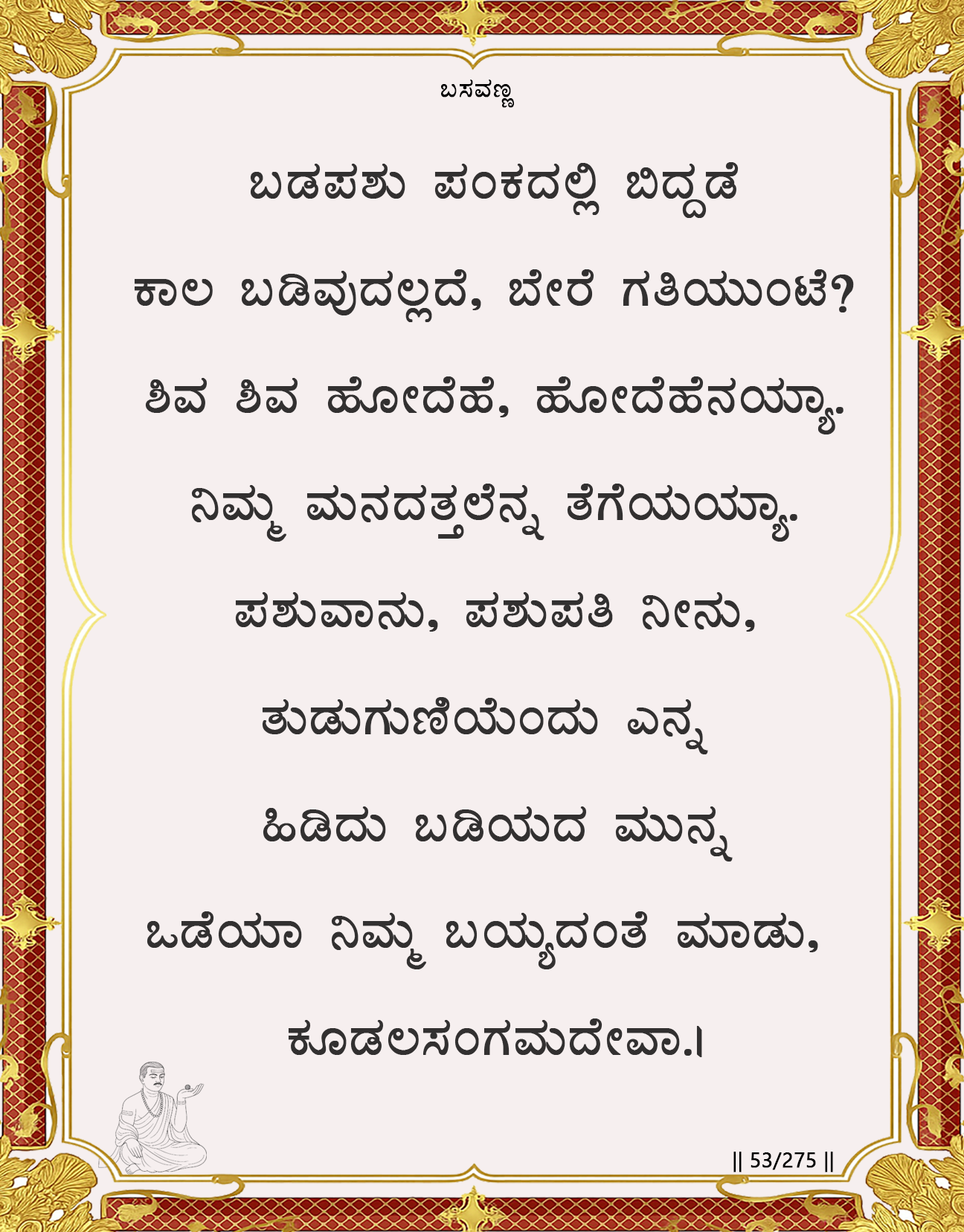
When a trapped beast sinks into the mire,
can it lift itself out without the master’s hand?
So too, without remembering You, O Lord,
how can Your shelter ever reach me?
I am but a creature a pashu bound by ignorance;
You alone are Pashupati,
the guardian of all that struggles and strays.
Before the world mocks me as false,
before they strike and scorn my fall,
let not their blame stain Your name.
Lift me up, O Kudalasangamadeva,
before my bondage becomes Your burden.
In this vachana, Basavanna uses the metaphor of a helpless animal trapped in mud to describe the human condition caught in ignorance and worldly entanglement. Just as the beast cannot free itself without the master, the soul cannot liberate itself without divine grace. Basavanna identifies himself as the bound pashu and Shiva as Pashupati, the compassionate Lord who alone can rescue. He pleads for timely grace, fearing that if he falls deeper into delusion, the world will ridicule both him and the spiritual path he represents. The vachana is a humble cry for inner upliftment before failure becomes a reflection on the Divine itself.
Spiritual Context
Core Spiritual Principle: Soteriological Heteronomy. Liberation (moksha) is not an achievement of the autonomous ego but a gift of grace received upon the ego’s surrender. The bound self (pashu) has no power to free itself; its only authentic action is to call upon the Lord (Pashupati).
Cosmic Reality Perspective: This is a non-dual depiction of the apparent separation. In reality, the beast (Shakti as bound energy) and the master (Shiva as conscious principle) are one. The “mire” is the self-contracting force of ignorance (avidya-shakti) that creates the illusion of separation and helplessness. Grace is the reassertion of the natural, non-dual state.
Historical Reality (Anubhava Mantapa Context): This vachana served as an antidote to spiritual pride within the revolutionary Lingayoga community. It reminded even the most ardent reformers that their strength flowed from divine grace, not personal will. It fostered a culture of humility and mutual dependence, ensuring the movement remained grounded in devotion, not ego.
Interpretation
“Can it lift itself out without the master’s hand?” This rhetorical question establishes the fundamental axiom of the path: self-effort (purushartha) alone, without grace (prasada), is futile against the adhesive power of primal ignorance.
“I am but a creature a pashu… You alone are Pashupati.” This is not self-deprecation but clear-eyed ontological diagnosis. It defines the relationship: the nature of the soul is to be bound; the nature of the Divine is to liberate.
“Before my bondage becomes Your burden.” This reveals a mature devotional responsibility. The seeker worries that their public failure or regression would cause others to doubt the efficacy of the path itself, thus “burdening” the Divine’s reputation. The plea for grace is also for the protection of the faith of the community.
Practical Implications: All spiritual practice must be suffused with the attitude of surrender (sharanagati). Meditation, worship, and service are not tools for self-elevation but channels to attract and receive the necessary grace for liberation.
The Cosmic Reality
Anga (Human Dimension): The Anga is the “beast” consciousness identified with limitation, struggle, and powerlessness. It is the state of contraction.
Linga (Divine Principle): The Linga is “Pashupati” consciousness itself, which is ever-free, sovereign, and the source of all emancipating power.
Jangama (Dynamic Interaction): Jangama is the urgent call and the answering pull. It is the moment the beast looks up and the master extends a hand. This transaction is the heart of the path.
Shata Sthala
Primary Sthala: Bhakta. The raw emotion, the sense of helplessness, and the direct, personal cry to the Lord are definitive of the Bhakta stage. Here, devotion is a survival cry.
Supporting Sthala: Prasadi. The desired outcome of this heartfelt cry is to be lifted into the state of Prasadi. The vachana maps the transition from the desperation of the Bhakta to the grateful reception of grace that characterizes the Prasadi.
Practical Integration
Arivu (Awareness Practices): Practice “beast meditation.” Sit quietly and feel the contours of your own inner bondage patterns of fear, addiction, or confusion. Instead of fighting them, inwardly cry out to Koodalasangamadeva as Pashupati to lift you from them.
Achara (Personal Discipline): Cultivate the discipline of surrender. Begin each task with the prayer, “I cannot do this without You.” End each day by offering back successes and failures, acknowledging your fundamental dependence.
Kayaka (Sacred Action): Perform your work as the “beast” obedient to the “Master’s” command. See your labor as following the divine will, drawing strength from the purpose bestowed upon you, not from your own limited reserves.
Dasoha (Communal Offering): Be a witness to others’ struggles without judgment, remembering your own state as a pashu. Offer support and prayer, acting as a reminder of Pashupati’s accessible grace, helping to lift others without pride.
Modern Application
“Toxic Positivity and the Tyranny of Self-Help.” The modern narrative insists we can “think ourselves free” from any problem, branding need for help as weakness. This leads to shame, isolation, and despair when individual willpower inevitably meets its limit.
This vachana legitimizes the cry for help. It provides a spiritual framework for understanding addiction, depression, and systemic oppression as “mire” from which we cannot simply will ourselves free. It points to the necessity of grace whether conceived as divine intervention, therapeutic breakthrough, or community support as the essential catalyst for real change.
Essence
The mire sucks deep, the beast strains weak.
A solitary fight is vain.
One name to cry, one hand to seek
the Master’s, over fear and pain.
I call before the mocking start:
Uphold your name, and lift my heart.
This vachana models the Quantum Collapse of the Egoic Wavefunction. The trapped beast represents a consciousness “collapsed” into a single, desperate state of bondage (a particle). Grace, as the act of the Master, is the intervention of the non-local, universal consciousness (the wave) that re-introduces possibility and freedom, causing a new “measurement” where the soul’s state is liberated. The plea is the trigger for this conscious intervention.
Imagine you are stuck in a deep, narrow well (your problems, your mind). You can’t jump out; the walls are too high. From down there, all you see is the circle of sky above. Your only hope is for someone up there to drop a rope. Your job isn’t to invent a way out; it’s to call, clearly and persistently, to someone who has the rope. Basavanna says: Stop trying to climb the slippery walls. Call for the rope of grace.
This speaks to the universal experience of hitting rock bottom in addiction, grief, or failure where our cleverness and strength are exhausted. In that place, the proud self dies, and what remains is either despair or a raw, honest plea for help. This vachana validates that plea as the most spiritually potent act, the necessary precondition for a transformation that we are powerless to engineer for ourselves. It is the foundation of true humility and the beginning of authentic liberation.

Views: 26