Poetic Rendering
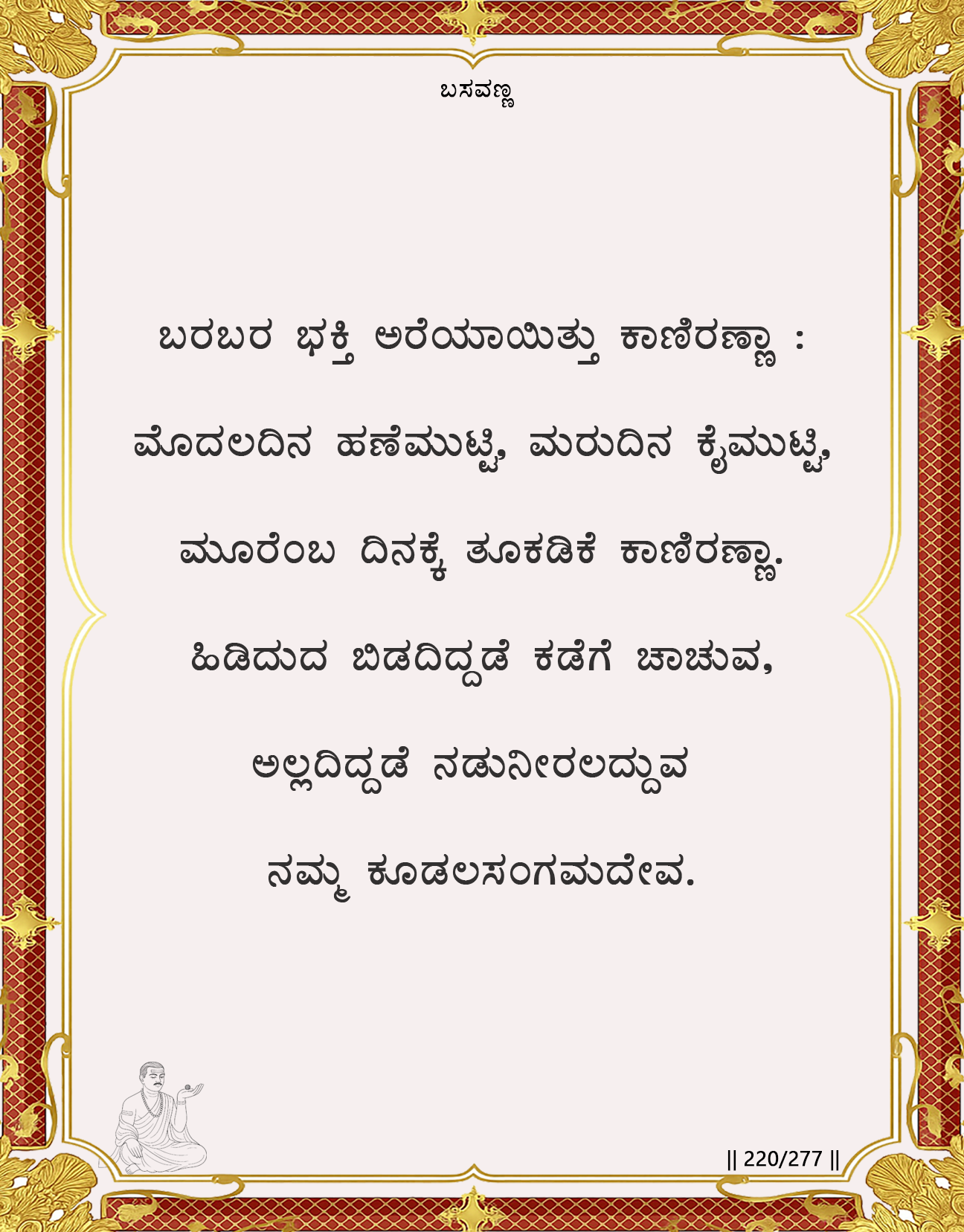
See, brother how shallow devotion can be!
On the first day, the head bends in reverence.
On the second, the hands move by habit.
By the third, the eyelids droop,
and drowsiness defeats the prayer.
Yet, if one holds steady, unwavering,
breath after breath, gaze after gaze
the crossing is sure.
But if the mind wavers midstream,
the current pulls him down,
says Koodalasangamadeva.
This vachana is a masterful diagnosis of spiritual entropy from Basavanna, the householder-yogi. He maps the subtle decay of devotion from vibrant awareness to mechanical ritual. The context is the core practice of Lingayoga specifically Trataka, the unwavering gaze upon the Istalinga. Basavanna is not condemning the devotee but compassionately revealing the universal trap: how sacred repetition, without sustained awareness, leads from reverence to habit, and finally to the spiritual slumber of Tamas (inertia). It is a practical guide for sustaining the flame of consciousness against the constant pull of automation.
Spiritual Context
Core Spiritual Principle: Conscious Continuity (Nitya-Samyama). True devotion is not in the ritual form alone but in the unbroken thread of awareness that animates it. Without this, practice succumbs to the inertia of habit (Pravritti) and spiritual sleep (Tamas).
Cosmic Reality Perspective: In the non-dual Shiva-Shakti dynamic, the initial reverence is Shakti (energy of consciousness) fully oriented toward Shiva (pure awareness). Habit represents Shakti becoming latent, and drowsiness is its dissolution into inert Maya. Steady gaze is the continuous, conscious union (Sangama) of Shakti with Shiva, sustaining creation’s luminous flow.
Historical Reality (Anubhava Mantapa Context): This vachana was a direct instruction to the householder-yogis of the Anubhava Mantapa, for whom daily Istalinga worship was central. It addressed the practical challenge of maintaining the revolutionary fire of Basavayoga amid the repetitions of domestic life, ensuring that social reform was rooted in ever-fresh spiritual experience, not new dogma.
Interpretation
First Day – Reverence: The conscious bowing of the head signifies the initial, wholehearted surrender of ego (Ahamkara). The Anga fully aligns with the Linga in a moment of true meeting.
Second Day – Habit: The hands move automatically. The ritual form remains, but the inner offering of attention (Chitta) has withdrawn. This is the realm of memory (Smriti) rather than direct perception (Anubhava).
Third Day – Drowsiness: The eyelids, the gates of perception, close. The seeker is overcome by the Tamo Guna, the principle of obscuration and inertia. The Jangama (dynamic interaction) is nearly extinct.
The Steady Path – The Crossing: “Breath after breath, gaze after gaze” denotes the micro-moments of consciousness (Kshana). Holding steady here is the practice of Shivayoga uninterrupted attention that burns away the seeds of habit and reveals the ever-present union.
The Wavering Mind – The Downfall: “Midstream” is the critical juncture between mechanical practice and conscious practice. Wavering signifies a lapse back into identification with the fluctuating mind (Chitta Vritti), which is swept away by the current of latent tendencies (Vasanas).
Practical Implications: The vachana transforms ritual from a performance into a laboratory of awareness. Each day’s practice must be approached as the “first day,” with a beginner’s mind. It mandates constant self-inquiry: “Am I truly present, or am I moving by memory?”
The Cosmic Reality
Anga (Human Dimension): The finite, time-bound vehicle. It experiences the sequence of days and the entropy of enthusiasm. Its nature is to settle into patterns; thus, it requires constant vigilance to remain a conscious instrument.
Linga (Divine Principle): The infinite, timeless anchor. It is unaffected by the devotee’s fluctuating states. As the object of the gaze, it is the still point that reflects back the quality of the seeker’s attention, offering grace proportionate to steadfastness.
Jangama (Dynamic Interaction): The real-time flow of attention and intention. It is the “work” of Lingayoga. When unwavering, it becomes the sacred river that carries the Anga to the Linga. When intermittent, it fragments into disjointed actions, leaving the Anga stranded on the shore of habit.
Shata Sthala
Primary Sthala: Bhakta. The seeker is firmly in the stage of formal devotion, establishing daily worship. The danger here, as Basavanna pinpoints, is the subtle shift from loving devotion (Bhava) to empty routine (Kriya).
Supporting Sthala: Sharana. The antidote to this decay is the essence of the Sharana stage: taking refuge with such total surrender that every act becomes a fresh offering. The Sharana does not rely on yesterday’s fervor but generates it anew in each moment.
Practical Integration
Arivu (Awareness Practices): Before beginning worship, pause and set the intention: “This is my first gaze.” Practice counting breaths (1-10, then restart) while performing the ritual actions to tether the mind to the present. Use the sensation of breath as the Jangama thread linking body and Linga.
Achara (Personal Discipline): Introduce a “conscious disruption” in the ritual sequence once a week a different prayer, a slower pace to prevent the mind from anticipating and automating. Keep a brief journal noting the quality of attention after each practice.
Kayaka (Sacred Action): Extend the principle of the “steady gaze” to one’s profession. Whether crafting, computing, or cleaning, perform each subtask with the same uninterrupted attention as the ideal Trataka, seeing the Linga in the work itself.
Dasoha (Communal Offering): In community gatherings, occasionally practice rituals in silence, or have different members lead different parts, to collective-ly re-sensitize to the practice. Share experiences of “drowsiness” without judgment, fostering a supportive sangha that rekindles the flame.
Modern Application
“The Autopilot Paradox.” Our lives are a series of optimized routines from scrolling through feeds to executing work tasks that breed neural habit loops. Spirituality, mindfulness, and even relationships become checklist items, performed with a distracted mind, leading to existential fatigue and the feeling of “going through the motions.”
This vachana provides the algorithm for conscious re-engagement. Apply it to any meaningful practice (exercise, meditation, deep work, listening to a loved one). The moment you notice yourself operating from habit (second day), pause and reset with a deep breath, returning to the “first day’s” intention. This breaks the trance of automation and reclaims the vitality of the present.
Essence
Day One: a bow from the soul.
Day Two: the hands recall their role.
Day Three: the spirit pays its toll.
But in the space between breath and will,
A flame is fed that time cannot kill.
Hold the gaze, and the river stands still.
This vachana describes the thermodynamics of consciousness. Any ordered system (sadhana) tends toward disorder (habit) without a continuous infusion of energy (awareness). In metaphysical terms, the creative pulse of the cosmos (Spanda) must be consciously participated in; otherwise, individual consciousness lapses into the derivative, conditioned reality of memory, losing its generative power.
Like learning to drive. At first, you are intensely aware of every mirror, pedal, and turn. With time, you drive home without remembering the trip. The vachana warns that this “autopilot” is spiritual death. The master driver remains as alert on the thousandth trip as on the firstand finds freedom in that very alertness.
The central human struggle is against the seduction of numbness. We are wired to automate to conserve energy, but our greatness lies in the conscious choice to feel, see, and engage fully, again and again. The path is not a one-time leap but the perpetual courage to stay awake.

Views: 4