Poetic Rendering
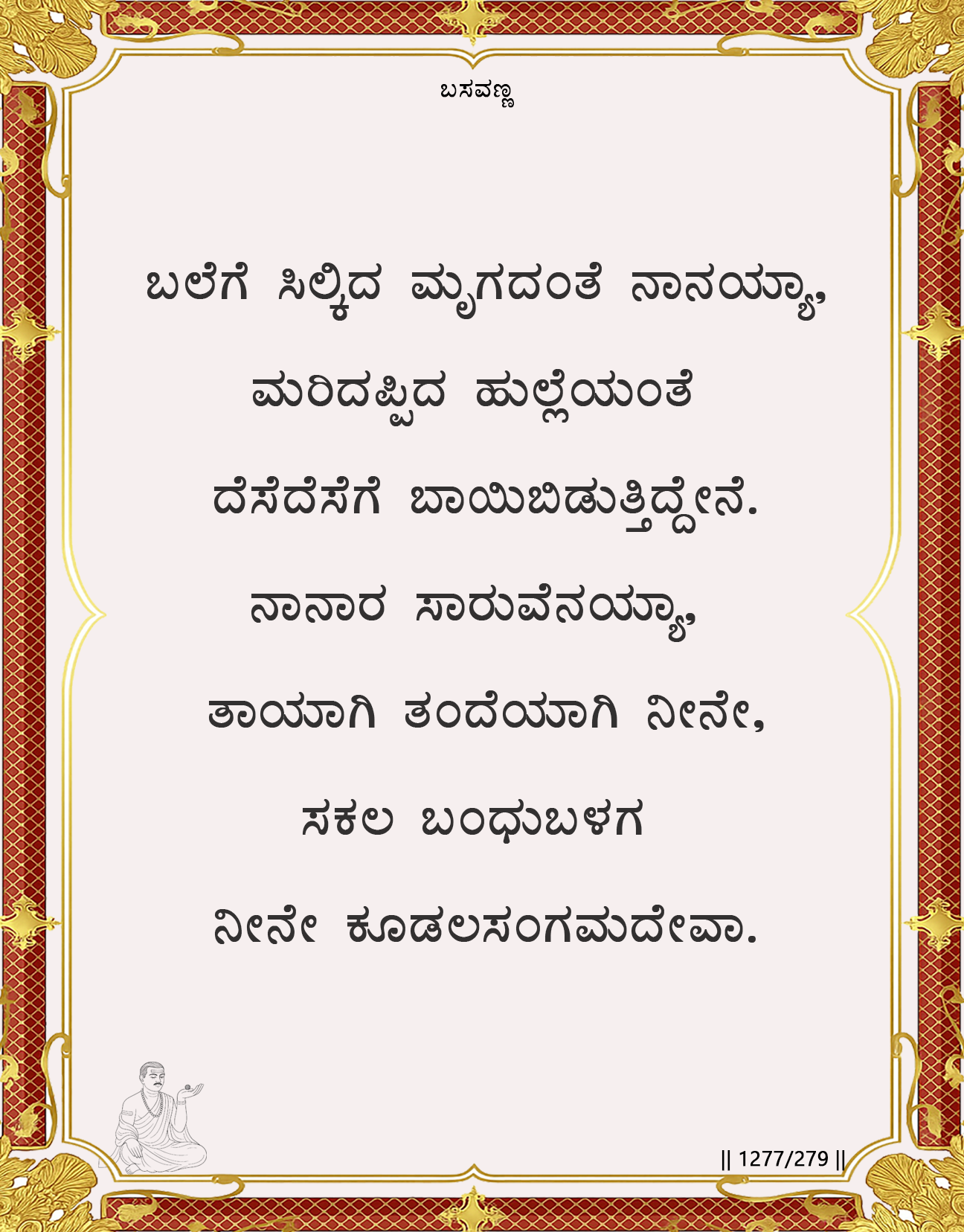
Caught in the hunter’s snare,
I struggle like a frightened beast
twisting, pulling, straining
yet the net of this world will not loosen.
Like the doe bereft of her fawn,
I wander crying through the forest of life,
seeking what I have lost
but finding no path.
At last, with all disguises fallen,
I speak the truth aloud:
You alone are my mother,
You alone my father
my kin, my refuge, my all,
O Kudalasangamadeva.
This vachana voices the soul’s raw cry from within samsara the grinding cycle of fear, loss, and confinement. Basavanna speaks not as a guru but as the universal human being who feels trapped by life itself, struggling only to tighten the knots of bondage. In this moment of existential clarity, all worldly supports fall away, revealing that no human relationship or effort can mend the soul’s separation from its Divine Source. This helpless, authentic cry becomes the turning point: a pure prayer through which the soul recognizes Kudalasangamadeva as its only true refuge its mother, father, and all in one.
Spiritual Context
Core Spiritual Principle: Viraha as the Path. The intense agony of separation (Viraha) is not an obstacle but the very fuel for awakening. When worldly struggles exhaust themselves, the soul’s authentic cry pierces through illusion, forcing a recognition of its only true relationshipwith the Divine Source.
Cosmic Reality Perspective: From the non-dual view, the snare and the forest are projections of the mind (Shakti in its contracted, identificatory mode). The crying soul is Shakti yearning to remember its innate unity with Shiva. The final declaration” You alone are my mother…”is Shakti’s recognition of its own source, the moment contraction begins to dissolve in remembrance (Smarana).
Historical Reality (Anubhava Mantapa Context): This vachana gave voice to the inner turmoil of the revolutionary Sharanas. Leaving behind caste, family, and social identity to follow Shivayoga was akin to being a “doe bereft of her fawn.” Basavanna validates this profound dislocation, not as a failure, but as the necessary precondition for discovering the only identity that matters: being a child of Koodalasangamadeva.
Interpretation
“Caught in the hunter’s snare…”: The “snare” is the ego (Ahamkara) and its identifications with body, mind, and social roles. The struggle against it only tightens its grip, illustrating how self-willed effort (Purushartha) within the dream of separation is futile.
“Like the doe bereft of her fawn…”: This expresses the soul’s innate, inconsolable longing (Mumukshutva) for the Divine, felt as a loss. The “forest of life” is the labyrinth of Maya where one seeks fulfillment in objects and relationships, only to find dead ends.
“At last, with all disguises fallen…”: Exhaustion of the ego’s resources leads to authenticity (Satya). The social masks of son, daughter, householder, or achiever drop away, revealing the naked, needy core of being.
“You alone are my mother, You alone my father…”: This is not metaphorical but ontological. It declares the dissolution of biological and social karma as primary identity. The Linga is recognized as the sole causeless cause, the unconditional source, and the ultimate refuge transcending all human relationships which are conditional and temporary.
Practical Implications: Spiritual practice must include space for this honest despair. Rather than suppressing feelings of fear, loss, or entrapment as “unspiritual,” one is to voice them directly as a prayer, turning the agony itself into the doorway to the Divine.
The Cosmic Reality
Anga (Human Dimension): The experience of fragmented, orphaned consciousness. It lives under the hypnosis of being a separate entity navigating a hostile or indifferent world, leading to cycles of struggle and grief.
Linga (Divine Principle): The non-dual ground of being, the ever-present parent-source. It is not a separate entity to be found but the very substance from which the Anga has seemingly separated. It is the home the doe unconsciously seeks.
Jangama (Dynamic Interaction): The stream of longing and the ultimate cry of recognition. This is the critical, active link. The Jangama is the soul’s movement of remembrance. In the moment of crying “You alone…”, the Anga’s awareness turns toward the Linga, and the separating veil thins. The cry itself is the Sangama (union-in-movement).
Shata Sthala
Primary Sthala: Bhakta. The entire first half of the vachana depicts the Bhakta stage: the soul is a devotee burning with the fire of separation, actively struggling and seeking in the forest of experience, not yet having found stable refuge.
Supporting Sthala: Prasadi. The turning point” At last, with all disguises fallen “signifies the dawn of grace. The Prasadi stage is marked by the clarity that comes from the exhaustion of ego, where one sees the truth and begins to receive the understanding that liberation comes from the Divine, not from oneself.
Practical Integration
Arivu (Awareness Practices): In moments of anxiety, fear, or profound sadness, practice this vachana as a meditation. Instead of analyzing the feeling, become the cry. Inwardly or aloud, articulate the feeling of being trapped and lost, and then consciously direct that cry toward the Istalinga/Koodalasangamadeva as the ultimate parent.
Achara (Personal Discipline): Create a daily ritual of “shedding disguises.” Before worship, sit quietly and verbally renounce identification with your roles: “I am not my profession, I am not my relationships, I am not my achievements/failures.” Conclude with the affirmation from the vachana.
Kayaka (Sacred Action): When faced with a “snare” at work a conflict, a difficult task, a feeling of being stuck pause. Offer the struggle itself as your “cry.” Then perform the required action as an offering to the Divine Parent, not as a means of personal escape, transforming the work into an act of remembrance.
Dasoha (Communal Offering): Foster a community environment where expressing spiritual desperation is safe and welcomed. When someone shares their “struggle in the snare,” the community’s role is not to offer quick solutions but to hold space and gently guide the person to offer that pain at the feet of the Linga, collectively affirming the truth of the vachana.
Modern Application
Existential Orphan hood. In an age where traditional family structures are changing, community ties are weak, and identities are fluid and self-constructed, a deep sense of rootlessness and anxiety prevails. We seek refuge in ideologies, relationships, careers, or digital tribes, only to find them transient, leaving us feeling like the “doe bereft of her fawn” in a vast, impersonal forest.
This vachana offers The Prayer of Radical Belonging. It legitimizes the profound sense of loss and provides a direct outlet: to consciously transfer the need for unconditional security and identity from worldly structures to the Divine Ground. The practice is to inwardly say, when feeling lost or insecure, “You are my only true parent, my only home.” This ends the exhausting search for perfect human belonging and establishes an unshakable inner refuge.
Essence
The net tightens with every thrashing breath,
The path is lost in the woods of birth and death.
Then, from the depths where all pretenses die,
A truth leaps naked to the sky:
“Before all names, beneath all guise,
You are the Light within my eyes.”
This vachana describes the holographic principle of identity. The Anga (individual) experiences itself as a fragmented, isolated piece struggling in a web. The culminating realization is that the fragment is a holographic projection of the whole (Linga). The cry of despair is the fragment’s dissonance signal, which, when fully felt and directed, becomes the tuning frequency that realigns it with the source hologram, restoring the experience of non-separate, familial unity.
Imagine a wave in the ocean crying, “I am lost! I am tossed about, separate from everything!” Its struggle is real to it. The moment it realizes, “The entire ocean is my mother, my father, my very self,” the struggle ceases. It still moves, but no longer as a separate entity fighting the sea; it moves as the sea.
Our deepest fear is ontological orphan hood the suspicion that we are alone in a universe that did not intend us. Our greatest need is not just love, but to be begotten, to know we arise from a benevolent Source that holds us in an unbreakable bond. This vachana affirms that the very agony of feeling orphaned is the proof of, and the path back to, that Source.

Views: 5