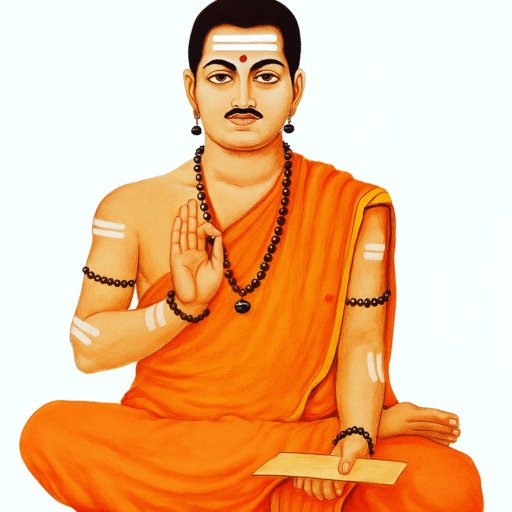

Poetic Rendering

O mind,
like the monkey that once tasted jaggery
and forever remembers its sweetness
hold fast to what is true.
Slip not away
like the fox that, though its belly is full of cane,
runs off forgetting its own contentment
O wavering mind.
Do not scatter yourself
like the crow flitting from place to place,
greedy for every stray morsel
O restless mind.
Know this with certainty, O mind:
the Sharanas are the very Linga
the cosmic axis,
the still point of the universe itself.
Anchor yourself in them,
and forget nothing of your own sweetness.
The vachana urges the mind to remember the divine sweetness it has already tasted just as a monkey never forgets jaggery. It warns against becoming like the fox that forgets its fullness or the crow that roams endlessly in greed. The teaching concludes with the highest truth: the Sharanas are themselves the Linga, the central axis of the cosmos. Recognizing and staying aligned with them keeps the mind steady and rooted in its inherent spiritual sweetness.
Spiritual Context
Core Spiritual Principle: Anchored Remembrance (Sthira-Smarana). In Shivayoga, liberation is not amnesia but perfect, unwavering memory of one’s true, sweet nature (Sat-Chit-Ananda). The mind’s disease is forgetfulness (Moha) and distraction (Vikshepa). The cure is to tether it to a living manifestation of that truththe Sharana.
Cosmic Reality Perspective: From the non-dual view, the mind’s restlessness is Shakti (the energy of consciousness) moving in uncentered, dissipative patterns. The Sharana as Linga is Shiva (pure, centered awareness). To “anchor” the mind in the Sharana is to consciously unite the mobile Shakti with the still Shiva, creating the enlightened state of centered dynamism (Sthira-Sukham).
Historical Reality (Anubhava Mantapa Context): This vachana provided a psychological toolkit for the community. Amidst the demands of revolutionary life, minds would waver, forget the revolutionary’s divine flavor, and scatter into greed or doubt. Basavanna prescribes the community itself the fellowship of realized Sharanas as the living cure. One’s spiritual stability was made dependent on conscious, relational grounding in the sangha.
Interpretation
Monkey & Jaggery: The “sweetness” is the taste of the Divine (Rasa) once experienced in worship or grace. The monkey’s unwavering memory represents the ideal: a mind that once tasting this, never lets go of the impression (Samskara). This is Smarana Sadhana.
Fox & Sugarcane: The fox fills its belly but runs off, symbolizing the mind that receives grace or fulfillment (Prasada) but fails to integrate it. It immediately forgets its contentment and resumes seeking. This is spiritual amnesia, the failure to digest experience (Anubhava).
Crow & Morsels: The crow’s endless flitting represents the scattered mind (Viksipta Chitta) drawn to every sensory or mental stimulus (“stray morsels”). This is greed (Lobha) manifesting as spiritual distraction, preventing deep focus on the one essential thing.
“The Sharanas are the very Linga”: This is the radical, non-dual equation. It collapses the distinction between the human vehicle and the divine principle. The realized being is not a pointer to the truth but the truth itself in human form. They are the “axis” (Dhruva) around which the seeker’s chaotic mind can find its orbit.
“Anchor yourself in them, and forget nothing…”: The practice is relational grounding. By fixing attention (Dharana) on the Sharana their teachings, presence, example the mind’s fluctuations are absorbed into that stability, and the innate “sweetness” of the Self is remembered.
Practical Implications: Spiritual practice is the training of memory. When the mind wavers, one must recall the “taste” of past grace or directly contemplate the steadiness of one’s spiritual guide or community.
The Cosmic Reality
Anga (Human Dimension): The mind as process. It is inherently kinetic, associative, and prone to entropy (forgetting, scattering). Left to itself, it loses its center and its memory of essence.
Linga (Divine Principle): The absolute center, the unmoving reference point. It is pure consciousness and the source of all “sweetness.” In this vachana, it is not abstract but embodied, made accessible in the form of the Sharana.
Jangama (Dynamic Interaction): The tethering of the kinetic mind to the still center. This is the active discipline of remembrance and refuge. The Jangama is the love and trust that binds the seeker’s mind to the Sharana, creating a stable circuit through which the Linga’s nature is recalled and realized.
Shata Sthala
Primary Sthala: Bhakta. The entire address is to the Bhakta’s mind, characterizing its pitfalls and providing its central practice: to remember and anchor. The animal metaphors describe the Bhakta’s possible regressions.
Supporting Sthala: Sharana. The Sharanas are the realized ideal. They are the anchored state. The Bhakta’s path is to move from being the scattered crow to becoming, through that very anchoring, a stable axis for others.
Practical Integration
Arivu (Awareness Practices): Practice “Monkey Mind Meditation.” When the mind scatters (crow) or forgets its peace (fox), deliberately recall a specific moment of divine “sweetness” a feeling of grace, peace, or connection. Hold that memory as the monkey holds the taste of jaggery. Use the image or name of your Sharana or guru as the anchoring point.
Achara (Personal Discipline): Create a daily “anchoring ritual.” At fixed times, pause and consciously remember: “The Sharanas are the Linga. I am anchored in that truth.” Let this be a short, powerful mental act of re-centering, cutting through accumulated distraction.
Kayaka (Sacred Action): Choose one quality of a Sharana you admire (e.g., steadiness, compassion) and make it the “axis” of your workday. Let all actions revolve around embodying that single quality, preventing your energy from scattering into petty ambitions (the crow’s morsels).
Dasoha (Communal Offering): The community should function as a collective anchor. In gatherings, begin by collectively remembering the “sweetness” of the path through shared chanting or silence. Let the community physically and energetically embody the “still axis” for its members, providing a refuge from the world’s scattering forces.
Modern Application
Digital Scatter and Spiritual Amnesia. Our minds are the ultimate crow, flitting between notifications, tabs, and feeds, consuming countless “stray morsels” of information. We experience moments of peace (a meditation, time in nature) but, like the fox, we immediately run back to the noise, forgetting the contentment we just felt. We lose the flavor of our own depth.
This vachana prescribes Strategic Anchoring. It instructs us to choose a single, profound “axis”a deep principle, a trusted guide, a core community and consciously tether our attention to it multiple times a day. We must fight forgetfulness by deliberately recalling what matters most, using that memory to pull our focus back from digital and mental fragmentation. True sanity lies in remembering what is real and refusing to let the mind forget.
Essence
Mind, be the monkey clutching sweet,
Not the fox in full retreat,
Nor the crow on wings of want.
When thoughts like scattered seeds are sown,
Know this one truth, and hold it known:
The Saint’s heart is the Cornerstone.
This vachana describes the psychodynamics of attention and entropy. The mind’s natural tendency is toward entropy: remembered sweetness fades (fox), focused attention scatters (crow). The Sharana-Linga represents a negentropic singularitya point of infinite organizational pull. “Anchoring” the mind to it is the process of reversing personal psychic entropy by entangling one’s consciousness with a higher-order, coherent system. The memory of sweetness is preserved because it is no longer stored in the mind’s dissipative memory but in the stable field of the anchor.
Imagine a spinning top (the mind). Left alone, it wobbles and falls (forgets, scatters). But if you place it inside a large, perfectly stable, gyroscopically suspended sphere (the Sharana as Linga), it spins perfectly steady, maintaining its energy and orientation indefinitely. The sphere doesn’t spin the top; it provides the unwavering context that allows the top to express its own spin flawlessly.
We are creatures of memory and desire, but our memory is faulty and our desires are endless. Our deepest longing is for a memory so profound it becomes our permanent state, and a desire so focused it becomes our still center. This vachana says that center exists outside us, in the form of the true teacher or community, so that we may find it inside us. We must cling to that external anchor with the tenacity of a monkey, until we realize we are the sweetness we seek.

Views: 4