Poetic Rendering
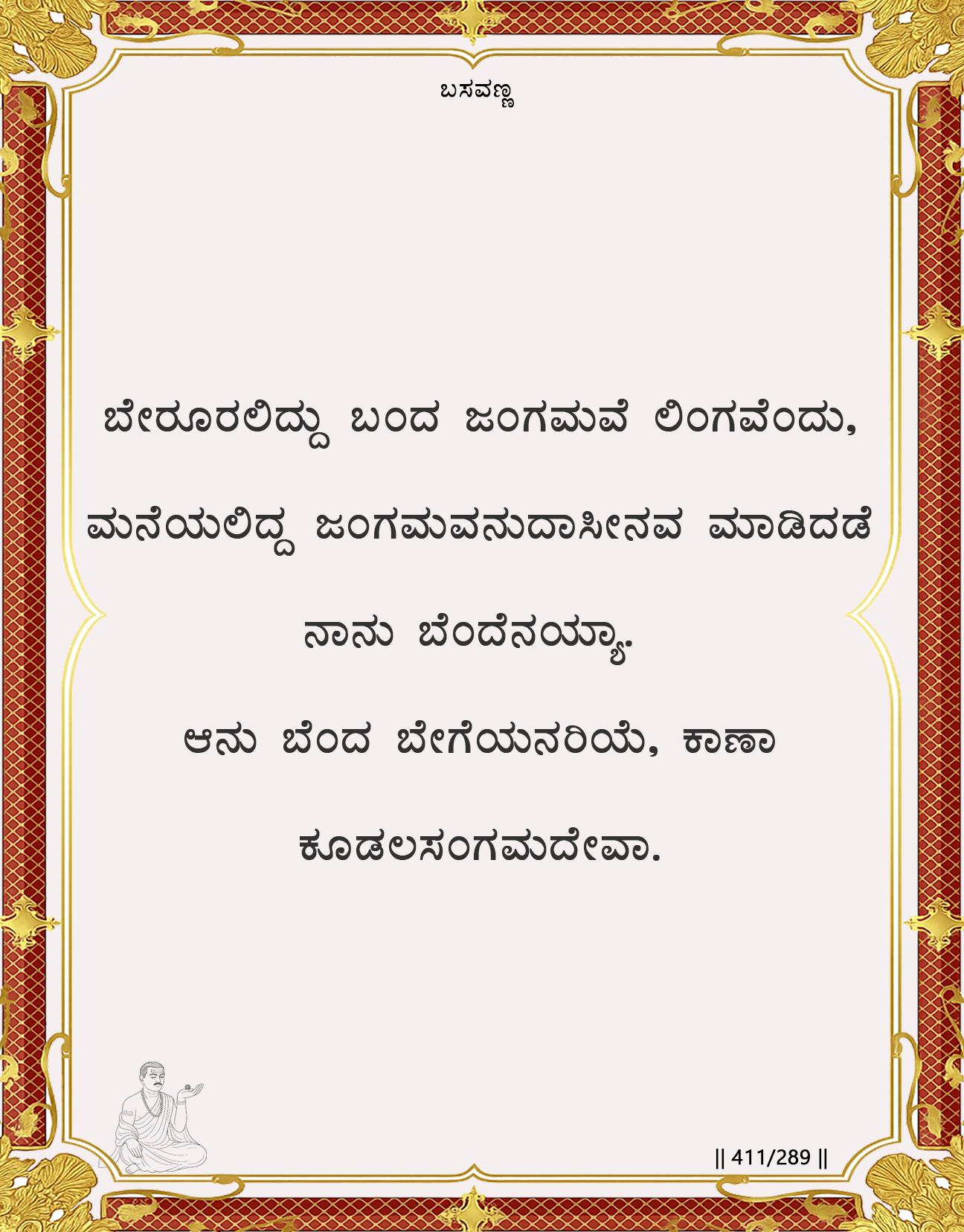
When the Jangama arrives from afar,
a traveler steeped in stillness, bearing truth’s own fragrance
we rise in reverence,
seeing only the Linga in him.
But if, in that moment,
we forget the Linga that dwells within
the eternal One seated in the heart
and cast it aside in our
eagerness to honor the guest,
we kindle a fire against our own inner shrine,
scorching the very presence we seek to uphold.
Why this folly, O Lord?
Why do we create distance where none exists?
Why do we fail to see what is ever near?
Koodalasangamadeva,
keep my vision whole
let me not lose You in one form
while bowing to You in another.
This vachana exposes a subtle spiritual misunderstanding: honoring the outer embodiment of divinity (the Jangama) while neglecting or forgetting the inner Linga, the ever-present divine within. Basavanna warns that such partial recognition creates an inner conflict an unintentional “burning” of one’s own spiritual center.
The Jangama must be revered, but never at the cost of abandoning the continuous inner practice of Lingayoga. The outer and inner forms of Shiva are inseparable; recognizing one while denying the other is a spiritual contradiction. Basavanna confesses the seeker’s bewilderment at this lapse and prays for clarity so devotion remains whole, integrated, and unwavering.
Spiritual Context
Core Spiritual Principle: Non-Dual Reverence (Advaita Bhakti). In Lingayoga, true devotion must honor the divine without creating a separation between its inner residence and its outer manifestation. To privilege one over the other is to perpetuate duality (Dvaita) and engage in a form of spiritual self-harm (“scorching the very presence we seek to uphold”).
Cosmic Reality Perspective: From the non-dual Shiva-Shakti view, the inner Linga is Shiva as pure, unmoving consciousness. The Jangama is Shakti the dynamic, manifest energy of that consciousness in motion. To honor Shakti while ignoring Shiva, or to abstract Shiva while denying Shakti, is to fracture the inseparable whole. The “fire” kindled is the friction of this self-created split.
Historical Reality (Anubhava Mantapa Context): This vachana provided crucial guidance for the Basavayoga community, which revered wandering saints (Jangamas) as sacred guides. Basavanna prevents the formation of a devotional hierarchy or guru-dependency. He insists that the ultimate authority (the inner Linga) must never be surrendered, even in the act of honoring its living embodiment. This protects the seeker’s autonomy and keeps the community’s focus on direct realization.
Interpretation
“We rise in reverence, seeing only the Linga in him”: This is the correct first stepperceiving the universal in the particular. This is Ishvara Darshana, seeing God in all.
“If… we forget the Linga that dwells within… and cast it aside”: This is the critical error. “Casting aside” means suspending one’s own inner worship, discernment, or silence in the face of external spiritual authority. It is the transfer of sovereignty from the inner altar to an outer form.
“We kindle a fire against our own inner shrine”: This is a powerful metaphor for the violence of self-betrayal. The “fire” is the energy of devotion misdirected, which now burns the seat of one’s own connection. It creates inner conflict, doubt, and a sense of distance from the divine.
“Why do we create distance where none exists?”: The lament highlights the self-defeating nature of the error. The Jangama’s purpose is to remind us of the ever-near Linga, not to become a substitute for it. By making the Jangama an intermediary, we insert a fictional distance between ourselves and the divine.
“Let me not lose You in one form while bowing to You in another”: This is the prayer for Samyak Darshana (right perception). It seeks the wisdom to see the singular truth in multiplicity, to bow to the guest without unbowing from the host within.
Practical Implications: When in the presence of a revered teacher or community, one must consciously practice simultaneous awareness: feeling the reverence for the outer form while actively feeling the presence of the same divine principle within one’s own heart. The inner Linga remains the primary reference point.
The Cosmic Reality
Anga (Human Dimension): The realm of attention and focus. It can only attend to one “object” at a time with full devotional intensity. Its pitfall is to mistake the shift of attention from inner to outer as a necessary choice, rather than an expansion of the same recognition.
Linga (Divine Principle): The singular reality that is both immanent (within) and transcendent (without). It is not two. The Jangama is a focal point of this transcendence; the heart is the seat of its immanence.
Jangama (Dynamic Interaction): The sacred encounter itself. In its highest form, this interaction should function as a mirror: the Jangama reflects the Linga back to the devotee, not pointing to itself but activating the devotee’s recognition of the Linga within. If the interaction instead deactivates the inner reference, it has failed its purpose.
Shata Sthala
Primary Sthala: Bhakta. The described experience is classic for the earnest Bhakta, who can project divinity outward onto saints and teachers, sometimes at the cost of their own inner practice and confidence.
Supporting Sthala: Aikya. The integrated vision prayed for is the perspective of Aikya. At this stage, one sees the guest, the host, and the act of hospitality as a seamless flow of the same conscious reality. There is no possibility of “losing” the divine in one form while honoring it in another.
Practical Integration
Arivu (Awareness Practices): Practice “Simultaneous Sanctuary.” When greeting anyone, especially a spiritual friend or teacher, pause inwardly. Feel the presence of the Linga in your own heart as a steady flame. Then, look at the other and see that same flame in them. Let your reverence be the connection between the two identical flames, not an abduction of your own.
Achara (Personal Discipline): Never suspend your daily personal worship (Istalinga Puja) for any external spiritual event. Let the outer event be an extension and celebration of that inner practice, never its replacement. This ritualizes the principle of non-abandonment.
Kayaka (Sacred Action): In collaborative work with inspiring leaders, consciously offer your skills to the Linga within the project and within yourself. Avoid transferring your creative authority entirely to the external leader. Maintain your inner discernment and offering.
Dasoha (Communal Offering): In community gatherings for a visiting teacher, structure the event to include silent meditation that directs attention back to the inner Linga. The introduction should frame the guest as one who reminds us of our own inner truth, not as one who possesses truth we lack.
Modern Application
The Modern Malady: Guru Worship and Spiritual Outsourcing. In contemporary spirituality, there is a strong tendency to seek external saviors charismatic gurus, coaches, or thought leaders and outsource our spiritual authority to them. We “cast aside” our own intuition, critical thinking, and inner practice in devout following, which can lead to dependency, disillusionment, and the “scorching” of our own inner wisdom.
The Liberative Application: This vachana teaches Devotional Integrity. It allows us to fully appreciate and learn from external guides while radically retaining our own inner ground. The test is this: does this teacher’s presence make me feel more connected to my own divine core, or does it make me feel that connection is dependent on them? The former is true Satsangha; the latter is a warning to reclaim the inner shrine.
Essence
The saint arrives, and I bow low,
Seeing the God I yearn to know.
But in that bow, if I forget
The very ground on which I’m set
The silent shrine within my breast
My reverence becomes a theft.
O Lord, let every outward knee
Find its curve in intimacy
With the You that never leaves,
The You my own heart receives.
The Deeper Pattern: This vachana describes the holographic error in perception. In a hologram, every fragment contains the whole image. The Jangama is one fragment manifesting the whole image of the Linga vividly. The error is to think, “The whole image is only in that fragment,” and thus to neglect or devalue the same whole image contained in one’s own fragment (the heart). This creates a perceptual duality that fractures the holographic unity of consciousness.
In Simple Terms: Imagine a room of mirrors (the community of beings). You see a brilliant light reflected in one mirror (the Jangama) and run to worship that reflection, turning your back on the source lamp (the inner Linga) that is equally lighting up your own mirror (your being). You end up worshipping a reflection while ignoring the source that makes both your own and the other’s reflection possible.
The Human Truth: We have a deep yearning to see the divine in a form we can love and follow. Yet, we equally fear losing our own ground in the process. This vachana resolves the tension: love the form, but let that love constantly refer you back to the formless source within you. The true teacher is not the one who demands you look only at them, but the one who points insistently back to the altar of your own heart.

Views: 22