Poetic Rendering

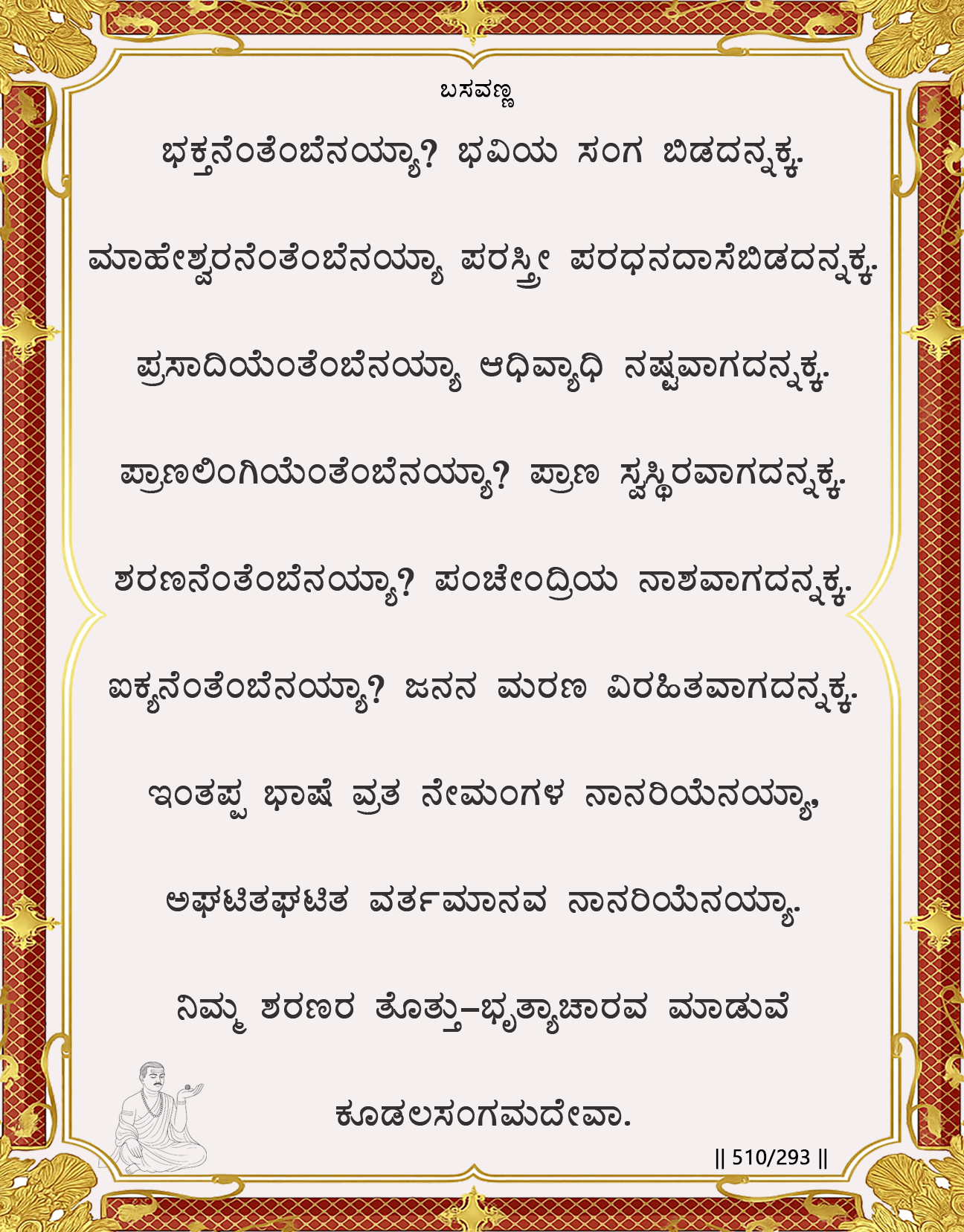
Who can be called a bhakta
if he still clings to the company
that pulls him from the path?
Who is a Maheshwara
if desire and greed still stir
for another’s wealth?
Who is a Prasadi
when the body’s cravings
have not yet been tamed?
Who is a Pranalingi
when the life-force wanders,
unanchored, uncontrolled?
Who is a Sharana
if the five senses still rule him
like tyrants of an unguarded kingdom?
Who can be called Aikyaone with the Divine
if he has not understood
the true flow of life-energy
or the One who dwells within it?
Such words, such titles,
such empty rituals and claims
let them not even touch my ears.
What has never happened,
what never will happen in truth
I refuse to chase such fantasies.
Let me instead be the servant
of those true Sharanas
who live Your reality,
O Kudalasangamadeva.
In this vachana, Basavanna exposes the hollowness of spiritual labels when unbacked by inner transformation. He questions the validity of various exalted statuses bhakta, Maheshwara, Prasadi, Pranalingi, Sharana, Aikya when the person still carries the very tendencies these titles are meant to transcend. He critiques those who claim spiritual rank while remaining in the grip of sensuality, greed, ungoverned life-force, or social entanglements. Such titles, he declares, become masks for the ego rather than expressions of realization. Basavanna rejects empty spiritual talk, ritualistic posturing, and hypothetical achievements. Instead, he chooses humility: to serve the genuine Sharanas whose lives embody the truth of Kudalasangamadeva. This vachana teaches that true spiritual identity is lived, not proclaimed; earned through inner conquest, not through borrowed names.
Spiritual Context
Core Spiritual Principle: Authenticity as Sadhana (Satya-Achara). In Lingayoga, spiritual progress is validated solely by inner transformation, not by titles, rituals, or claims. The ego’s tendency to cloak itself in spiritual labels is a primary obstacle that must be relentlessly unmasked through honest self-scrutiny and humble service to the genuinely realized.
Cosmic Reality Perspective: The Shatsthala stages represent progressive alignments of individual consciousness (Shakti) with universal consciousness (Shiva). Claiming a stage without the corresponding inner unity is a play of MayaShakti contracting into a false identity. This vachana calls for the dissolution of that contraction, allowing Shakti to recognize its actual state and sincerely move toward true union (Sangama).
Historical Reality (Anubhava Mantapa Context): Within the revolutionary egalitarian community, there was a risk of spiritual one-upmanship and premature claims of attainment. Basavanna, as the guiding force, used this vachana as a radical corrective to preserve the integrity of Basavayoga. It ensured that the community remained grounded in lived experience, preventing the formation of a new hierarchy based on empty spiritual status.
Interpretation
1. Bhakta: True Bhakta is defined by unwavering devotion. If one’s company still pulls them from the path, the label is a facade. The essence is single-pointed orientation, not nominal affiliation.
2. Maheshwara: This stage involves mastery over ritual and selfless offering. Lingering greed for another’s wealth contradicts the fundamental detachment and generosity required.
3. Prasadi: Marked by the dawn of grace that purifies the senses. If bodily cravings remain untamed, it indicates grace has not yet penetrated and transformed the instinctual nature.
4. Pranalingi: Characterized by the Linga becoming vibrantly alive in one’s life-force (Prana). If the prana wanders uncontrolled, the Linga is not enlivened there; the stage is not attained.
5. Sharana: Defined by total surrender. If the five senses still rule like tyrants, surrender is incomplete; the ego remains on the throne.
6. Aikya: The non-dual union. If one has not understood the flow of life-energy and the indwelling Divine, the knowledge required for union is absent.
Each rhetorical question highlights a specific, tangible failing that invalidates the corresponding lofty claim. The conclusion to serve true Sharanas provides the antidote: grounding oneself in the living presence of those whose being matches the teachings.
Practical Implications: Regularly audit your inner state against the core criteria of each stage, not to claim advancement but to identify areas for growth. Reject spiritual labeling of oneself. Let humility and the quality of your consciousness be the only measure, and seek the company of those whose lives are authentic expressions of the path.
The Cosmic Reality
Anga (Human Dimension): The realm of self-image and social persona. The ego here seeks to enhance its value through spiritual branding, using titles as currency. It operates in the world of appearances, where claims can be made independent of reality.
Linga (Divine Principle): The unshakeable reality of what is. It is the absolute truth that cannot be falsified, impersonated, or claimed. The Linga shines only in a consciousness purified of all pretension.
Jangama (Dynamic Interaction): The process of honest self-inquiry and the act of serving the true Sharanas. This interaction creates a friction that wears away false identities. The true Sharanas, as living Jangamas, act as mirrors and catalysts, dynamically facilitating the Anga’s alignment with the Linga.
Shata Sthala
Primary Sthala: Bhakta. The speaker’s stance rejecting false labels, acknowledging the gap between claim and reality, and choosing humble service is the essence of the sincere Bhakta, who approaches the path with honesty and devotion, not entitlement.
Supporting Sthala: Sharana. The vow to serve the true Sharanas is an act of taking refuge. It aligns the seeker with the living power of the Sangha, which is the practical method for progressing from the honesty of the Bhakta toward the actualization of the Sharana stage and beyond.
Practical Integration
Arivu (Awareness Practices): Practice “Label-Shedding Meditation.” Sit quietly and mentally list any spiritual identities you claim or desire. For each, ask: “Do I fully embody the freedom from the attachments this stage implies?” Let the answers guide you to a more honest, less defined sense of self.
Achara (Personal Discipline): Institute a personal vow to never refer to yourself using spiritual titles (e.g., yogi, devotee, seeker). If others use them, deflect gracefully. Make your spiritual practice intensely private, focused solely on inner change.
Kayaka (Sacred Action): In your profession, perform duties with excellence but without attaching a narrative of spiritual superiority to them. Let your work be an anonymous offering, its “spiritual level” known only to the Divine.
Dasoha (Communal Offering): Cultivate a community culture where members share struggles and questions more often than insights and achievements. Celebrate acts of humble service and honesty about failures as the true markers of progress.
Modern Application
Spiritual Branding and Influencer Culture. In the digital age, spirituality is often packaged and performed online. People build personal brands as “gurus,” “healers,” or “awakened beings,” using the lexicon of deep transformation without the requisite inner work. This leads to widespread disillusionment and a marketplace of empty labels.
Embrace Spiritual Anonymity. Actively resist the urge to perform your spirituality for an audience. Find value in unseen growth. Follow teachers who shun the spotlight and embody quiet integrity. Let your practice be a hidden root system, not a decorative flower. In a world of curated selves, choosing authenticity becomes a revolutionary act of inner freedom.
Essence
A name that’s worn but not become
Is a hollow bell, a silent drum.
From Bhakta’s fire to Aikya’s rest,
Each name demands a passed test.
So let the titles fall away,
And in the dust of saints, I’ll stay
A servant to the truly real,
Where God alone sets forth the seal.
This vachana operationalizes the quantum principle of decoherence. A spiritual title (like “Sharana”) represents a pure, coherent state of consciousness. The ego’s claim to that title while maintaining incompatible tendencies (like sensory tyranny) creates a superpositiona contradictory, unstable state. The vachana’s questioning induces a “measurement,” causing decoherence: the wave function collapses to reveal the actual, mixed state of the individual. Serving the true Sharanas represents entangling with a coherent system to stabilize one’s own state.
It’s like wearing a general’s uniform without having trained or led troops. The uniform (title) might impress some, but in battle (the challenges of life and spirit), the lack of real skill is exposed. It’s wiser to be a humble cadet who learns from real generals, slowly earning each stripe through real competence.
We crave the security and status that come with being “someone” especially someone spiritually advanced. This vachana reveals that this very craving is the core obstacle. True security is found not in being called something, but in being nothing in particular fluid, honest presence committed to growth. The greatest dignity lies in the courage to be an authentic work-in-progress, free from the need for masks.

Views: 2