
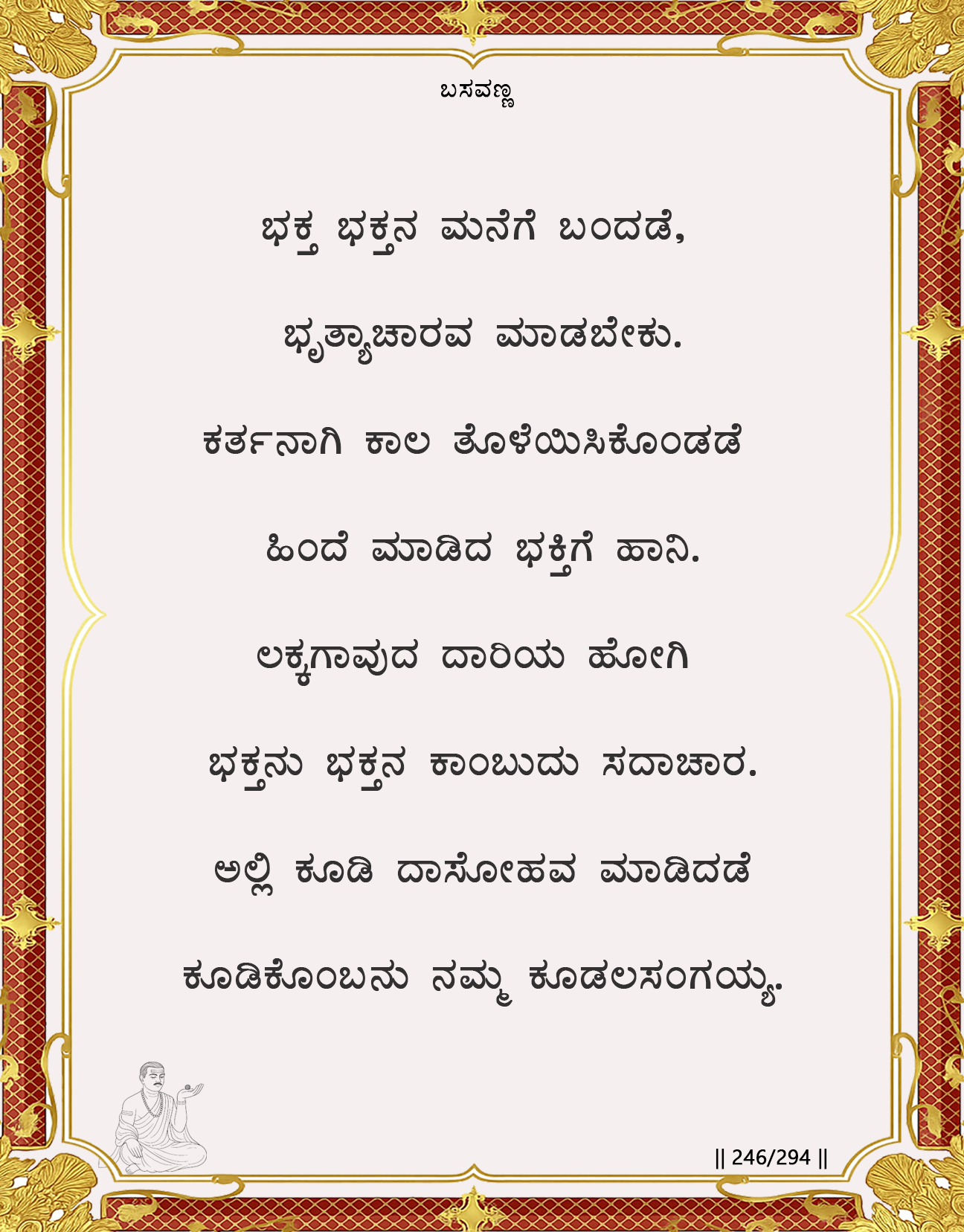
Poetic Rendering

When a bhakta steps into the home of another bhakta,
let service rise from the heart
as naturally as breath.
For if we think, even for a moment,
that we are doing him a favor,
the merit of all our past devotion
falls away like dust in rain.
The bhakta who has journeyed
far upon the inner road
his feet bearing the miles
of inward pilgrimage
with such a one,
let us sit,
let us speak,
let us listen deeply.
Where their lived experience is shared
without pride, without concealment,
there
in that gathering,
in that communion
Kudalasangamadeva
bestows His grace.
This vachana describes the ethos of Anubhava Mantapa, Basavanna’s visionary model of spiritual community grounded in equality, humility, and shared experience. Basavanna teaches that when one devotee visits another, the host must serve with authentic reverence, not superiority. Even the slightest sense of “I am doing you a favor” destroys the spiritual merit accumulated through past discipline. True devotion expresses itself through humility. He honors the bhakta who has walked far on the inner journey, emphasizing the importance of heartfelt dialogue among such seekers. Speaking truthfully, exchanging spiritual insight, and learning from one another are the practices that transform an ordinary meeting into a sacred congregation. Where sincere seekers gather and share their experience of the Divine, Basavanna declares that Kudalasangamadeva’s grace descends. Thus, the vachana establishes satsanga holy company as the living ground of realization, and the community of sharanas as the true temple.
Spiritual Context
Core Spiritual Principle: Communion as Conduit (Sangha-Yoga). In Lingayoga, grace is not merely an individual revelation but a communal event. The collective field of consciousness generated by sincere, humble exchange becomes a direct conduit for divine blessing. The individual ego must be sacrificed at the altar of the Sangha for this to occur.
Cosmic Reality Perspective: From the non-dual view, the separate “I” that thinks it confers a favor is a contraction of Shakti. True service is Shakti flowing freely between apparent individuals, recognizing itself. When this flow is unobstructed by pride, it aligns with the boundless outflow of Shiva (grace). The gathering becomes a localized singularity of non-dual awareness.
Historical Reality (Anubhava Mantapa Context): This vachana was the social covenant of the Anubhava Mantapa. It translated the philosophy of non-duality into a binding social protocol: eradicate hierarchical thinking even in acts of kindness. It defined the space as one where authority came only from the depth of lived experience (Anubhava), not from birth, status, or even seniority. This made every meeting a potential site of revolution and revelation.
Interpretation
“Let service rise from the heart as naturally as breath”: Service (Dasoha) is not an act but an expression of being. Like breath, it should be unconscious of itself, an autonomic function of a living devotion.
“If we think… we are doing him a favor, the merit… falls away like dust in rain”: The “favor” mindset reinstates the dualistic giver-receiver framework. It turns Dasoha into a transaction, which immediately collapses the sacred space and voids (washes away) the merit (Punya) built on non-dual understanding.
“The bhakta who has journeyed far upon the inner road…”: This honors the value of experience over dogma. The “miles” symbolize the struggles, insights, and purifications of sincere practice.
“With such a one, let us sit, speak, listen deeply”: This outlines the sacred dialogue. It is not debate or lecture but a mutual offering and reception of truth (Satyasangha). Listening is as important as speaking.
“Where lived experience is shared without pride, without concealment…”: This defines the quality of the sharing. “Without pride” negates ego-inflation; “without concealment” negates hypocrisy. This creates a field of radical honesty.
“Therein that gathering… Koodalasangamadeva bestows His grace”: The conclusion establishes causality. The grace is not arbitrary; it is drawn by the coherent, open, and humble field of consciousness created by the community.
Practical Implications: Every act of hospitality, every conversation with a spiritual friend, must be examined for the subtle shadow of “I am the benefactor.” The goal is to serve so seamlessly that the server disappears, leaving only the service.
The Cosmic Reality
Anga (Human Dimension): The provider of food, shelter, and words. It is necessary but dangerous; its pride can poison the offering. Its role is to prepare the ground and then get out of the way.
Linga (Divine Principle): The grace that is the true substance of the meeting. It is the “guest of honor” that appears only when the human hosts are not vying for attention.
Jangama (Dynamic Interaction): The shared space of storytelling and silence. This Jangama is the true “host.” It is the energetic circuit that connects all Angas and, when clear of ego-resistance, plugs the gathering directly into the Linga.
Shata Sthala
Primary Sthala: Bhakta. The entire vachana is a manual for the Bhakta on how to create and participate in Satsangha, which is the lifeblood of this stage. The warnings about pride are fundamental teachings for the devotee.
Supporting Sthala: Sharana. The ideal gathering described is a prototype of the Sharana community. To seamlessly live this ethos is to inhabit the Sharana stage, where individual identity is subsumed in the collective body of devotion.
Practical Integration
Arivu (Awareness Practices): Before hosting or engaging in spiritual dialogue, set this intention: “May I be an empty channel. May any sense of ‘I am doing’ dissolve.” During the exchange, periodically check: “Is there a hidden sense of superiority or expectation?”
Achara (Personal Discipline): Practice “Anonymous Nourishment.” Periodically provide a meal or help to a spiritual companion without them knowing it came from you, or without any possibility of thanks. This severs the ego’s link to the act.
Kayaka (Sacred Action): Transform team meetings at work into opportunities for “Anubhava.” Begin by having each person share a genuine challenge or lesson (a “mile” journeyed) before discussing agenda items. This fosters authentic collaboration over transactional interaction.
Dasoha (Communal Offering): Structure community gatherings around a circle where each person has equal time to share a current struggle or insight from their practice, with the group listening silently. The leader speaks last, if at all. This ritualizes the egalitarian sharing of experience.
Modern Application
Transactionalism and Spiritual Networking. Our connections are often utilitarian, even in spiritual circles: networking for opportunities, seeking audiences, or offering help with an unspoken expectation of reciprocity or enhanced reputation. Our gatherings are often performances, not communions.
Cultivate Circles of Vulnerable Truth. This vachana calls us to create small, protected spaces where people meet not to impress, but to confess; not to teach, but to share their authentic journey. It means hosting dinners where the agenda is deep listening, forming study groups where the goal is mutual uncovering, not debate. In such spaces, where hierarchy and pretense die, grace becomes palpable.
Essence
Let service be a silent breath,
Uncounted, given life to death
Of “I” and “mine.” Let stories told
Of roads within, not fame of old,
Be all our wealth. And in that ring,
Where humble truth takes wing,
A Guest arrives, unseen, unknown
And makes our shared heart His throne.
This vachana describes the emergence of a self-organizing, egalitarian network of consciousness. In such a system, individual nodes (seekers) are not ranked. The protocol for interaction is a foundational, non-negotiable rule: all exchanges must be governed by humility, erasing any trace of hierarchical transaction. When this protocol is followed, the network bypasses the inefficiencies and corruptions of ego-centric control. Information (spiritual experience) flows without distortion, resources (service) circulate without hoarding, and the system as a whole achieves a state of coherent resonance. This resonance is the “grace” that emerges as a new property of the system it self a collective intelligence and spiritual potency that no single node could generate alone. The Anubhava Mantapa was the historical instantiation of this network protocol.
Imagine a potluck where the only rule is that you cannot announce what you brought or take credit for it. Everyone simply places their dish on a shared table and eats from whatever is there. The focus shifts from the contributor to the contribution, and from individual prestige to collective nourishment. The meal that emerges is invariably abundant, diverse, and satisfying in a way that a meal planned by a single host could never be. The shared table becomes a place of unexpected generosity and unity. The Anubhava Mantapa was this shared table for the soul.
We long for a community where we are valued for our authentic experience, not our status; where giving is instinctive, not calculating; and where leadership is fluid, not fixed. This vachana confirms that such a community is possible, but only if we adopt a radical internal rule: to see every act of service as honoring the divine in the other, and every shared truth as an offering to the collective wisdom. It extends this truth to our relationship with the world: the Earth itself is the “home” we enter. To serve it and each other without arrogance is the only ethics that can sustain a sacred life together. The divine is not just in the solitary heart or the distant heaven, but in the very space of connection between humble, truthful beings.

Views: 1