Poetic Rendering
A Bhakta appears before you
“Ah, a simple one,” you say.
A Jain monk walks past
“Lo, the unclad ascetic,” you remark.
A Brahmin appears
and at once you murmur, “Hari, Hari,”
as custom has taught you.
Whatever you see,
you name according to habit
surface calling to surface.
But after knowing,
after worshipping Kudalasangamadeva
the One who is here in this very moment,
the One who merges the seeker
into the God within
still you wander, searching elsewhere
for some other god.
Such wanderers,
though their eyes are open,
see nothing of truth.
Call them what you will
they are not Bhaktas,
for they have not yet learned
where the Divine truly dwells.
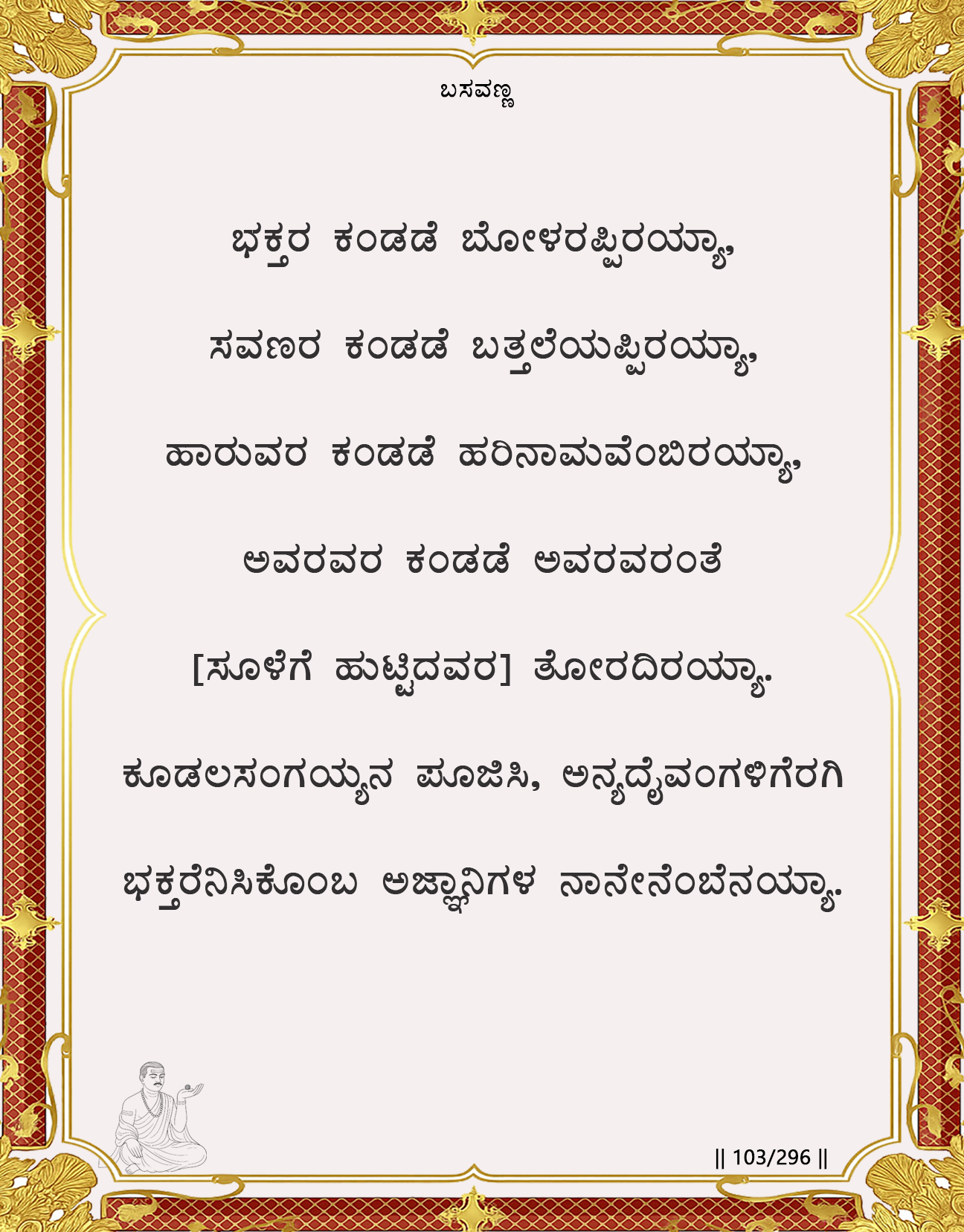
Basavanna observes how people label spiritual figures Bhaktas, Jain monks, Brahmins based on outward appearances. But even after praying to Kudalasangamadeva, the immanent and ever-present divine, these same people keep searching elsewhere for God. He criticizes this spiritual blindness: those who seek the divine outside after knowing the divine within are not true Bhaktas but seekers without understanding.
Core teaching:
If you know that the divine is present here and now within you, stop searching outside otherwise, you remain blind though your eyes are open.
Spiritual Context
Core Spiritual Principle: The End of Seeking (Mumukshutva-Nivritti). In Lingayoga, the purpose of worship is not to perpetuate seeking but to consummate it by recognizing the worshipped as one’s own innate reality. If worship leads to further external search, it has failed. True devotion culminates in the understanding that the seeker, the seeking, and the sought are one in the here and now (Koodala).
Cosmic Reality Perspective: The non-dual Shiva-Shakti dynamic reveals that all external forms (ascetics, priests, rituals) are manifestations of Shakti. To chase these forms while ignoring the Shiva-consciousness from which they arise and within which they subsist is to mistake the dance for the dancer. Koodalasangamadeva is the name for the instant (Koodala) of recognizing that the dancer and dance are not separate (Sangama).
Historical Reality (Anubhava Mantapa Context): This vachana was a direct challenge to the syncretic but confused religiosity of 12th-century Karnataka. People would venerate Basavanna’s Sharanas, Jain ascetics, and Brahmin priests all in the same day, seeing them as different paths to different gods. Basavanna cuts through this: if you have truly known the Linga (the unifying principle), this compartmentalized, external search must stop. It was a call for consequential faith, where your understanding transforms your perception and ends spiritual tourism.
Interpretation
1. Labeling by Habit: “A Bhakta appears… ‘a simple one,’ you say.” This is perception trapped in societal and conceptual categories. The viewer sees the costume, not the consciousness.
2. The Pivotal “But”: “But after knowing, after worshipping Kudalasangamadeva…” This establishes the contradiction. The knowing and worshipping referenced are not mere rituals but should lead to a transformative insight.
3. The Definition of Koodalasangamadeva: “The One who is here in this very moment, the One who merges the seeker into the God within.” This is a precise metaphysical definition. The Divine is 1) Immanent (here now), and 2) Unitive (merges seeker with sought).
4. The Central Critique: “Still you wander, searching elsewhere for some other god.” This exposes the disconnect between intellectual/ritual knowledge and embodied realization. The feet wander because the heart has not fully understood the definition.
5. Diagnosis of Blindness: “Such wanderers, though their eyes are open, see nothing of truth.” Their physical eyes work, but the eye of wisdom (Jnana Chakshu) is closed. They see diversity but not the unifying principle within it all.
6. The True Bhakta Defined: “They are not Bhaktas, for they have not yet learned where the Divine truly dwells.” A Bhakta is redefined not by fervor of search, but by the clarity of their address for the Divine. The learning is not intellectual but existentiala relocation of one’s seeking to within.
Practical Implications: The test of your spiritual practice is this: does it decrease your need to find salvation in another person, place, or external form? Does it bring the search to a peaceful close within your own being? If not, the practice itself may be reinforcing the outward gaze.
The Cosmic Reality
Anga (Human Dimension): The apparatus of perception and locomotion. It is naturally oriented outward, labeling the world and moving through space in search of fulfillment. Untransformed, it is a vehicle of distraction.
Linga (Divine Principle): The still, omnipresent center. It is not in a direction; it is the ground of here-ness. It is the “God within” that the seeker is to be merged into.
Jangama (Dynamic Interaction): The turning of the Anga’s attention from the horizon to the center. True Jangama is not physical pilgrimage but this inward pivot. The wandering search is a Jangama gone in circles; the inward merge is the Jangama reaching its terminus.
Shata Sthala
Primary Sthala: Bhakta. The vachana is fundamentally about the qualification of a Bhakta. It raises the bar from superficial devotion to a devotion that understands the locus of the divine, which is the necessary foundation for all further stages.
Supporting Sthala: Aikya. The promised end of the true Bhakta’s journey is the merger described, which is the state of Aikya. Thus, the correct understanding of Bhakti inherently contains its destination.
Practical Integration
Arivu (Awareness Practices): Practice “Label Dissolution.” When you notice yourself labeling someone spiritually (e.g., “a devout person,” “a teacher”), pause. See if you can perceive the conscious presence within them, the same “here-ness” that is within you. Let the label fall away.
Achara (Personal Discipline): For a set period, abstain from all physical pilgrimage and visits to temples/gurus. Turn the ritual of worship entirely inward to the Istalinga or the heart-space. Observe the mental impulse to seek externally and offer that impulse itself at the inner altar.
Kayaka (Sacred Action): Let your work be your only “search.” Pour all seeking energy into the perfection of your Kayaka, seeing the Divine in the task itself. Let the completion of each duty be the arrival you previously sought elsewhere.
Dasoha (Communal Offering): In community, discourage gossip or assessment of other paths and groups. Redirect conversation to the shared experience of the indwelling presence. Make the community a space that reinforces the end of seeking, not a marketplace of spiritual options.
Modern Application
Spiritual Consumerism and the Guru Marketplace. The modern seeker often hops from one workshop to another, one online teacher to the next, collecting techniques and insights without ever ceasing the search. We confuse the accumulation of spiritual experiences with realization, remaining perpetual consumers in a marketplace of enlightenment, our eyes open but our seeing impaired by choice overload and FOMO (Fear Of Missing Out).
Cultivate Radical Inward Sufficiency. This vachana calls for a “spiritual boycott” of external seeking. It asks us to take one teaching the immanence of the divine seriously enough to stop shopping. It means investing deeply in one path that points within, and having the courage to declare the search over, not because you have found everything, but because you have realized what you are looking for is not to be found out there. True peace begins when the seeking stops.
Essence
You name the robe, you hail the creed,
A prisoner of what you think you see.
You call the Name that ends all name,
Yet on the road of search you remain.
When will you learn, O wandering mind?
The God you seek, you left behind
Within the heart that beats your chest
In knowing this, the search finds rest.
This vachana describes a perceptual error in spiritual topology. The seeker operates in a Euclidean geometry of faith, believing the Divine is a distant point to be reached by traveling straight lines (pilgrimages, progressions). Lingayoga reveals reality’s topology to be non-Euclidean, like a Klein bottle or Möbius strip: the “outside” and “inside” are a continuous surface. Koodalasangamadeva is the awareness of this continuity. The wanderer searches the external surface, not realizing that a single, seamless turn of attention (a twist in the strip) reveals they are already on the “inside.” The search is not wrong in direction but in its failure to understand the topology of consciousness itself.
Imagine a man inside a house, frantically looking for his glasses. He runs from room to room (external search). The whole time, the glasses are on his face (the indwelling divine). His eyes are open, but he doesn’t see because he’s looking for the glasses out there, not realizing they are the very means by which he sees. The moment he stops running and touches his face, the search ends.
We are wired to seek; it is a survival impulse. Spirituality often gets co-opted by this seeking energy, creating an endless quest. This vachana speaks to the profound exhaustion of that quest and offers the revolutionary possibility of its end. The deepest human longing is not to find, but to be home. It reveals that home is not a location to be reached, but a recognition of where you have always been standing. The blindness is not lack of effort, but the inability to recognize that the search itself is the veil.
The vachana provides an essential safeguard for all spiritual seekers in every age: the wisdom to recognize that the ultimate temple of God is the sanctum of one’s own awakened consciousness.
Basavanna’s insight is crucial in today’s world.
Humanity now bows before technology, fame, political idols, and wealth all forms of false deities.
He reminds us that worship without awareness becomes slavery.
- When religion forgets compassion, it becomes ritual.
- When spirituality forgets discernment, it becomes cult.
- When education forgets wisdom, it becomes competition.
- When love forgets awareness, it becomes possession.
Basavanna’s words call us back to simplicity: Seek the divine not in the noise of crowds, but in the silence within. Do not be led by the blind; open your own eyes and see the Linga breathing in your heart.

Views: 2