Poetic Rendering

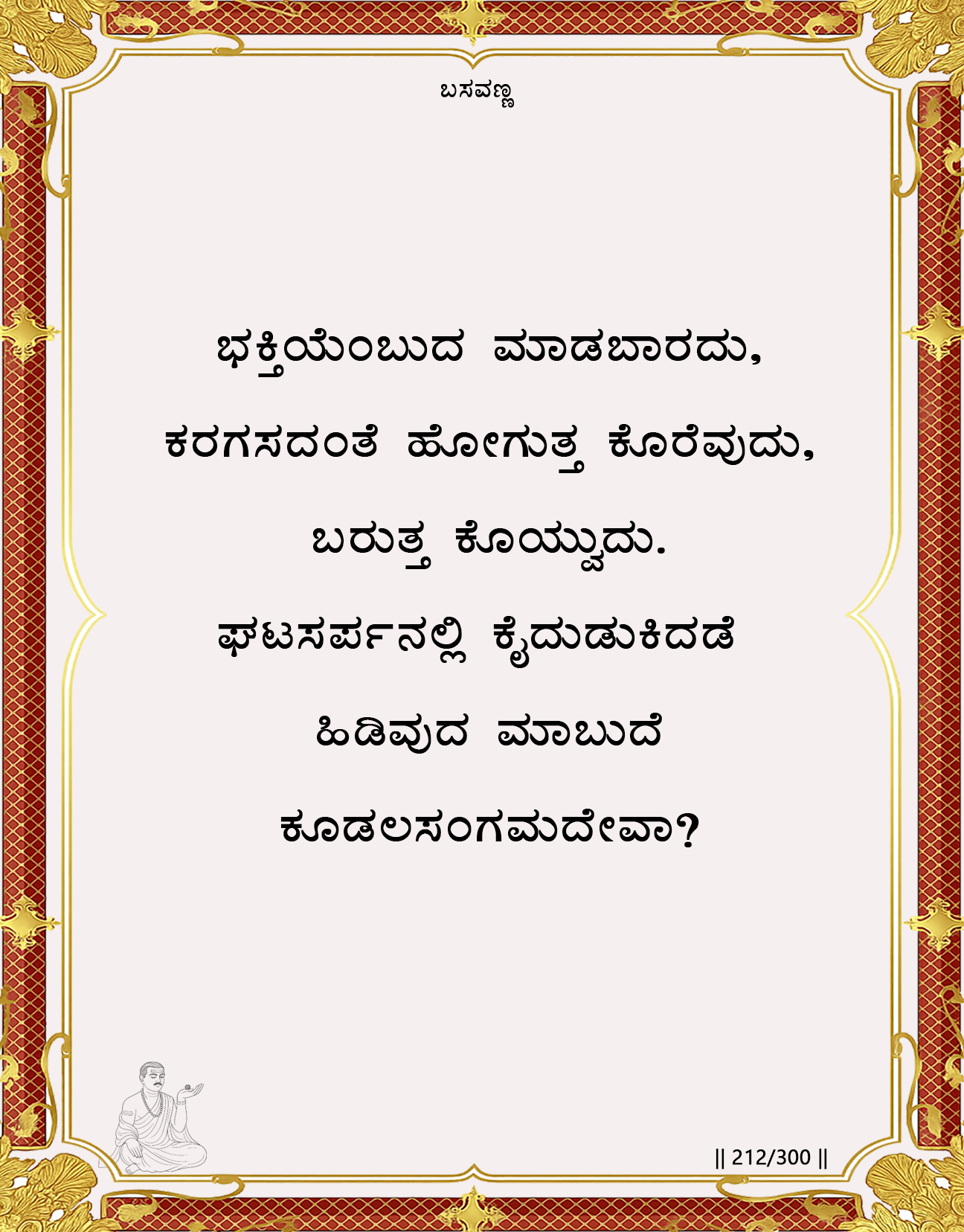
Devotion is not a task
you can pick up and put down
it is a blade that cuts both ways.
Like a saw that bites
whether it moves forward or back,
like a cobra poised to strike
the very instant you falter
devotion demands vigilance.
For the moment you slip,
it pierces you without mercy.
Tell me,
O Kudalasangama Deva
how can one walk this razor-edge
without trembling?
In this Vachana, Basavanna describes true devotion (bhakti) as something dangerous, sharp, and uncompromising not a casual practice but a lifelong discipline. He compares devotion to: A double-edged saw It cuts regardless of the direction. This means devotion holds us accountable even in the smallest actions there is no “safe direction” where negligence goes unnoticed.• A vigilant cobra A cobra strikes instantly if disturbed. Likewise, devotion is not forgiving of hypocrisy, pride, or carelessness. The moment the seeker slips into ego or delusion, they feel the sting. Through these metaphors Basavanna shows that walking the spiritual path is like navigating a razor’s edge. One must remain awake, alert, and honest. Devotion cannot be faked, delayed, or performed mechanically; it is a living force that reveals our flaws without hesitation. The Vachana ends with a direct appeal to Kudalasangama Deva, acknowledging the difficulty and asking for divine support because only grace can help the seeker move steadily on this sharp, demanding path.
Spiritual Context
Core Spiritual Principle: The Integrity of Attention (Aparādha-Bhayam). In Lingayoga, devotion is a state of total, undivided attention to the Divine. Any diversion of that attentionthrough hypocrisy, pride, or carelessnessis an offense (Aparādha) that carries its own immediate, painful consequence. The path is “double-edged” because it tolerates no half-measures; it rewards full presence and punishes inattention with the same mechanism.
Cosmic Reality Perspective: In the non-dual framework, the “blade” represents the sharp discernment (Viveka) between the real (Shiva) and the unreal (Maya). This discernment cuts through illusion but can also wound the ego that clings to illusion. The seeker’s consciousness (Shakti) must align perfectly with this blade; any wavering causes Shakti to fall upon its own edge, experiencing the pain of self-contradiction.
Historical Reality (Anubhava Mantapa Context): This vachana served as a sobering reminder to the revolutionary Sharanas. Their path of Basavayoga was not merely a social reform but a spiritual undertaking with zero tolerance for internal compromise. In challenging entrenched power structures, any ethical lapse or moment of pride could destroy both their spiritual progress and the community’s credibility. Basavanna instilled a culture of fierce self-honesty and reliance on grace.
Interpretation
1. “Devotion is not a task you can pick up and put down”: True bhakti is ontological, not transactional. It is a reorientation of one’s very being, not an activity confined to rituals or moods. To treat it as optional is to misunderstand its nature entirely.
2. “A blade that cuts both ways… a saw that bites whether it moves forward or back”: This signifies that spiritual practice is ambi directional. “Forward” motion (striving, effort) can cut if fueled by ego. “Backward” motion (neglect, regression) also cuts. There is no safe, neutral gear in devotion.
3. “A cobra poised to strike the very instant you falter”: The cobra symbolizes the latent power of consciousness (Kundalini Shakti) and the immediacy of karma. Spiritual energy, once awakened, is volatile; loss of reverence or awareness triggers a recoil of that energy, striking the inattentive mind with doubt, fear, or confusion.
4. “Devotion demands vigilance… it pierces you without mercy”: The requirement is constant self-awareness (Sakshi Bhava). The “mercy” lies in the immediacy of the feedback the pain of being pierced is itself a grace, a rapid correction before one wanders further astray.
5. “How can one walk this razor-edge without trembling?”: This is the culmination of self-knowledge. The question acknowledges that the required perfection is humanly impossible. It transforms the vachana from a warning into a prayer, establishing that the razor’s edge can only be walked with divine support.
The Cosmic Reality
Anga (Human Dimension): The embodied, fallible consciousness that experiences trembling. It is the locus of effort and the capacity for error. Its role is to hold the intention to walk truly and to cry out for help when it realizes its instability.
Linga (Divine Principle): The absolute, unchanging sharpness of reality itself. It is the standard of truth that does not bend. It is also the compassionate source of the grace that answers the cry, providing the balance.
Jangama (Dynamic Interaction): The real-time process of correction and alignment. It is the feedback loop where a tremor in the Anga is met with either a cut (consequence) or a steadying force (grace), depending on the quality of the seeker’s attention and surrender.
Shata Sthala
Primary Sthala: Bhakta. This vachana is fundamental instruction for the Bhakta, instilling a respectful, even fearful, understanding of the path’s seriousness. It destroys any casual or complacent approach to devotion.
Supporting Sthala: Maheshwara. The ability to maintain the vigilant, disciplined practice described here is the hallmark of Maheshwara. The Bhakta aspires to this steadiness, which is developed through consistent, discerning worship.
Practical Integration
Arivu (Awareness Practices): Practice “Razor’s Edge Meditation.” Sit in silence and visualize your attention as a single point balancing on a fine line. Notice how thoughts and distractions pull it off. The practice is to gently return it to the line each time, cultivating the vigilance Basavanna describes.
Achara (Personal Discipline): Implement a “Cobra Watch.” For a day, observe your thoughts, words, and actions with the alertness of one expecting a strike at any false move. Note where hypocrisy, pride, or negligence appear. This isn’t for self-punishment but for cultivating the reverence that prevents the strike.
Kayaka (Sacred Action): In your work, apply the “double-edged” principle. Understand that both over-identification with success (ego) and neglect of duty (sloth) are harmful. Perform each task with balanced, focused attention, offering the results to dissolve the ego’s stake in the outcome.
Dasoha (Communal Offering): In community, foster an environment of gentle, vigilant support. Like fellow walkers on a narrow path, remind each other to stay centered. When someone stumbles, offer grace (the steadying hand) rather than judgment (the cut), embodying the divine support we all need.
Modern Application
Convenience Spirituality and Moral Relativism. We often seek spiritual practices that fit neatly into our schedules and comfort zones, avoiding those that demand uncomfortable integrity. We justify ethical compromises with situational logic. This vachana diagnoses this as deadly to true progress; the path does not adapt to us, we must adapt to it, and its standards are absolute, not relative.
Commit to Uncompromising Awareness. This vachana calls us to stop shopping for an easy path and to embrace the demanding, precise path of unwavering honesty. It means applying our values consistently, in private and in public, especially when it’s inconvenient. It means recognizing that every moment is a test of our alignment, and that the only safe way forward is to coupled with a humble, continual plea for the grace that makes such alignment possible.
Essence
Not a tool to be set aside,
But the sharp edge on which we bide.
A saw that cuts through false and true,
A cobra’s strike if thought ask sew.
This razor-path, how can I tread?
With trembling soul and humble dread,
I cry to You, the Edge and Friend
On Your grace, my steps depend.
This vachana describes the control theory of spiritual consciousness. The seeker is a system trying to maintain a state of perfect equilibrium (devotional alignment) along a setpoint (the razor’s edge). The system is inherently unstable due to internal noise (egoic impulses) and external disturbances (Maya). The “double-edged” feedback is a proportional control: any deviation from the setpoint, in either direction, generates an immediate corrective signal (the “cut” or “strike”). This harsh feedback is necessary to prevent catastrophic drift. However, the system’s own gain is too low to correct itself it trembles. The required solution is an external integrator: divine grace, which provides a stabilizing force that accumulates over time to offset the inherent instability, allowing the system to settle at the desired setpoint.
Imagine trying to balance a sword upright on your palm. The sword is the path of devotion. Any tiny shake of your hand (a lapse in attention) makes the sword wobble dangerously. The sword’s blade is sharp if it falls, it cuts you (the consequence). You cannot hold it perfectly still by your own will; you tremble. You need someone else to gently steady your wrist (grace). The steadiness doesn’t come from you, but through you, enabling the balance. Your job is to keep your palm open and upward, and to cry for help when you shake.
We desire the stability and clarity of the spiritual peak but resent the precipitous path that leads there. We want the reward without the risk. This vachana shatters that bargain, revealing that the peril of the path is inseparable from its promise. Our trembling is not a sign of inadequacy but the authentic human condition. The ultimate act of courage on this path is not to stop trembling, but to acknowledge it and to direct our plea to the only Source capable of transforming our shaky footing into a steady, graceful walk. The blade is not our enemy but our teacher; the wound is not punishment but the incision that removes the tumor of self-deception.

Views: 18