Poetic Rendering
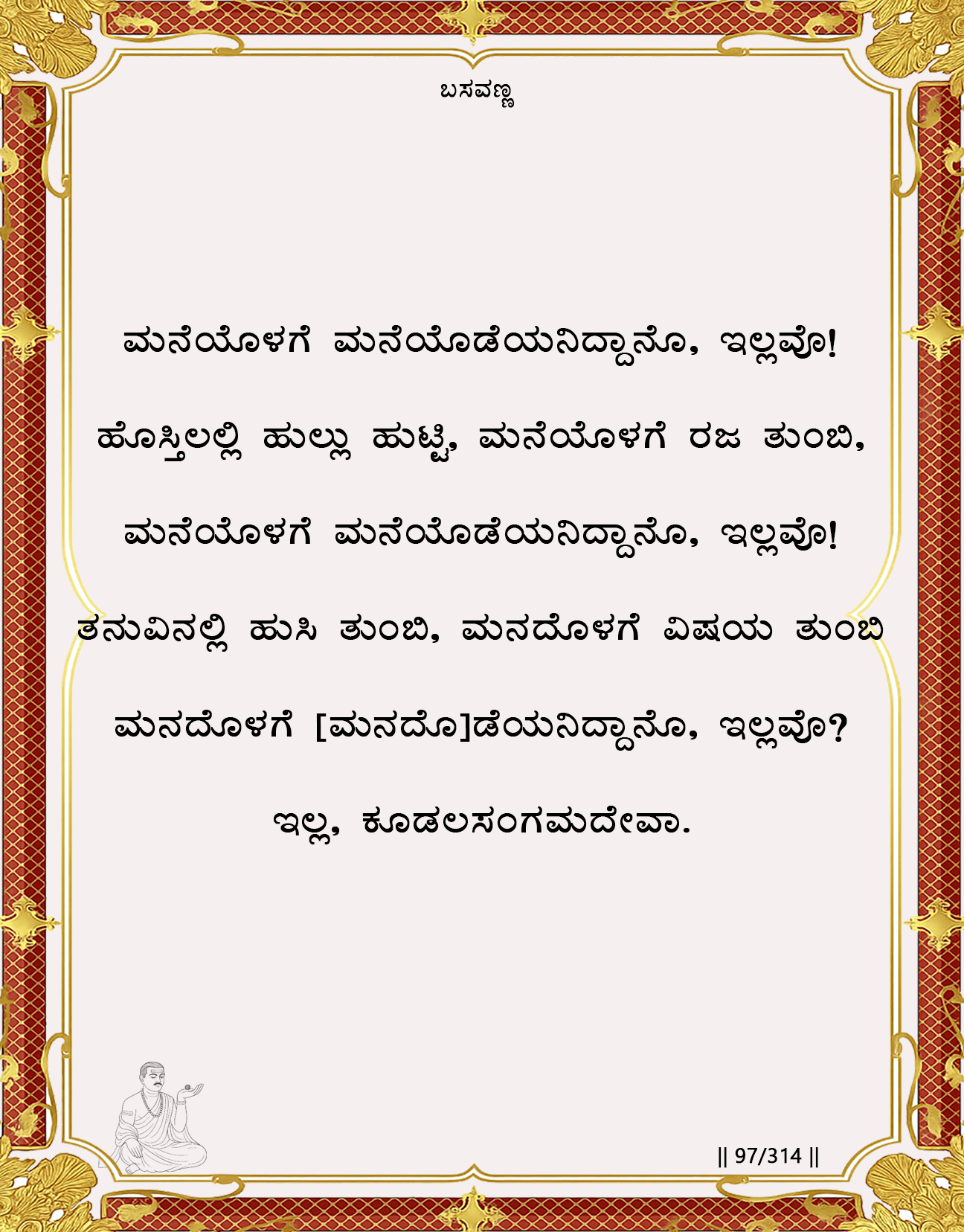
Within the house, does the Master dwell?
Or have we filled His seat with pride and shell?
In the courtyard of devotion, new grass may grow,
but weeds of ego steal its sacred glow.
O mind! You claim this house as thine,
but where is the Lord, the Light Divine?
If the Master has departed and weeds have spread,
what remains but a dwelling of the dead?
O Koodalasangama Deva,
return and dwell in me again.
When the Divine Vacates and the Ego Moves In This vachana represents Basavanna’s most intimate spiritual diagnosis the subtle process through which divine consciousness vacates the human temple when ego quietly assumes residence. Using the powerful metaphor of a house whose owner has departed, Basavanna maps the spiritual anatomy of forgetfulness: how awareness gradually diminishes through neglect, allowing the weeds of ego to overgrow the courtyard of devotion. This isn’t a teaching about divine abandonment but about human inattention the slow, often unnoticed replacement of sacred presence with mundane preoccupation. The vachana serves as both mirror and alarm: it reflects our current spiritual condition while awakening us to the possibility of conscious re-inhabitation by the Divine.
Spiritual Context
Core Spiritual Principle: The Law of Conscious Indwelling (Vāstu-Nivāsa). The human being (vāstu) is by design a dwelling place (nivāsa) for the Divine. Suffering arises not from the Divine’s absence, but from the ego’s occupation of the central seat (āsana). Spiritual practice is the vigilant maintenance of this dwelling for its rightful Owner.
Cosmic Reality Perspective: This is a non-dual exploration of the experience of duality. From the absolute view, the Linga (Shiva) never leaves; it is the very substance of the house. The feeling of vacancy is Shakti (the power of awareness) turning away from its source and identifying with the temporary furnishings (ego, thoughts). The “weeds” are the proliferation of this misidentification.
Historical Reality (Anubhava Mantapa Context): This vachana served as a communal examination of conscience. In the fervor of social revolution and community building, Basavanna included this deeply personal poem to remind the Lingayoga movement that the outer work of equality (samaya) must be rooted in the continuous inner work of clearing the “house” for the divine Indweller. It prevented the movement from becoming merely a social reform project, grounding it in perpetual spiritual self-audit.
Interpretation
1. “Within the house, does the Master dwell? Or have we filled His seat with pride and shell?” This establishes the central dilemma of ownership. The “seat” is the heart-mind, the throne of identity. “Pride and shell” represent the hollow, brittle structures of ego that mimic substance. The question is diagnostic: Who or what currently occupies the seat of authority in your consciousness?
2. “In the courtyard… weeds of ego steal its sacred glow.” The courtyard represents the field of action and relationship, the visible expression of the inner state. “Weeds” are not inherently evil; they are unchecked growth, symbolic of mental and emotional habits that proliferate without the discerning hand of the Master Gardener. They don’t destroy the courtyard but obscure its sacred purpose.
3. “O mind! You claim this house as thine… what remains but a dwelling of the dead?” This is the moment of horrific realization. The mind (manas), the appointed steward, has staged a coup. It has claimed ownership (“mine”) and now presides over a lifeless structure. A house without its animating spirit is a corpse functional perhaps, but devoid of the life that gives it meaning.
Practical Implications: Spirituality becomes a continuous practice of evicting the squatter. It requires honest introspection to identify where “pride and shell” have taken the Master’s seat. It involves daily “weeding” the conscious pruning of selfish thoughts, reactive emotions, and self-referential narratives that choke the space meant for divine presence.
The Cosmic Reality
Anga (Human Dimension): The Anga is the house in crisis. Its role shifts from passive occupancy to active reclamation. It must acknowledge the vacancy, cease colluding with the usurping mind, and become the voice that calls out for the Owner’s return. Its suffering is the catalyst for grace.
Linga (Divine Principle): Koodalasangama is the rightful Owner and the true substance of the house. The Linga is not a separate entity that comes and goes, but the fundamental clay from which the house is built. The feeling of absence is an illusion created by the clutter (ego) blocking the view. The final address is not to a distant deity, but to the essential nature that has been obscured.
Jangama (Dynamic Interaction): The Jangama is the act of clearing and welcoming. It is the sweeping out of pride, the tearing down of “shells,” and the preparation of the seat. The living Jangama is a house perpetually inhabited, where every action in the courtyard is done in service to and in the presence of the Owner.
Shata Sthala
Primary Sthala: Bhakta. This is the Bhakta in a state of agonizing longing (viraha). Their devotion is tested by the feeling of the beloved’s absence. This painful recognition of inner poverty is a necessary purification that deepens the bhakta’s yearning and cracks open the heart for genuine surrender.
Supporting Sthala: Maheshwara. The contrast is stark. The Maheshwara is one who sees the Great Lord everywhere, especially within. This vachana describes the exact opposite state the failure to see the Lord even within oneself. It defines the problem that the Maheshwara stage has solved.
Practical Integration
Arivu (Awareness Practices): Practice the “Owner Inquiry.” Several times a day, pause and ask: “Who is sitting on the throne of my consciousness right now?” Is it anxiety (a fearful squatter), ambition (a proud claimant), or the serene awareness of the Linga? Simply asking begins the eviction process.
Achara (Personal Discipline): Establish a “Daily Weeding Ritual.” In evening reflection, identify one “weed” that grew that daya instance of selfishness, a judgment, a complaint. Acknowledge it and consciously offer that space back to the divine Owner through a moment of silent remembrance.
Kayaka (Sacred Action): Perform your work as “maintenance for the Owner.” Clean your physical space as an act of cleaning the inner house. Cook, create, or labor as if preparing for the Master’s inspection and enjoyment. Let action be an offering that maintains the dwelling.
Dasoha (Communal Offering): In community, help each other clean house. Create a trusting environment where members can gently point out when they see “weeds” of ego overgrowing in a brother or sister, and where all collectively call upon the grace of Koodalasangama to fill their shared spiritual home.
Modern Application
The Self-Optimized House and Existential Vacancy. The modern project is the ultimate ego-renovation: optimizing the “house” (body, career, persona) for social media views and market value, while the question of the true Owner is never asked. We live in beautifully furnished, digitally connected, yet spiritually vacant dwellings, resulting in epidemic loneliness and meaninglessness.
The Grace of Eviction Notice. The practice of Basavayoga today is to serve the divine eviction notice to the ego-squatter. It is to stop the endless renovations for the false owner and instead let the house fall into a state of purposeful neglect of worldly validation. It is to sit in the uncomfortable silence of the vacant temple and to call out, from that authentic emptiness, for the true Resident to return. This is the antithesis of self-help; it is surrender-help.
Essence
I kept adding rooms
for guests who never came,
polishing floors for my own reflection,
until the central chamber,
dark and still,
echoed only with the name
of the One I had locked out.
Now I kneel in the dust
of my own construction,
and the only key I have left
is this cry: Come home.
This vachana describes consciousness undergoing a phase transition from coherence to decoherence. The “Master-dwelling” state is a coherent quantum system where all parts of the self (thoughts, emotions, senses) are entangled with and aligned to the singular frequency of the Linga. Neglect introduces “weeds” random, dissonant frequencies (egoic thoughts). These act as measurements that collapse the system into decoherence a chaotic, “classical” state where the Master’s presence is no longer detectable. The final plea is an attempt to re-establish quantum coherence through an act of intentional observation/surrender focused on the divine source.
Imagine a symphony orchestra (the coherent self) perfectly playing the music of the Divine Composer (the Linga). If the musicians (faculties of mind) stop listening to the conductor and each start playing their own tune (ego), the beautiful symphony collapses into noise. The house isn’t empty; it’s filled with cacophony that drowns out the true music. Basavanna’s cry is a plea for the Conductor to retake the podium.
We are terrified of emptiness. We would rather fill our inner house with the noisy, chaotic presence of our own ego than face the silent vacancy that asks us to surrender control. Basavanna reveals that this very emptiness is not our enemy, but the sacred space cleared for grace. Our deepest anguish the feeling of God’s absence is, paradoxically, the most honest prayer and the necessary precondition for the Divine to return not as a guest, but as the recognized Owner of all we are.

Views: 16