Poetic Rendering
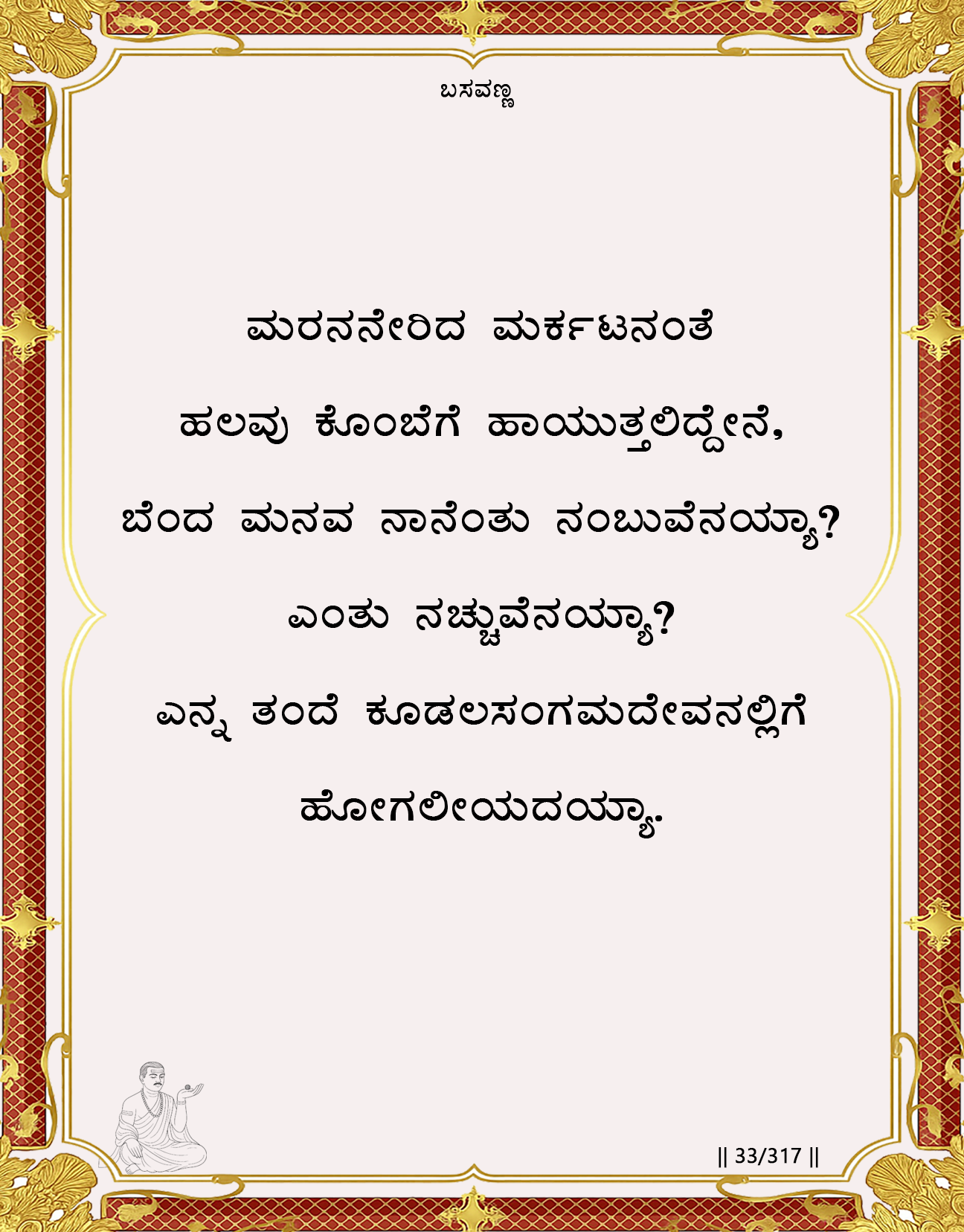
Like a monkey scrambling up a tree,
I leap from branch to branch
thought to thought, desire to desire.
This fierce, untamed mind of mine
how can I trust it?
How can I lean upon it?
For it won’t let me rest
even for a moment
in the presence of my own Maker,
O Kudalasangama Deva.
The Mind’s Restlessness and the Longing for Stillness In this vachana Basavanna reveals the raw human struggle with the restless mind. Through the image of a monkey jumping from branch to branch, he captures the ceaseless motion of thoughts, desires, and impulses. The metaphor is not merely descriptive it is diagnostic, showing how the mind’s instability undermines trust in its ability to guide spiritually. Basavanna neither demonizes the mind nor pretends mastery over it. Instead, he openly confesses its unreliability. This vulnerability is itself a teaching: self-honesty is the beginning of spiritual maturity. The restless mind prevents him from abiding in the stillness of divine presence. Yet this very recognition becomes a turning point because knowing the mind’s limits prepares the ground for surrender. The vachana reveals Basavanna’s core insight:
The mind cannot be conquered by force but only stilled by turning toward the divine center, where restlessness dissolves in grace. This is not a failure but the start of true devotion where human limitation becomes the doorway to divine refuge.
Spiritual Context
Core Spiritual Principle: Surrender Through Recognition of Incapacity (Aśakti Jñāna). Authentic spiritual progress begins not with the assertion of will to control the mind, but with the humble acknowledgment that the mind, in its ordinary state, is incapable of achieving the stillness required for union. This honest confession is the prerequisite for grace.
Cosmic Reality Perspective: This is a non-dual diagnosis of identification. The restless mind represents Shakti the dynamic power of consciousness when identified with the phenomenal world (the branches). Shiva is the silent, unmoving awareness (the tree trunk). The problem is not the energy itself, but the misidentification of the self with that energy’s scattered movements. The process of Koodalasangama is the reorientation of attention from the moving branches to the still trunk.
Historical Reality (Anubhava Mantapa Context): This vachana served as a great equalizer and source of solace within the Shivayoga community. By publicly confessing his own mental restlessness, Basavanna democratized the spiritual struggle, assuring every seeker that their internal battles were not signs of inadequacy but the shared raw material of the path. It fostered a culture of honesty over pretense, where communal support (satsangha) was valued as an antidote to individual mental chaos.
Interpretation
1. “Like a monkey scrambling up a tree, I leap from branch to branch thought to thought, desire to desire.” This describes the mechanics of egoic consciousness. The “monkey” (markaṭa) is the sense of “I” (ahaṃkāra) that identifies with each successive thought-wave (vṛtti). Each “branch” is an object of consciousness a memory, a worry, a fantasy. The leaping is the prāṇa (life force) entangled with and driven by these vṛttis, creating the experience of a scattered, restless self.
2. “This fierce, untamed mind of mine how can I trust it? How can I lean upon it?” This is the moment of discernment (viveka). Basavanna realizes that the instrument he has been using to seek truth (the mind) is itself the source of distortion. To “trust” or “lean upon” it would be to perpetuate the problem. This inquiry dismantles the default authority of the thinking mind.
3. “For it won’t let me rest even for a moment in the presence of my own Maker.” This reveals the core obstruction. The “presence” is ever-available, the ground of being. The mind’s compulsive activity creates a veil of noise, making the ever-present silence seem absent. The agony is not distance from God, but the inability to notice God due to self-generated interference.
Practical Implications: Practice shifts from “mind control” to “attention redirection.” The goal is not to stop the monkey from leaping, but to train it to leap toward and cling to a single, sacred “branch” the iṣṭalinga, a mantra, or the breath. The energy of the mind is not destroyed but harnessed through focus (ekāgratā).
The Cosmic Reality
Anga (Human Dimension): The Anga is the monkey-in-training. Its task is to observe the leaping without becoming the leaper, to cultivate the witness (sākṣī). Its maturity is measured by its ability to consciously return its attention to the Linga each time it notices it has been captured by a “branch.”
Linga (Divine Principle): Koodalasangama is the tree of awareness itself the stable, silent substratum that holds all the branches. It is not disturbed by the monkey’s activity. The Linga represents the ever-restful presence that is the seeker’s true nature, obscured only by the belief that one is the monkey.
Jangama (Dynamic Interaction): The Jangama is the trained monkey, the mind that has turned its leaping into a disciplined dance of devotion. It is also the living teacher who demonstrates a mind so utterly absorbed in the Linga that its movements are no longer random but are expressions of grace.
Shata Sthala
Primary Sthala: Bhakta. The state described is quintessential to the Bhakta stage, where devotion (bhakti) is often experienced as a turbulent longing (viraha) exacerbated by mental distraction. The Bhakta’s primary work is to purify the mind so it can become a fit vessel for love.
Supporting Sthala: Prasadi. The intense, uncomfortable awareness of one’s own mental chaos is a form of Prasadi the grace that illuminates the problem. This painful clarity is what forces the turning outward (to the Guru) and upward (to the Linga) for a solution that the egoic mind cannot provide.
Practical Integration
Arivu (Awareness Practices): Practice “Labeling the Leap.” During meditation, silently note “leaping” whenever the mind wanders. This creates a meta-awareness, reinforcing that you are the awareness watching the monkey, not the monkey itself.
Achara (Personal Discipline): Institute “Sacred Pauses.” Set regular timers throughout the day. When they chime, stop all activity for one minute. Let the mind leap, but do not follow it; simply feel the body breathing. This is practicing “rest in the presence.”
Kayaka (Sacred Action): Choose one daily activity as “Single-Branch Work.” Perform it with full attention, letting the task itself be the only “branch” the mind is allowed to cling to. This trains one-pointedness (ekāgratā) in action.
Dasoha (Communal Offering): In community gatherings, share struggles with mental restlessness without shame. Practice group meditation where the collective intention supports individual focus, creating a shared “tree” of silent support.
Modern Application
Hyper-Stimulation and Attention Fragmentation. The digital age has created a super-charged monkey, with endless “branches” (notifications, feeds, alerts) engineered to capture and fragment attention. This leads to chronic anxiety, decreased capacity for depth, and a profound alienation from inner stillness.
Digital Asces is as Spiritual Practice. The Basavayoga response is conscious, disciplined simplification. It means creating tech-free zones and times, not as austerity, but to provide the monkey-mind the space to exhaust itself and discover the tree beneath. It reframes mindfulness not as a productivity tool, but as the sacred act of returning home to the Linga-presence amidst the digital storm.
Essence
I mistook the dance of shadows
for the tree.
I wore myself out
chasing what was never lost.
Now, breath by breath,
I unclench my grasp.
Let the branches sway
I am learning
the patience of the trunk,
the silence that holds
all motion
within its endless calm.
This vachana describes the second law of thermodynamics applied to consciousness: the mind in its ordinary state tends toward entropy increasing disorder and scatteredness (the monkey’s random leaps). Spiritual practice is the application of negentropy (or negative entropy): the infusion of organizing energy (grace, focused attention) to create a coherent, low-entropy state (one-pointed devotion). The Linga is the negentropic pole, the attractor that draws chaotic mental energy into ordered patterns.
Your mind is like a room full of excited children (thoughts, impulses). Trying to silence them by shouting adds to the noise. Basavanna’s method is to bring in a captivating storyteller (the Linga). You don’t fight the children; you provide a single, compelling focus. Gradually, the chaos subsides as all attention converges on the story. The stillness was always available in the children’s capacity for rapt attention.
We are exhausted by our own minds. We believe peace is something we must achieve by winning a war against our thoughts. Basavanna offers the profound relief of surrender: peace is not the absence of the monkey, but the discovery of the tree. When we stop trying to be the monkey-tamer and instead become the tree the silent, supportive awareness the monkey naturally settles. Our deepest rest is found not in control, but in being the unmoved ground that can accommodate all movement.

Views: 2