Poetic Rendering

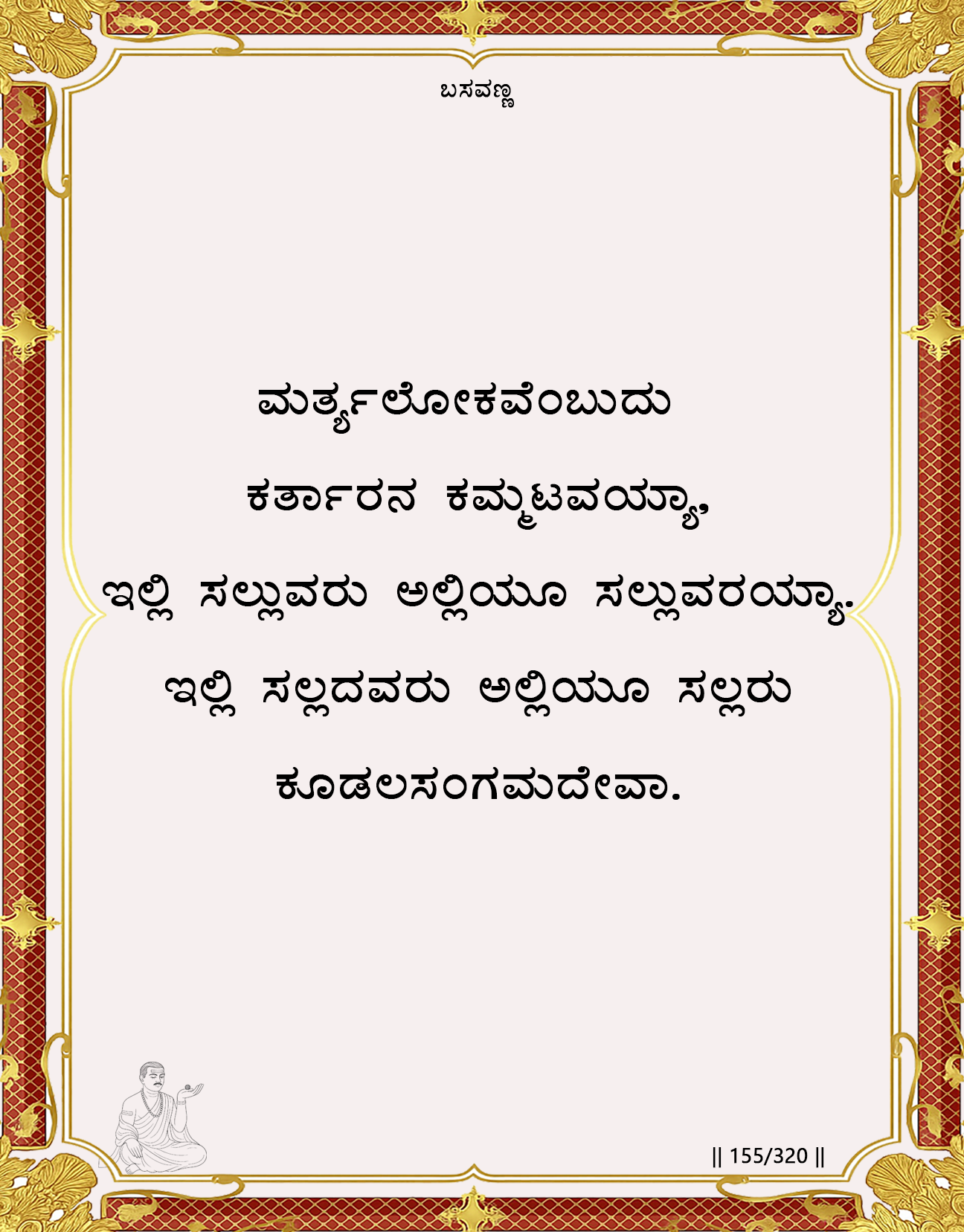
This world, O Lord, is Your workshop
the great forge of creation.
Those who fit rightly here
will fit rightly there as well;
those who falter here,
shall falter there too,
O Koodalasangama.
In this Vachana, Basavanna dismantles the false division between this world and the next, between earthly life and divine destiny. He proclaims that the path to liberation does not begin after death it begins here, in the very midst of life. This world itself is God’s sacred workshop (shilpashala), the training ground of the soul. This vachana represents Basavanna’s radical affirmation of the sacredness of earthly existence and the continuity of spiritual development beyond physical death. He demolishes the conventional religious dichotomy between this world and the next, revealing instead a single continuum of consciousness development.
The teaching presents the Way of Basava’s essential insight: spiritual realization is not an escape from the world but the fulfillment of our earthly existence. Basavanna redefines the world as God’s “workshop” not a place of exile or punishment but the very arena where divine qualities are forged through conscious living. This vachana embodies the essence of practical spirituality: the understanding that how we live now directly determines our capacity to experience divine reality.
Spiritual Context
Core Spiritual Principle: The Law of Ontological Continuity (Sādhanā-Siddhi Anubandha). Spiritual attainment (siddhi) is in unbroken continuity with spiritual practice (sādhana). The qualities of consciousness forged in the conditions of this world become the permanent structure of the soul. There is no discontinuity between the character built here and the state realized hereafter.
Cosmic Reality Perspective: This is a non-dual affirmation of the reality of manifestation. The world is not māyā (illusion) in the sense of being unreal or unimportant; it is the dynamic play (līlā) of Shiva-Shakti, the very workshop where Shakti (the power of manifestation) actively shapes consciousness. To reject the world is to reject the arena of divine activity. The goal is not to leave the workshop but to become a conscious co-creator within it.
Historical Reality (Anubhava Mantapa Context): This vachana was the philosophical bedrock for the social revolutionary ethic of Lingayoga. It countered the world-denying asceticism and ritualistic other-worldliness of orthodox paths. It empowered the Sharanas to engage fully in society, kayaka (work), and family life, seeing these not as distractions but as the primary locus of spiritual work. It justified their radical involvement in the world as the highest form of religious practice.
Interpretation
1. “This world, O Lord, is Your workshop the great forge of creation.” This is a re-sacralization of the mundane. “Workshop” implies purpose, utility, skill, and transformation. It is not a paradise of rest nor a valley of tears, but an active, purposeful environment. The “forge” specifically indicates a place of heat, pressure, and deliberate shaping where raw potential (the soul) is tempered into a finished, useful instrument.
2. “Those who fit rightly here will fit rightly there as well…” This establishes the principle of isomorphic development. “Fitting rightly” (sāru iru) means to be in harmonious, functional relationship with the environment. It implies adaptability, integrity, and skillful engagement. The “here” and “there” are not different in kind, but in degree of refinement. The capacity for harmony is a transferable skill of consciousness.
3. “…those who falter here, shall falter there too.” This states the inevitability of consequence. “Faltering” (sāru illadiru) means to be in a state of friction, dysfunction, and dissonance. A consciousness that cannot find peace, act ethically, or perceive unity amid the relative complexities of earthly life will be utterly unequipped for the absolute simplicity and intensity of pure divine presence. The workshop reveals our flaws so they may be mended; to ignore them is to carry a broken tool forever.
Practical Implications: There is no “spiritual life” separate from “daily life.” Every momenta work, in conflict, in joy, in service is a session in the workshop. Spiritual practice is the moment-to-moment effort to “fit rightly”: to respond with awareness instead of react with habit, to see unity instead of division, to act from compassion instead of selfishness. The quality of your attention and intention in the mundane is your spiritual resume.
The Cosmic Reality
Anga (Human Dimension): The Anga is the apprentice artisan. Its task is to learn the craft of conscious living. It must submit to the heat and hammer of life’s challenges, not to be destroyed, but to be shaped. It must study the Master’s design (the Linga) and strive to align its own form with it through continuous practice and correction.
Linga (Divine Principle): Koodalasangama is the Master Craftsman, the design, and the workshop’s purpose. The Linga is the ideal pattern of a perfectly realized being. It is also the intelligence operating the forge (the laws of karma, grace). The workshop exists to produce beings who reflect this pattern.
Jangama (Dynamic Flow): The Jangama is skilled craftsmanship in action. It is the lived expertise of one who has learned to “fit rightly” in every situation. A Jangama moves through the world as a master artisan, their every action beautifully functional, harmonious, and contributing to the workshop’s purpose. They are both the finished product and a living guide for other apprentices.
Shata Sthala
Primary Sthala: Bhakta. This is the essential orientation for the Bhakta. It answers the question, “Where do I practice?” The answer is: everywhere. It turns the Bhakta’s devotion from a sentiment into a practical discipline of fitting into God’s world with love and integrity.
Supporting Sthala: Sharana. To Sharana means to take refuge. This vachana clarifies that taking refuge does not mean leaving the workshop, but trusting the Master Craftsman completely within it. It is surrendering to the forging process itself, knowing it is for your ultimate perfection.
Practical Integration
Arivu (Awareness Practices): Practice “Workshop Awareness.” Throughout the day, mentally note: “This is the forge. This challenge is the heat. This interaction is the hammer. My awareness is the anvil.” See discomfort as purposeful tempering, not meaningless suffering.
Achara (Personal Discipline): Focus on “Fitting Rightly” in one specific role (as a parent, colleague, neighbor). Consciously work to bring harmony, honesty, and skillful action to that domain. Consider it your primary spiritual apprenticeship.
Kayaka (Sacred Action): See your job or daily duties as your assigned craft in the workshop. Perform it with the excellence, integrity, and dedication of an artisan offering work to the Master. The quality of the work is the offering.
Dasoha (Communal Offering): Help maintain the workshop. Contribute to creating a community (sangha) that functions as a supportive, truthful, and skillful training grounda microcosm of the “world workshop” where all can learn to fit rightly.
Modern Application
The Escapist Imagination and Deferred Life. Modern spirituality and consumer culture often sell fantasies of escape to a retreat, a paradise, a different life. This leads to a devaluation of the present and a passive waiting for some future transformation, creating existential discontent and disengagement.
Embodied, Practical Sanctification. The practice of Basavayoga is to sanctify the immediate. It is to approach your current city, job, relationships, and body as the only workshop you will ever have. It rejects the search for a “spiritual” life elsewhere and demands we build it here, with the materials at hand. It transforms existential angst into focused craftsmanship.
Essence
Do not ask for a different world.
This one, with all its grit and grace,
is the anvil chosen for you.
Every blow that seems to break you
is shaping your true form.
Learn to fit the space you’re given,
to strike when the iron is hot,
to cool in the water of patience.
For you are not being made
for some other, easier place.
You are being forged
to be the fitting place
for the Maker Himself.
This vachana describes consciousness evolution through the process of progressive adaptation within a complex system. The “world-workshop” is a dynamic, learning system (a universe) designed to produce agents (souls) capable of higher-order integration. “Fitting rightly” is achieving homeostasis and synergistic reciprocity with the entire system. The system’s “there” is its most coherent, unified state. An entity that cannot achieve coherence in the subsystem (“here”) lacks the organizational complexity required for integration into the super-system (“there”). Spiritual practice is iterative problem-solving within the system to increase one’s adaptive fitness for ultimate integration.
Imagine training for the Olympics (the ultimate “there”). Your daily life (the “here”) is your training gym, diet, sleep schedule, and practice matches. If you are lazy, unfit, and unskilled in your daily training, you will absolutely fail at the Olympics. No last-minute ticket gets you a medal. The Olympic stage merely reveals the fitness you built or failed to build in the gym of everyday life. Basavanna says the soul’s destiny works the same way.
We are haunted by the idea of a “second chance,” a clean slate elsewhere. This can make us irresponsible with our present chance. Basavanna removes this consolation. He says with terrifying and liberating clarity: This is it. This life is not a rehearsal; it is the performance that determines everything. Our eternal state is not awarded; it is earned or rather, built through the cumulative quality of our attention, intention, and action in the relentless, glorious, difficult workshop of the now. The call is not to escape our humanity, but to forge it into divinity.

Views: 12