Poetic Rendering
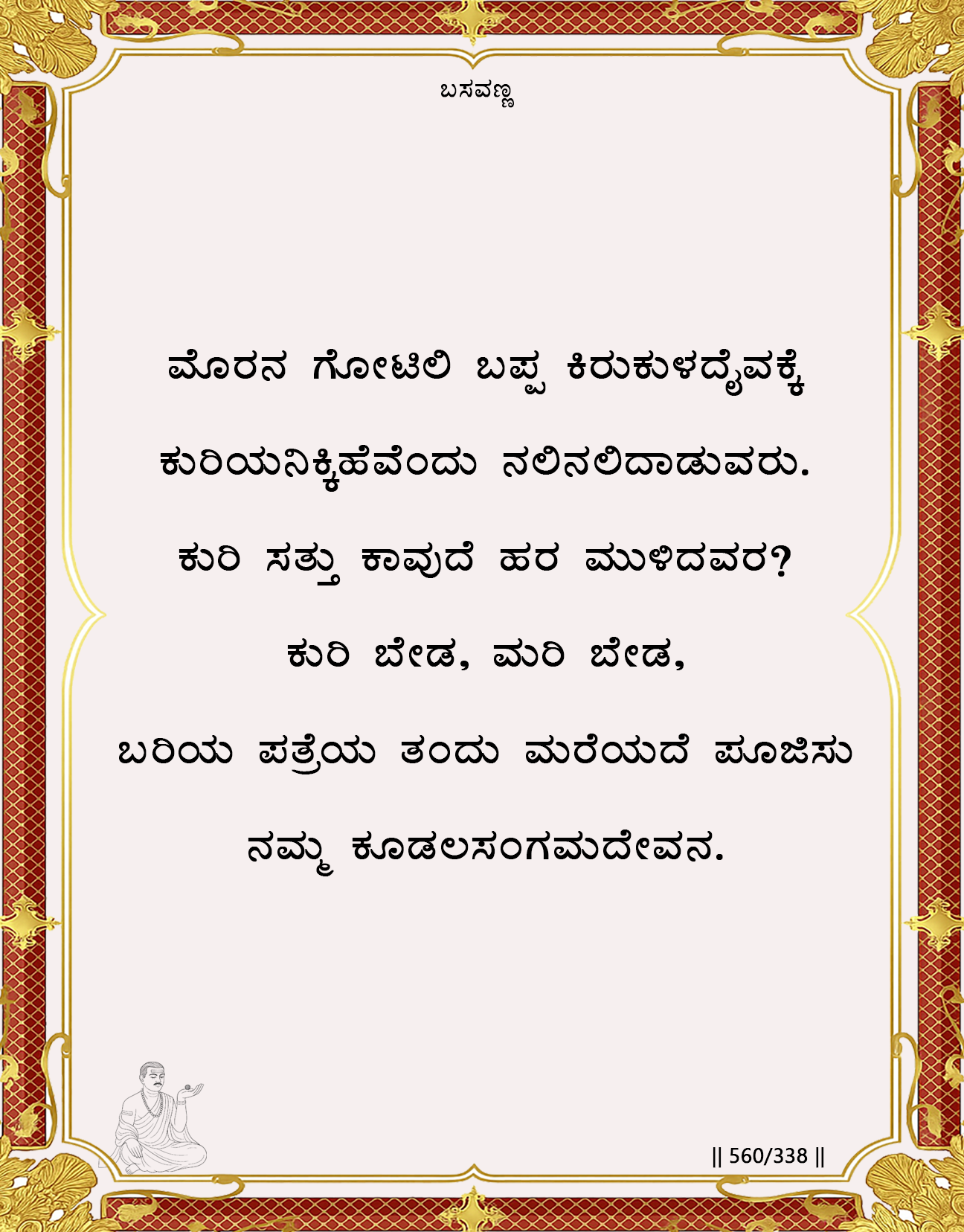
They promise worship
by slaughtering goats, lambs,
and gentle creatures
calling blood a holy gift.
But when the sheep dies,
what remains?
When life falls,
who is nourished?
What offering reaches You
through the cry of another?
No sacrifice,
no killing,
can feed the soul.
Offer instead a single bilva leaf
threefold, tender, stainless
placed with love,
free from harm,
born of remembrance alone.
Let this be worship,
O Kudalasangama Deva:
the hand unstained,
the heart awake.
The True Offering In this vachana, Basavanna dismantles the idea that devotion can be expressed through violence. He exposes the spiritual futility of animal sacrifice, asking what is truly gained when life is taken in the name of worship. Basavanna shifts the center of devotion from the outer ritual of killing to the inner act of remembering. A single, harmless bilva lea offered with sincerity carries more spiritual weight than a hundred sacrificial rites. The teaching establishes compassion as the foundation of true worship and reveals that the Divine responds not to bloodshed, but to awareness, gentleness, and heartfelt remembrance.
Spiritual Context
Core Spiritual Principle: Non-Violence as the Substance of Worship (Ahimsātmaka Upāsana). The highest offering is that which preserves and honors the flow of consciousness (cit) and life (jīva). To destroy life in the name of worshiping its Source is a fundamental ontological contradiction. True worship aligns with the creative sustaining pulse of the Divine, not its negation.
Cosmic Reality Perspective: This is a non-dual critique of sacrificial dualism. In the Shiva-Shakti continuum, all life is a manifestation of Shakti. Ritual sacrifice severs a strand of Shakti and offers it back to Shiva, perpetuating the illusion of separation. True worship, as symbolized by the tender leaf, is to offer Shakti back to Shiva in her living, vibrant form through appreciative awareness and conscious participation in the dance of creation, not through its interruption.
Historical Reality (Anubhava Mantapa Context): This was a frontal assault on the Vedic sacrificial (yajña) paradigm. Basavanna directly challenged the core Brahmanical ritual that legitimized social hierarchy and animal slaughter. He democratized worship by stating that the most accessible, humble offering leaf given with a pure heart was superior to the most elaborate, expensive, and violent priestly ritual. This redefined sacred authority around compassion rather than ritual expertise.
Interpretation
1. “They promise worship by slaughtering goats, lambs, and gentle creaturescalling blood a holy gift.” This identifies the confusion of violence for sanctity. The “promise” represents a transactional, fear-based relationship with the Divine. “Calling blood holy” is the tragic spiritualization of himsa (harm), sanctifying separation and death instead of unity and life.
2. “But when the sheep dies, what remains? When life falls, who is nourished?” This is the penetrating inquiry into causality and benefit. It exposes the emptiness of the sacrificial economy. The rhetorical questions reveal that the ritual consumes life but produces no spiritual nourishment; it only leaves a corpse and a burden of violence on the soul of the worshipper.
3. “What offering reaches You through the cry of another?” This question cuts to the heart of divine empathy. It implies that the Divine, as the source of all consciousness, resonates with the pain of the victim. An offering borne of suffering cannot reach a compassionate God; it can only echo in the hollow chamber of a hardened heart.
4. “Offer instead a single bilva leaf… placed with love, free from harm, born of remembrance alone.” This presents the positive, transformative alternative. The bilva leaf (sacred to Shiva) is a symbol of life, simplicity, and the threefold nature of reality (trimurti). The offering’s value lies not in the object but in the qualifiers: love (the emotion), free from harm (the ethics), and born of remembrance (the consciousness). This is worship as an integrated act of being.
Practical Implications: Spiritual practice must be audited for any trace of violence physical, verbal, or mental. The principle of ahimsa becomes the first criterion for any ritual. Worship is recentered in daily, mindful acts of gratitude, service, and silent remembrance.
The Cosmic Reality
Anga (Human Dimension): The Anga is the conscientious offeror. Its evolution is from being a “taker of life” to a “giver of awareness.” It must cultivate the sensitivity to see all life as inviolable and develop the creativity to express devotion through nurturing, protecting, and appreciating rather than destroying.
Linga (Divine Principle): Kudalasangama is life-in-itself, consciousness-itself. It does not “need” blood; it is the blood. It does not “demand” sacrifice; it is the sacredness inherent in every atom. To offer violence to life is to offer violence to the Linga’s own manifestation.
Jangama (Dynamic Interaction): The Jangama is compassion-in-motion. Their life is a continuous, harmless offering. They “sacrifice” their ego, their pride, their possessions in service, but never another being’s life. They are the living bridge between the human capacity for reverence and the divine principle of compassionate existence.
Shata Sthala
Primary Sthala: Bhakta. This vachana fundamentally reforms the practice of Bhakti. It shifts devotion from a realm of external ritual performance (which can include violent sacrifice) to a realm of inner intention characterized by love, harmlessness, and constant remembrance.
Supporting Sthala: Sharana. The state of Sharana taking refuge is here defined as taking refuge in a path of non-violence. To surrender to God is to surrender the violent, grasping ego. The harmless leaf offered with remembrance is the perfect symbol of this surrendered, refuge-seeking heart.
Practical Integration
Arivu (Awareness Practices): Practice “The Ethics of Offering.” Before any act considered an offering (prayer, charity, service), ask: “Does this arise from remembrance? Is it free from harm to any being? Does it express love?” Let this triage refine your actions.
Achara (Personal Discipline): Adopt a personal vow of non-violent offering. This could mean committing to a vegetarian diet as a spiritual practice, choosing ethically sourced puja items, or dedicating time to animal or environmental care as a form of worship.
Kayaka (Sacred Action): Let your work be an “offering of sustenance, not destruction.” In your profession, seek ways to create, heal, educate, or nourish. Consciously reject roles or methods that cause unnecessary harm, viewing your labor as a daily bilva leaf placed on the altar of the world.
Dasoha (Communal Offering): Build community practices around seva (selfless service) that actively repair harm and nourish life feeding the hungry, caring for animals, cleaning environments. Make these acts your collective yajña (sacrifice), where the ego is offered up for the benefit of all.
Modern Application
The Sacrificial Economy of Exploitation. Our global system is built on modern “sacrifices”: environmental destruction for profit, animal cruelty for consumption, and psychological violence for social media engagement. We worship progress, wealth, and convenience, offering the “blood” of ecosystems, ethical integrity, and mental peace on their altars.
Cultivating an Ecology of Reverence. The practice of Lingayoga today is to become a conscientious objector to this economy of sacrifice. It means making consumer, career, and lifestyle choices that minimize harm. It transforms activism into worship and conscious living into the primary offering. It is to see every purchase, every vote, every interaction as a potential “bilva leaf” of remembrance or an unconscious act of “slaughter.”
Essence
They built altars of stone,
lit fires to consume
the breath of the innocent,
calling the smoke a prayer.
They traded life for favor,
blood for blessing,
and wondered why the heavens stayed silent,
filled only with echoes of crying.
Then came the whisper:
Lay down the knife.
The offering God seeks
is not what you can kill,
but what you can love.
Pluck not a life, but a leaf.
Bring not an end, but awareness.
For the gift that crosses the infinite
is the one that carries no stain,
the one given not from a flock,
but from the flock’s keeper’s heart.
This vachana performs a systemic transfer of value from the symbolic/object level to the consciousness/relational level. In sacrificial ritual, value is mistakenly located in the object (the life of the goat) and its destruction. Basavanna relocates value entirely to the subject (the state of the offeror’s consciousness: love, harmlessness, remembrance). The leaf is not valuable in itself; it is a pointer to the quality of mind behind it. This is a fundamental repatterning of the spiritual economy from one of scarcity and exchange (a life for a boon) to one of abundance and expression (consciousness expressing its innate qualities of love and reverence).
Imagine two people trying to communicate their love for a great artist. One burns the artist’s own paintings, saying, “I offer you the sacrifice of your work to show my devotion.” The other carefully studies a single brushstroke, understands its beauty, and is inspired to create a simple, heartfelt poem. The first is sacrifice; it destroys the very thing it claims to honor. The second is true offering; it receives, understands, and gives back in a new, non-destructive form. Basavanna says God is the ultimate Artist; don’t burn His creation. Understand it, love it, and offer back the poetry of a compassionate life.
Violence often arises from a sense of lack and desperation we sacrifice something precious because we believe we must pay for what we need. This vachana reveals that the Divine operates on a logic of grace, not transaction. Our feeling of lack is healed not by paying a price through another’s suffering, but by awakening to the abundant, sacred reality already present. The “cry of the other” that reaches God is not an acceptable prayer; it is an indictment of the worshipper’s ignorance. The path forward is to still that cry, both within and without, and from that silence, offer the simple, undeniable truth of a heart that has chosen to remember, to love, and to cease causing harm. “A single green leaf offered in love is worth more than all the gold of kings.”

Views: 17