Poetic Rendering

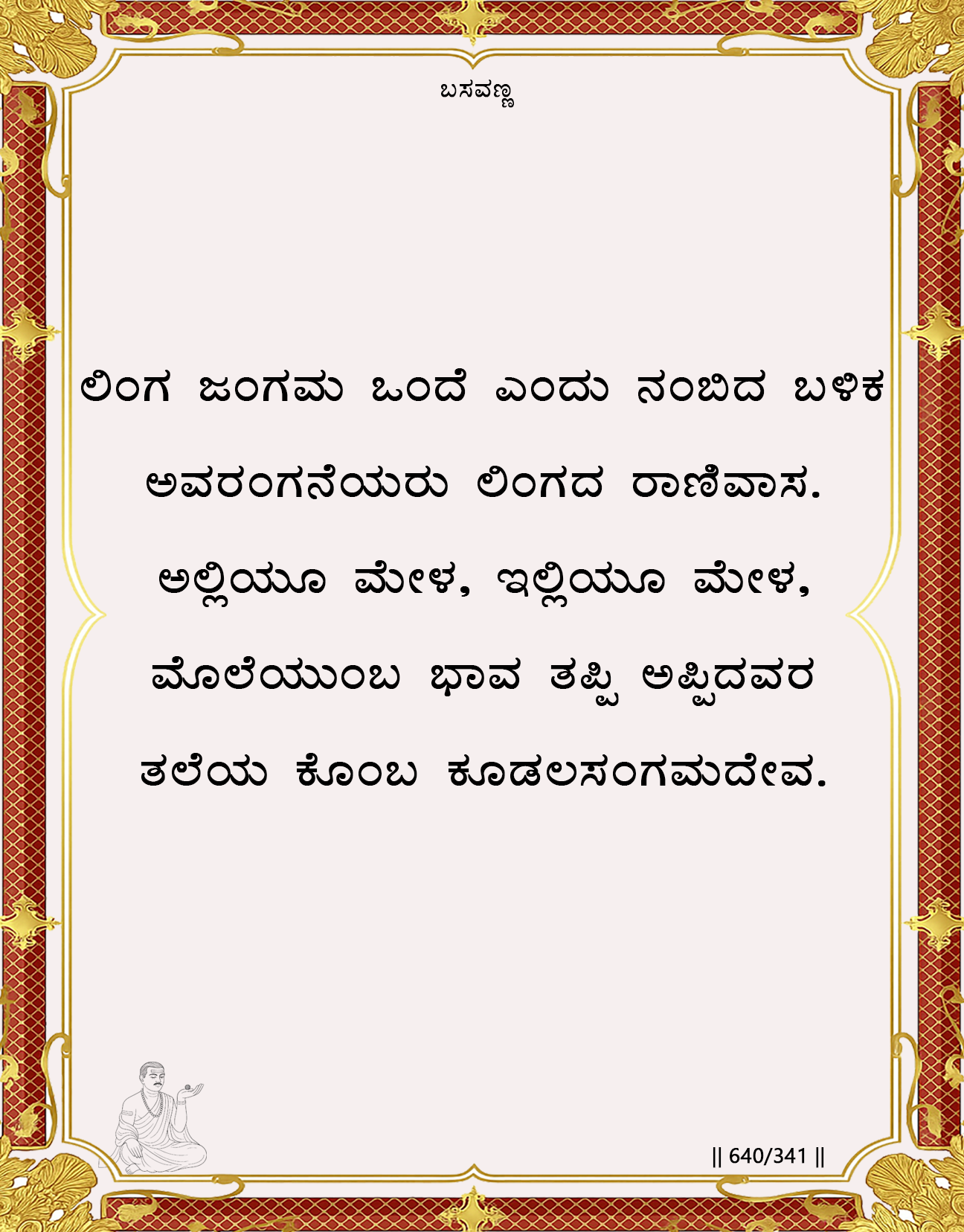
When Linga and Jangama
are known as one
not believed,
but realized in the marrow
how can one fail to see
that this very body
is the palace of the Linga?
Within and without,
in breath and in stillness,
the two are never two.
Is this some festival of Chowdeshwari,
a passing celebration
raised for a day and emptied the next?
If ever one imagines himself higher,
holier,
or greater than the other
if pride casts even a shadow
between Linga and Jangama
then know:
that very head
is claimed by Kudalasangama Deva.
This vachana asserts Basavanna’s core teaching: Linga and Jangama are inseparably one. The Divine (Linga) and the realized devotee (Jangama) are not two different entities but two expressions of the same presence. Basavanna declares: When this unity is realized, the body becomes the temple, not a structure of stone nor a festival ground built for a momentary ritual. The reference to the Chowdeshwari festival (Known as Adi Parashakti – The supreme goddess) criticizes spirituality that becomes event-based, temporary, or external. The union of Linga and Jangama is not a spectacle but an inner, continuous realization. Hierarchy has no place in this sacred unity. If one claims superioritywhether by knowledge, role, or status it is a betrayal of the very foundation of devotion. Thus, Basavanna warns: the ego that creates division destroys the spiritual seeker, for the Divine union tolerates no pride. Kudalasangama’s grace flows only where equality and oneness abide.
Spiritual Context
Core Spiritual Principle: Non-Dual Embodiment (Advaita Sākṣātkāra). The final realization is not of a transcendent God apart from creation, but of God as the very substance and activity of the apparent other especially the realized being (Jangama). The distinction between source (Linga) and expression (Jangama) collapses in direct experience.
Cosmic Reality Perspective: This is the culmination of Shiva-Shakti non-duality. Linga is Shiva (pure, static consciousness). Jangama is Shakti (dynamic, conscious energy in motion). To say they are one is to say that energy is consciousness moving, and consciousness is energy aware of itself. The “body as palace” means the entire manifest universe (Shakti’s play) is the abode and self-expression of Shiva.
Historical Reality (Anubhava Mantapa Context): This was the ultimate theological safeguard against guru-worship and clerical hierarchy. By declaring Linga and Jangama non-different, Basavanna ensured that reverence for a teacher (Jangama) never devolved into treating them as a separate object of worship. The Jangama was to be revered as the Linga made visible, not as an intermediary. This prevented the rise of a priestly class and kept the community’s focus on direct, embodied realization in everyone.
Interpretation
1. “When Linga and Jangama are known as onenot believed, but realized in the marrowhow can one fail to see that this very body is the palace of the Linga?” This moves from doctrine to ontology. Intellectual belief (śraddhā) is replaced by bone-deep realization (anubhava). This realization automatically recontextualizes the physical form. The body is no longer a disposable vehicle or a sinful obstacle; it is the royal residence (gÁtÂ) of the sovereign consciousness.
2. “Within and without, in breath and in stillness, the two are never two.” This eradicates spatial and temporal separation. “Within” (subjective experience) and “without” (objective world), “breath” (dynamic life) and “stillness” (pure being)these are all false dichotomies seen from the unified perspective. The non-duality is total and operational in all states.
3. “Is this some festival of Chowdeshwari, a passing celebration raised for a day and emptied the next?” This contrasts eternal truth with temporary ritual. The festival (utsava) is a socially constructed event of limited duration. It symbolizes a spirituality based on external observance, emotional peaks, and communal fervor that fades. True realization is not an event; it is the permanent ground of being.
4. “If ever one imagines himself higher, holier, or greater than the other… that very head is claimed by Kudalasangama Deva.” This is the cosmic law of egoic reclamation. The “head” symbolizes the seat of individual thought and pride. To assert hierarchy (“higher, holier”) is to reify separation, committing treason against the realized unity. The consequence is not petty punishment but a profound spiritual truth: the separate self that arrogates superiority is “claimed” that is, dissolved or subsumed back into the divine unity it has denied. It is the natural consequence of violating the fundamental law of oneness.
Practical Implications: Spiritual practice matures into simply abiding in the recognition of this unity in all interactions, especially with teachers and fellow seekers. It involves vigilantly watching for the subtlest emergence of spiritual pride or comparative judgment.
The Cosmic Reality
Anga (Human Dimension): The Anga is the palace realizing its own royalty. Its task is to clean the halls (purify perception) not for a future guest, but to recognize that the King (Linga) is both the resident and the very stones of the palace.
Linga (Divine Principle): Kudalasangama is the unity itself. It is the non-dual reality of Linga-Jangama. It is the principle that “claims the head” of arrogance not as an angry god, but as the gravity of truth pulling the illusion of separateness back into the singularity.
Jangama (Dynamic Interaction): The Jangama is the lived proof of this claim. They do not teach non-duality; they are the teaching. In their presence, hierarchy dissolves. You cannot worship them as separate; you can only recognize the Linga shining through them, which is the same Linga shining in you, awaiting your recognition.
Shata Sthala
Primary Sthala: Aikya. The entire vachana describes the perspective and peril of Aikya. The realization of non-duality is the state. The warning against pride is the safeguard for maintaining it.
Supporting Sthala: Maheshwara. The vision of the body as the divine palace is the expansive sight of the Maheshwara, which finds its fullest consummation in the non-dual identity of Aikya.
Practical Integration
Arivu (Awareness Practices): Practice “Seeing the Linga in the Jangama.” When in the presence of someone you respect or learn from, consciously look through their personal form to the conscious presence animating them. Then recognize it as the same presence within you. This collapses projected hierarchy.
Achara (Personal Discipline): Undertake a “Vow of Equal Regard.” Consciously treat all interactions with a stranger, a family member, or a teacher as meetings with the one Divine consciousness in different forms. Let your respect be for the indwelling presence, not the outer role.
Kayaka (Sacred Action): Let your work be an offering from the palace to the palace. See your labor as the Linga (the source) expressing itself as Jangama (dynamic action) to serve and maintain the world (the larger palace of the Linga).
Dasoha (Communal Offering): Foster a community culture of “Non-Hierarchical Sangha.” Rotate leadership, share teachings in circle formats, and actively discourage titles or behaviors that create spiritual rank. Let the community itself be a collective Jangama, embodying the unity it proclaims.
Modern Application
The Spiritual Marketplace and Guru Culture. Modern seekers often shop for gurus, creating hierarchies of “enlightenment,” comparing teachers, and seeking specialness through association. Social media amplifies this, creating spiritual celebrities and fostering subtle (or overt) pride in one’s path, teacher, or attainments. Spirituality becomes another identity to be curated and ranked.
Cultivating Sacred Equality. The practice of Lingayoga today is to inoculate oneself against this marketplace mentality. It means respecting teachers while refusing to pedestal them. It involves seeing your own daily, humble awareness as no less sacred than the guru’s. It transforms community from a pyramid with a guru at the top into a circle where each person is a unique window to the same light. Any feeling of being “higher” or “holier” is instantly recognized as the poison of separation.
Essence
You built altars of stone,
appointed priests of the word,
and called the echo in the temple
the voice of God.
I found the altar in my breath,
the priest in my own wakeful heart,
and the voice silent,
speaking everything.
Do not come to me with ranks and titles,
measuring whose flame burns brighter.
In this sky, all fires are one sun.
The moment you point and say “that light, not mine,”
you are left pointing in the dark,
and the sun you denied
claims the very finger that excluded it.
This vachana articulates the holographic singularity principle. In a hologram, every fragment contains the information of the whole. The Linga is the whole; the Jangama is a fragment that perfectly encodes the whole. The realization of their non-difference is the fragment becoming conscious of itself as the whole pattern. The “body as palace” is the fragment recognizing its own structure as the architecture of the whole. Hierarchy is the error of one fragment believing it contains a “more whole” pattern than another. The system’s integrity (Kudalasangama) automatically corrects this error by reabsorbing the deluded fragment’s sense of separate identity (“claims the head”) back into the coherent field.
Imagine an ocean (Linga) and a wave (Jangama). The wave is not part of the ocean; it is the ocean, temporarily appearing as a wave. A wave that boasts, “I am taller and more magnificent than that other wave!” is suffering from a temporary identity crisis. The moment it truly understands it is water, the boasting ceases. If it persists in its arrogance, the very force that lets it peak (the ocean’s energy) will simply dissolve it back into the sea. Basavanna says: you are not a soul seeking an ocean. You are the ocean, momentarily experiencing itself as a wave. Stop comparing waveforms. Realize you are water.
The ego’s final and most subtle fortress is spiritual superiority. After relinquishing material attachments, it can attach to the identity of being “a seeker,” “a devotee,” or “close to the guru.” This vachana demolishes that last fortress. It states that the ultimate truth is not merely egalitarian but identical. The peace we seek is found not in becoming the greatest devotee, but in ceasing to be a devotee altogether and simply being the worshipped. The terror of this loss of spiritual identity is the final barrier. But in crossing it, one finds not annihilation, but the end of all seeking the Stillness where Linga and Jangama are known, without a knower between them, to be one. Basavanna’s Cosmic Vision Where Unity Transcends Difference A Spiritual Ecology of Equality and Grace.

Views: 12