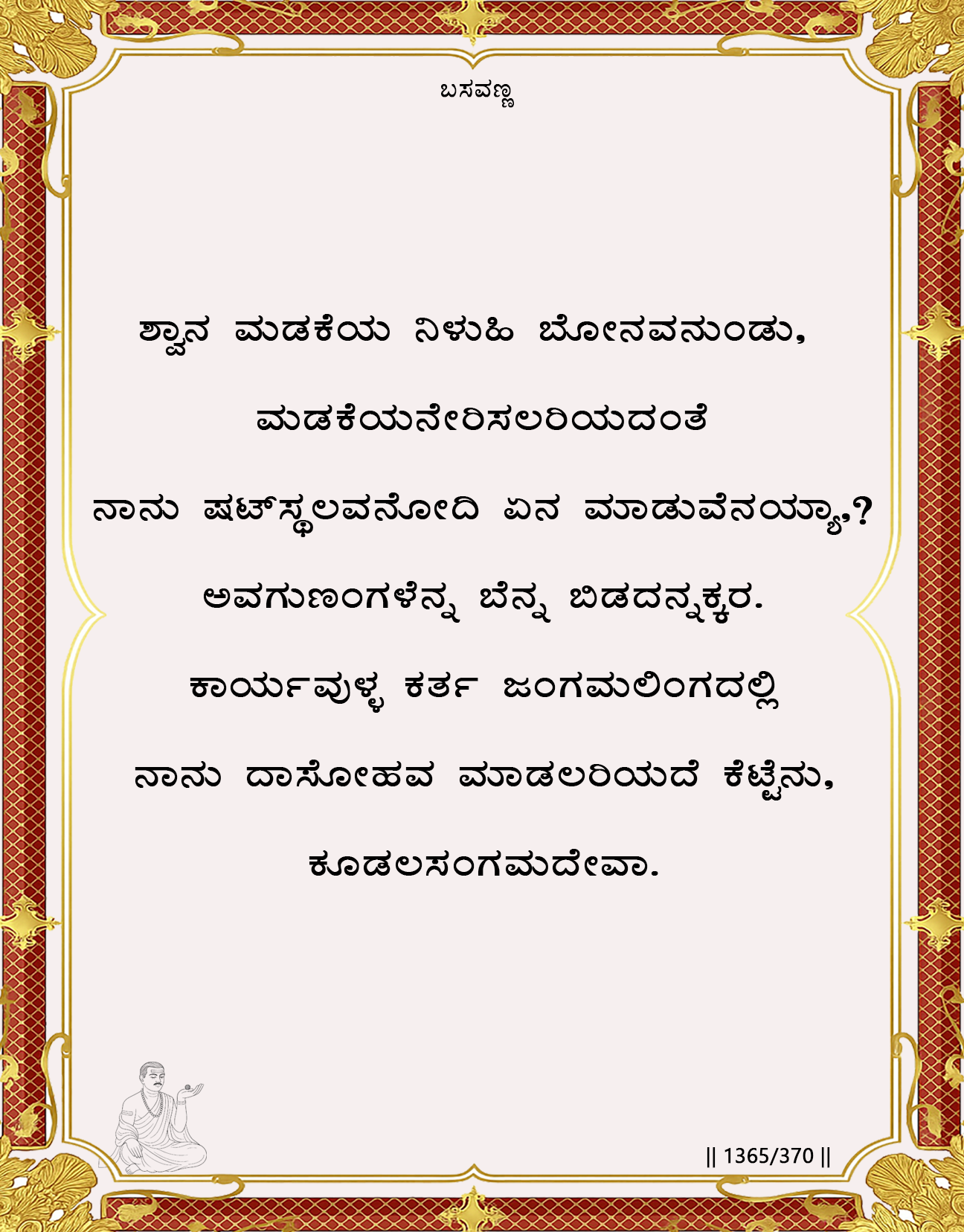
Poetic Rendering
Like a dog that licks from a cooking pot but cannot lift it back to its place,
so am II may recite the Shatsthala, but what have I truly done?
My inner faults still cling to me.
If I do not perform the sacred service,
the dāsoha,
in the living presence of the Jangama-Linga,
then I am utterly lost, O Kudalasangama!
The Pot-Licker’s Confession: When Knowledge Fails to Transform This vachana represents Basavanna’s profound confession about the ultimate spiritual danger: the gap between theoretical knowledge and lived transformation. Using the powerful metaphor of a dog licking from a pot it cannot properly handle, he exposes how even the most sophisticated spiritual understanding remains impotent if it doesn’t translate into embodied practice. The teaching establishes that spiritual knowledge must culminate in dāsoha selfless service to the living divine or it becomes another form of egoic accumulation that leaves the essential self unchanged.
Spiritual Context
Core Spiritual Principle: Embodiment is the Only True Knowledge. Intellectual understanding (jnana) is merely the blueprint; the building of the spiritual life (jivan) happens only through the labor of selfless action (kriya). Wisdom (viveka) is validated not by articulation but by transformation.
Cosmic Reality Perspective (non-dual, Shiva-Shakti dynamics): In non-duality, Shiva (Pure Consciousness/Knowledge) and Shakti (Dynamic Creative Power/Action) are one. To possess one without expressing the other is an impossibility in the cosmic reality, but a persistent delusion in the human mind. This vachana diagnoses that delusion: the attempt to have Shiva (knowledge of Shatsthala) without fully engaging Shakti (dāsoha). The integration occurs when knowledge flows as action, making the Anga a conduit for the unified Shiva-Shakti.
Historical Reality (Anubhava Mantapa context): This was a necessary corrective within the revolutionary community itself. It prevented the Lingayoga movement from degenerating into a new scholasticism or empty orthodoxy. It ensured that the radical theology of the Anubhava Mantapa was never separated from the radical ethics of kayaka and dāsoha, grounding enlightenment in social responsibility and humility.
Interpretation
1.”Like a dog that licks from a cooking pot…”: The “cooking pot” symbolizes the complete, nourishing spiritual tradition (Sampradaya). “Licking” represents extracting personal sweetness (intellectual insight, spiritual comfort) without assuming the responsibility for the whole. The inability to “lift it back” signifies a lack of mastery and the power to engage with the tradition creatively and responsibly for the community’s benefit.
2.”I may recite the Shatsthala, but what have I truly done?”: This exposes knowledge as a potential idol. Recitation is a mental activity that can inflate the ego (“I know the path”), creating a spiritual persona that masks stagnation. “Done” shifts the criterion from mental accumulation to causal action in the world.
3.”My inner faults still cling to me.”: This is the empirical proof of failed knowledge. Faults (dosha) like pride, hypocrisy, and attachment are energies rooted in the life-force (prana). They cannot be dissolved by mind-alone; they require the friction and self-forgetfulness of engaged action.
4.”If I do not perform the sacred service… in the living presence of the Jangama-Linga…”: Dāsoha is the alchemical fire. Serving the “living presence” means encountering the Divine in the dynamic, immediate, and often challenging human context (the Jangama). This burns away the subtle ego sustained by theoretical piety.
Practical Implications: It demands a ruthless audit: “Does my spiritual practice change my character and actions?” It prioritizes humble service over scholarly display. The seeker learns that the most advanced practice might be the simplest act of service performed with complete self-abandonment.
The Cosmic Reality
Anga (Human Dimension): The Anga here is in a state of cognitive dissonance its knowing and being are misaligned. It is a field of conflict between the elevated self-image as a “knower” and the felt reality of persistent flaws. This tension is the catalyst for the next step.
Linga (Divine Principle): The Linga, as Kudalasangamadeva, is truth itself. It cannot be contained by or satisfied with recitation. It demands congruence. It is the principle of integrity that makes the gap between knowledge and action painfully apparent, thus acting as a gracious goad toward authenticity.
Jangama (Dynamic Interaction): The Jangama is the flow from this painful confession into the redeeming act of dāsoha. It is the movement from the closed circuit of self-examination to the open circuit of self-offering. In serving the Jangama (the moving divine), the stagnant “knower” self is dissolved in the activity of relating and giving.
Shata Sthala
Primary Sthala: Bhakta. The vachana is a portrait of the Bhakta confronting the inherent limitation of devotion based on personal relationship and acquisition (even of knowledge). The Bhakta loves God, but the ego still uses that love for its own sustenance. The crisis described is the sign that this stage has matured and must be transcended.
Supporting Sthala: Sharana. The way out is the hallmark of the Sharana: total surrender through active service. The Sharana does not just hold knowledge; they are used by the knowledge. Their identity shifts from “one who knows” to “one through whom service flows.” Dāsoha is the bridge from Bhakta to Sharana.
Practical Integration
Arivu (Awareness Practices): Cultivate the awareness to detect when you are “licking the pot” using spiritual ideas for intellectual pleasure, debate, or ego-inflation. Notice the subtle pride in “knowing.”
Achara (Personal Discipline): Institute the discipline of “closing the gap.” For every spiritual concept you understand (e.g., non-duality, compassion), immediately devise a concrete, humble action that embodies it. Let action be the test of understanding.
Kayaka (Sacred Action): Let your daily labor (kayaka) be the primary arena for practicing dāsoha. Offer the work itself, especially its tedious or challenging aspects, as service to the divine presence inherent in the world it serves.
Dasoha (Communal Offering): Actively seek opportunities to serve the community (Sangha) in ways that demand no recognition, particularly tasks that feel beneath your perceived spiritual station. This actively dismantles the “pot-licker” mentality.
Modern Application
“Spiritual Bypassing” and “Information Obesity.” The modern seeker often confuses consuming spiritual content (podcasts, books, workshops) with actual practice. This creates a well-informed but unchanged self, leading to a sense of hollow sophistication and disillusionment. We collect maps but refuse to take the journey.
This vachana liberates us from the tyranny of endless spiritual consumption. It directs our energy from accumulation to application. The cure for spiritual bypassing is to take our profoundest insight and immediately use it to perform a concrete, kind, or necessary act for someone else, anonymously. True growth is measured in increased capacity for selfless responsibility, not in the sophistication of our concepts.
Essence
A learned tongue, a map of the stars above,
Yet still a slave to the faults I claim to disprove.
Like a dog at the feast, I take but cannot give,
In this theoretical life I pretend to live.
The pot is heavy with the truth I sip,
Until I lift it to another’s lip.
Only then, in the grace of the serving hand,
Will I begin to understand.
This vachana illustrates the metaphysical law of participatory realization. Consciousness (knowledge) and energy (action) are a quantum-entangled pair. Observing/reciting (knowledge) collapses only one potentiality of reality, creating a partial, subjective state. Full collapse into manifest reality requires the complementary act of participation (service). The “inner faults” are standing waves in the subjective field that can only be dissipated by engaging the objective field through dāsoha.
Imagine learning every fact about swimming from a book buoyancy, strokes, theory. You can recite it all perfectly. But until you jump into the water and start moving, you will drown, and your fear of water (the “inner fault”) will remain. The book knowledge is essential, but the water is where you truly learn to swim. Dāsoha is the water.
We all use knowledge as a defense a fortress of ideas to protect us from the vulnerability and risk of real engagement. This vachana speaks to the universal fear that our deepest understanding might not survive contact with reality. It calls us out of the fortress, promising that it is only in the messy, humble act of service that our knowledge becomes real, our faults are washed away, and we finally stop being spectators of the divine and become participants.

Views: 4