

Summary
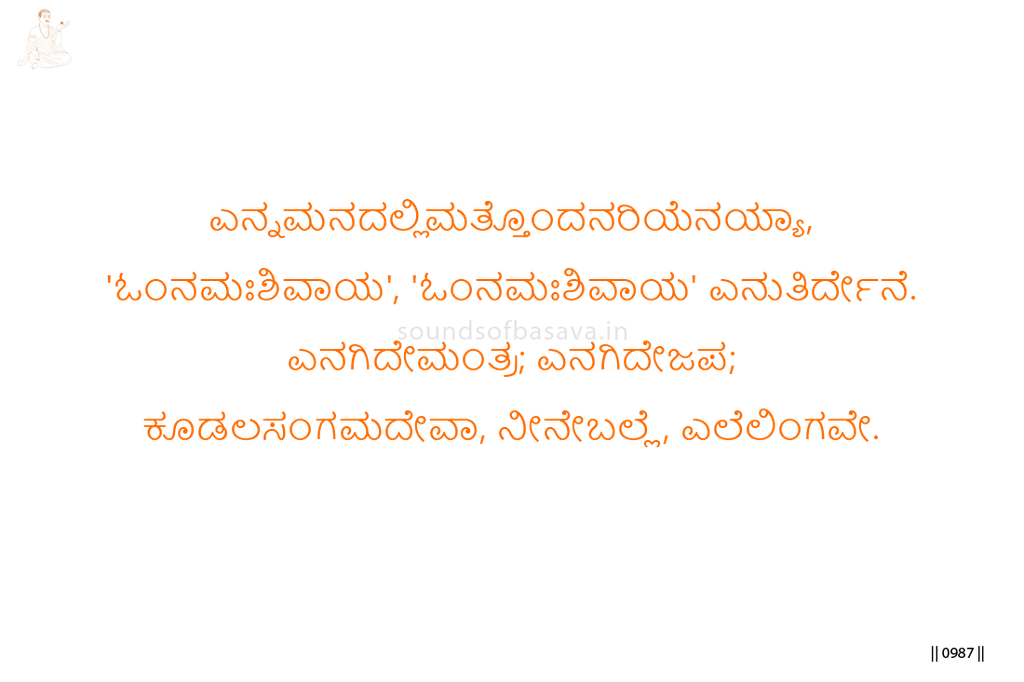
Basavanna speaks from a mind in which no second reliance remains. He says that he knows no other within his mind. The statement is not a rejection of others as objects; it is the absence of divided refuge within awareness.
The mantra “Om Namah Shivaya” is then identified as both mantra and japa. The source states that mantra and repetition are not separate acts here: the Name itself is japa, and japa itself becomes absorption. Practice and practitioner are no longer held apart.
The vachana closes by surrendering even the claim to know. Basavanna says that Kudalasangama Deva alone knows, and that He alone is the Linga. The Aikya teaching is complete inward unification: no second support, no separate ownership of remembrance, and no division between the Name, the act of remembrance, and the Linga.
Imagery & Symbolic Relevance
The line “in my mind I know no other” gives the first movement of the vachana. The mind is no longer moving between different supports. The source explains this as the end of inner division, where the mind no longer oscillates between refuges.
The repeated “Om Namah Shivaya, Om Namah Shivaya” gives the central sound-image. The repetition is not decorative. It shows that the Name has become the continuous movement of inward remembrance.
The statement “this is my mantra” identifies the Name as the sacred utterance held by the speaker. Basavanna does not multiply mantras or supports. The Name alone is sufficient within the mind that knows no other.
The statement “this is my japa” deepens the same image. Mantra and japa are not separated into formula and practice. The source states that “mantra” and “japa” collapse into one continuous movement of awareness.
The address to Kudalasangama Deva turns the whole inward state toward the Lord. Basavanna does not present remembrance as self-owned achievement. He places the condition before Kudalasangama Deva.
The statement “You alone know” marks the surrender of personal authorship. Even the act of remembering is not claimed as belonging to the separate self. The source directly states that this line marks the dissolution of personal authorship, where even remembrance is not claimed.
The closing address, “O Linga,” completes the vachana. The speaker does not treat Linga as one object among many. The source explains that “You alone are the Linga” reveals the recognition that the object of worship, the act of worship, and the awareness that knows are not separate.
Together, the lines move from inward undividedness, to continuous Name, to surrendered knowing, and finally to the recognition of Linga alone.
Lingayoga
In Lingayoga, this vachana teaches that remembrance must not be claimed as personal possession. The source states that the seeker does not claim ownership over remembrance, and that the impulse to chant, the movement of breath, and the continuity of awareness are recognized as arising within the Divine.
The practice-point is simple: let the Name remain the sole inward refuge. Do not separate mantra from japa, or remembrance from Kudalasangama Deva. When “You alone know” becomes true, even the claim “I remember” is surrendered.
Editorial Commentary
This vachana should be read as yielded awareness, not as verbal repetition alone. Basavanna does not merely say the Name; he rests in the Name as the only inward support. The final force of the vachana lies in the surrender of ownership: Kudalasangama Deva alone knows, and He alone is the Linga.
Related Vachana
Supporting Vachana
Sharana Sthala Vachana 79 — Refuge in the Name Alone
In Sharana Vachana 79, Basavanna asks whether “Om Namah Shivaya” taken as refuge is not enough to loosen the bondage of becoming and wrongdoing. He then repeats the names of Shiva and takes refuge again in Kudalasangama Deva for the removal of transgression. Vachana 80 carries this Sharana refuge into Aikya: what is taken as refuge in Vachana 79 becomes the state of no other refuge in Vachana 80.
Advancing Vachana
Aikya Sthala Vachana 81 — Beyond All Scripture, the Name Stands
Aikya Vachana 81 advances this teaching within Aikya Sthala itself. In Vachana 80, the Name is the only mantra and japa within the undivided mind. In Vachana 81, that same Name is shown as standing beyond Veda, Shastra, and reasoning. The source states that “Om Namah Shivaya” is not merely one practice among many, but the direct axis of awareness that surpasses conceptual structures. Thus the inward exclusiveness of Vachana 80 deepens into Vachana 81, where the Name stands beyond all mediated knowledge before Kudalasangama Deva.
