

Summary
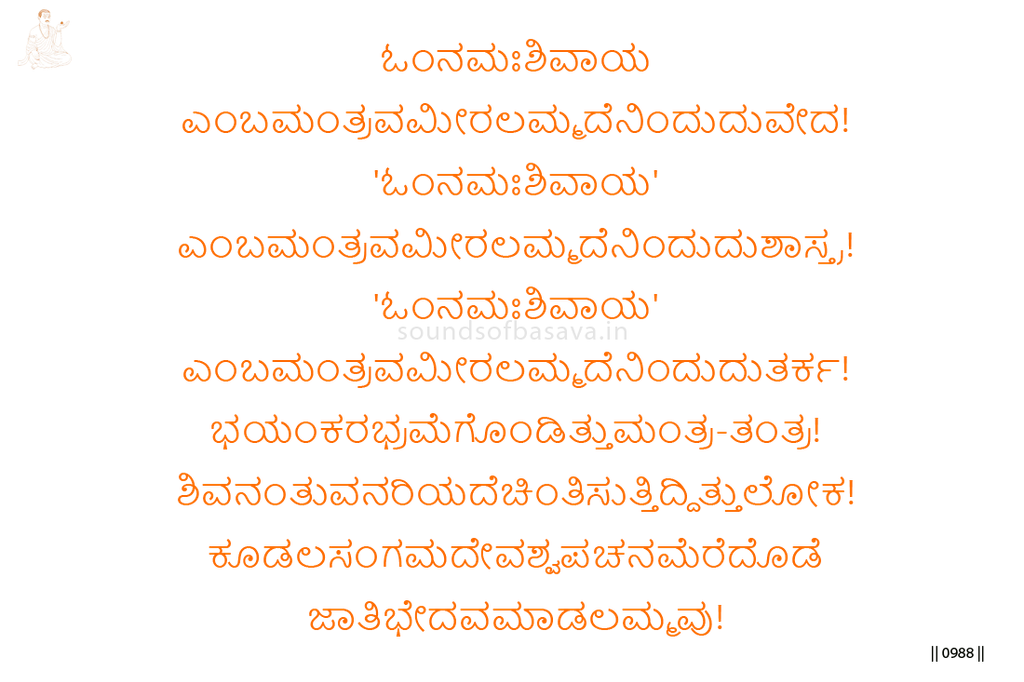
Basavanna places “Om Namah Shivaya” above Veda, Shastra, and argument. The teaching does not reject sacred knowledge, scripture, or reasoning as false; it shows that none of them can stand above living remembrance of the Name.
The vachana then warns that mantra and tantra, when caught in delusion and separated from knowing Shiva, become wandering forms rather than realized practice. The source states that the Name is not merely one practice among many, but the direct axis of awareness that surpasses conceptual structures.
The final movement turns from spiritual authority to social division. If even one considered lowly utters and joins in the same Name, caste distinction cannot stand. Basavanna’s point is direct: where the Name is alive, knowledge is fulfilled and constructed hierarchy loses its authority before Kudalasangama Deva.
Imagery & Symbolic Relevance
The first line places “Om Namah Shivaya” before the Veda. Veda represents sacred revealed knowledge. Basavanna asks what Veda can stand beyond the mantra. The image is not of rejection, but of measure: direct remembrance is placed higher than mediated knowledge.
The second line places “Om Namah Shivaya” before Shastra. Shastra represents codified teaching and scriptural explanation. Basavanna again asks what can stand beyond the mantra, showing that explanation cannot exceed living remembrance.
The third line places “Om Namah Shivaya” before tarka, or argument. Reasoning has its place, but Basavanna does not allow argument to become greater than the Name. The repeated structure gives force to the teaching: Veda, Shastra, and reasoning are all placed below direct remembrance.
The phrase “mantra-tantra caught in fearful delusion” gives the next image. Basavanna now turns from true mantra to empty or deluded practice. Mantra and tantra may become confused when they do not lead to knowing Shiva.
The phrase “without knowing Shiva” gives the criterion. Sacred sound and method are not sufficient when they remain external. The source explains that practices emptied of inward absorption become deluded, because sound and method remain outside realization.
The “world thinking in fragments” gives the social image. When awareness is divided, the world creates distinctions and separates persons by status.
The reference to the one considered low-born uttering the same Name is the sharpest social turn of the vachana. Basavanna uses it to expose the artificiality of caste distinction. When the same “Om Namah Shivaya” is uttered, the ground of division collapses.
The final address to Kudalasangama Deva completes the movement. The Name, the critique of empty practice, and the rejection of caste division are all placed before the Lord. The authority of the vachana rests in Kudalasangama Deva, not in scripture, argument, ritual method, or social rank.
Together, the lines show that the Name is the direct measure. Veda, Shastra, argument, mantra, tantra, and caste distinction must all be tested before living remembrance of Kudalasangama Deva.
Lingayoga
In Lingayoga, this vachana teaches that remembrance must become living and inward, not merely scriptural, argumentative, or formal. The practice-point is simple: hold the Name as direct remembrance, and do not let learning, method, or debate replace knowing Shiva.
The vachana also shows that the Name does not belong to caste, learning, or rank. When the Name is truly received, social division cannot remain as spiritual authority. The source states that the Divine Name does not discriminate, and that remembrance is accessible to all.
Editorial Commentary
This vachana should be read as both spiritual correction and social correction. Basavanna does not enter into a long debate against Veda, Shastra, or reasoning. He simply places them beneath the living Name. He also shows that if the same Name is uttered by one whom society calls low, caste distinction has no spiritual ground before Kudalasangama Deva.
Related Vachana
Supporting Vachana
Sharana Sthala Vachana 79 — Refuge in the Name Alone
In that vachana, Basavanna asks whether “Om Namah Shivaya” taken as refuge is not enough to loosen the bondage of becoming and wrongdoing. He then repeats the divine names and takes refuge again in Kudalasangama Deva. Vachana 81 carries this refuge further: the Name that is sufficient as refuge in Sharana Vachana 79 is now shown to stand beyond Veda, Shastra, reasoning, empty mantra-tantra, and caste distinction.
Advancing Vachana
Aikya Sthala Vachana 1064 — Beyond the Threefold Impurity
Aikya Vachana 1064 advances this teaching within Aikya Sthala itself. In Vachana 81, caste distinction collapses before the shared utterance of “Om Namah Shivaya.” In Vachana 1064, this movement deepens into Linga-Aikya, where identity based on former caste, stage of life, and ritual impurity loses authority. Thus the Name’s power to dissolve division in Vachana 81 advances into Vachana 1064 as the state where devotion becomes the body of life and the devotee lives from Linga rather than inherited social definition.
