

Summary
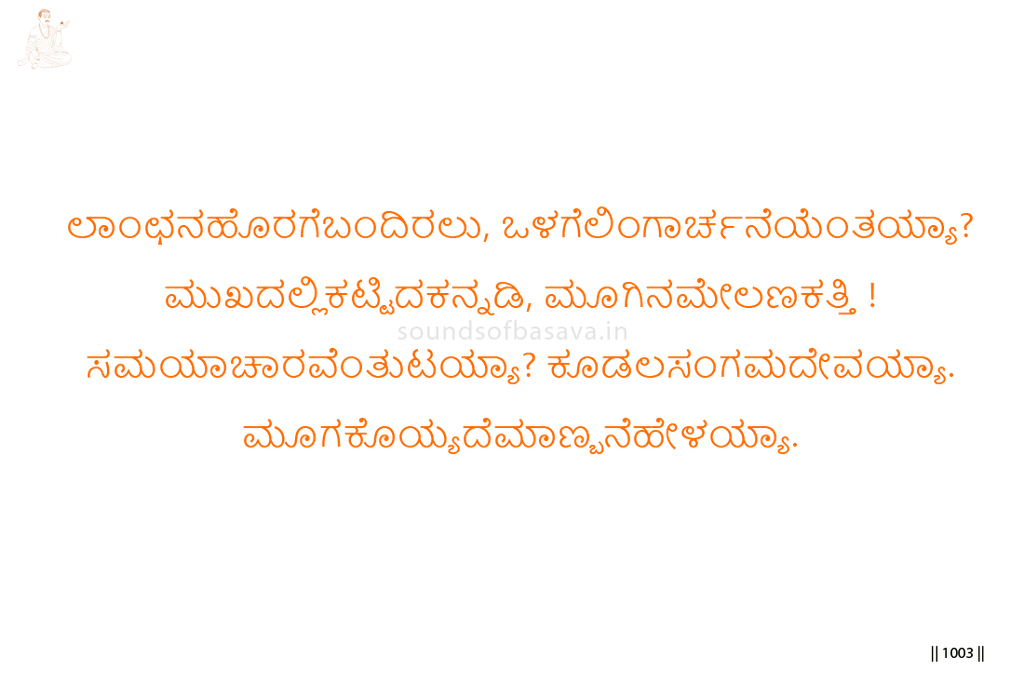
Basavanna questions worship that remains divided between outer sign and inner realization. If the lanchana, the sacred mark, remains only outside, how can there be true inward Linga-worship?
The vachana then gives a sharp image: a mirror tied before the face and a sword above the head. What should reveal has instead become obstruction; what should guide has become danger. The Aikya source explains that when the Linga is held apart as an object before the worshipper, the act of worship remains split. The worship continues, but the one who performs it remains intact as separate.
The final question asks what kind of samayachara this is. Basavanna is not rejecting the outer sign itself. He is rejecting the condition in which outer sign and inner worship do not meet. Before Kudalasangama Deva, right conduct cannot be mere external display; it must become undivided inward worship.
Imagery & Symbolic Relevance
The outer lanchana is the first image. Lanchana is the sacred sign or mark of belonging. Basavanna does not deny its value, but asks what happens when it remains outside only.
The question “if the mark has come outside, how is there inner Linga-worship?” gives the first correction. The outer sign should lead inward. If it does not awaken inner worship, the sign remains incomplete.
The mirror tied before the face gives the second image. A mirror normally helps one see. But when it is tied before the face, it can also become a fixed object held between the seer and clear seeing. The image suggests that even what reflects can obstruct when it is wrongly held.
The sword upon the head gives the sharpest image of the vachana. The Aikya source explains that the sword is not a literal threat but division: what is held in front cuts the field into two, one who sees and what is seen.
The head carries the sense of identity. When the Linga stands outside or above while the seeker remains below as a separate observer, the old identity has not dissolved. The source states that the head carries identity, and when the Linga stands above it, identity remains intact beneath.
The question “what kind of samayachara is this?” brings the teaching into conduct. Samayachara cannot be only outward correctness. If the sign remains outside and worship does not enter within, conduct has not become true alignment.
The final address to Kudalasangama Deva places the whole contradiction before the Lord. The outer mark, the inner worship, the mirror, the sword, and the question of right conduct are all measured before Kudalasangama Deva.
Together, the lines show that sacred form must not sharpen separation. The mark must not remain outside; the mirror must not obstruct seeing; the Linga must not become an object that leaves the worshipper separate. True samayachara is the ending of this divided posture.
Lingayoga
In Lingayoga, this vachana teaches that the outward sign must enter inward worship. The seeker should not be satisfied with wearing the mark while remaining divided from the Linga in awareness.
The practice-point is direct: do not hold the Linga merely before the eyes while keeping the worshipper intact as a separate self. Let the sign become inward turning. Let worship remove division rather than strengthen it.
The Aikya source states that when division ends, nothing stands as separate: the seer, the seeing, and the seen do not remain apart, and life rests in the unbroken presence of Kudalasangama Deva.
Editorial Commentary
This vachana should be read as a correction of externalization, not as a rejection of the Ishtalinga or sacred sign. Basavanna’s criticism is precise: when the sign remains outside and the Linga remains an object before the worshipper, the very act meant for union becomes a sword of division. The mirror and sword images should remain central. A mirror can reveal, but when tied wrongly it obstructs. A sword can cut, and here it cuts awareness into worshipper and worshipped. Basavanna asks whether such divided practice can be called true samayachara before Kudalasangama Deva.
Related Vachana
Supporting Vachana
Sharana Sthala Vachana 205 — The Outward Show and the Inward Offering
Sharana Vachana 205 supports this Aikya vachana by questioning devotion that remains outward. A person may wear many rosaries, apply Vibhuti in many ways, move among the religious gathering, eat, take betel, and depart; yet if body, mind, and wealth are not offered, Kudalasangama Deva is not reached.
Aikya Vachana 192 carries this correction inward. In Sharana Vachana 205, outward religious appearance is insufficient without offering. In Aikya Vachana 192, even the sacred mark and Linga-worship are tested: if the mark remains outside and the Linga stands before the worshipper as separate, the practice becomes divided rather than inwardly complete.
Advancing Vachana
Aikya Sthala Vachana 216 — The Rightful Harmony of Body, Mind, and Wealth
Aikya Vachana 216 advances this teaching within Aikya Sthala. In Vachana 192, Basavanna exposes the disorder of worship when the outer mark and inner Linga-worship remain divided. In Vachana 216, the question of alignment widens to body, mind, and wealth: if one is wrongly surrendered to another, disorder remains; when they stand in rightful harmony, Kudalasangama Deva abides there.
Thus Vachana 192 corrects divided worship, while Vachana 216 shows the broader Aikya condition of rightful integration. The sword of separation gives way to harmony, where body, mind, and all means no longer stand apart from Kudalasangama Deva.
