

Summary
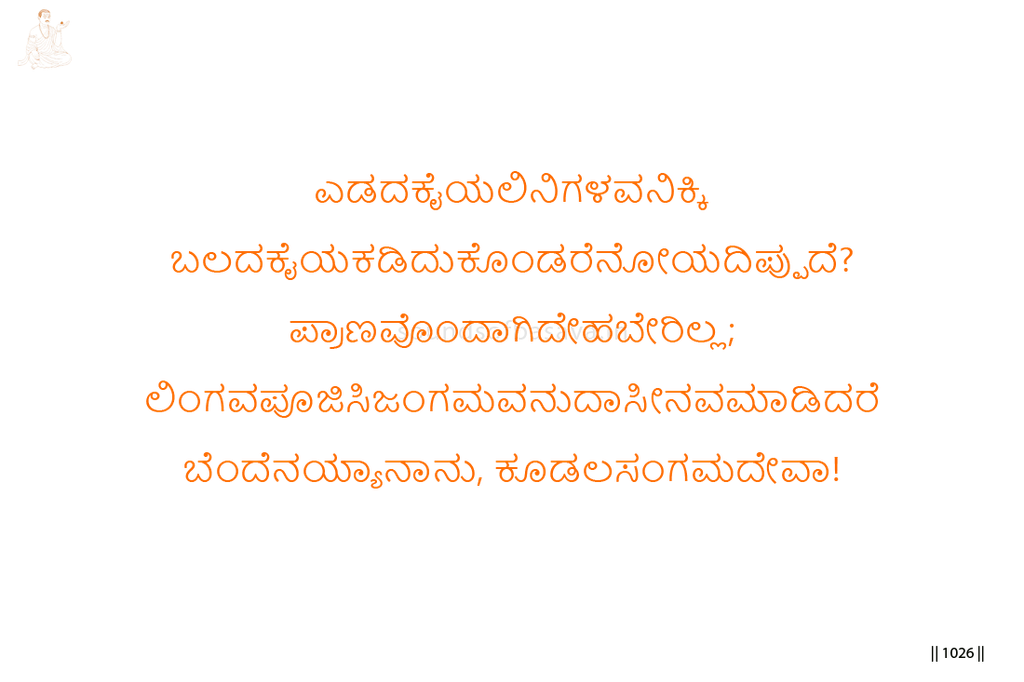
Basavanna uses the image of two hands belonging to one body. If the left hand is bound and the right hand is cut, the body cannot remain untouched. Pain belongs to the whole because life is one.
He then states the principle directly: prana is one, and the body is not separate. The two hands may appear distinct in function, but they do not possess separate life.
The final movement applies this to worship. If one worships the Linga but neglects the Jangama, the seeker is burned within that division. The Aikya source explains that this is not merely ritual imbalance, but the pain of separating inner realization from living sacred presence.
Imagery & Symbolic Relevance
The left hand is the first image. It is one part of the body, distinct in position and function, yet it does not live by a separate life.
The binding of the left hand shows obstruction. When one hand is tied, the whole body is affected. The injury does not remain isolated in that hand alone.
The right hand is the second image. Like the left, it appears as a separate limb, but it belongs to the same body and the same life.
The cutting of the right hand intensifies the image. Binding is painful; cutting is still more severe. Basavanna chooses this harsh image to show that division within what is one cannot be harmless.
The question “will there not be pain?” gives the first teaching. Pain proves unity. If the hands truly belonged to separate lives, harm to one would not trouble the whole. But because life is one, injury to one part burns through the whole body.
The line “prana is one” gives the core principle. Basavanna moves from the visible image of two hands to the invisible life that sustains them. The parts differ, but the life within them is one.
The line “the body is not separate” completes the bodily teaching. The body is not two because the hands are two. Difference of part does not create division of being.
The line “if I worship the Linga” gives the sacred parallel. Linga-worship is real and necessary, but it must not be isolated from the rest of sacred life.
The line “and neglect the Jangama” gives the fracture. Jangama is not an optional addition after Linga. To neglect Jangama while worshipping Linga is like harming one hand while claiming the body is whole.
The line “I am burned” gives the consequence. The burning is the pain of contradiction. The Aikya source says that to worship Linga while neglecting Jangama is to affirm unity inwardly while practicing division outwardly.
The final address to Kudalasangama Deva places the whole fracture before the Lord. Basavanna does not excuse divided worship. He confesses that such separation burns him.
Together, the lines show that Linga and Jangama must not be severed. Just as the two hands belong to one body and one prana, Linga-worship and Jangama-recognition belong to one indivisible spiritual life.
Lingayoga
In Lingayoga, this vachana teaches that inward worship and living recognition must remain joined. The seeker cannot honor Linga inwardly and neglect Jangama outwardly without creating fracture.
The practice-point is direct: do not divide the sacred field. Let the hand that worships Linga also serve and recognize Jangama. Let devotion remain one in body, life, worship, and conduct.
The Aikya source states that the error is not social negligence alone, but perceptual severance: Jangama is living Linga, and neglecting Jangama while worshipping Linga wounds the path itself.
Editorial Commentary
This vachana should be read through the body-image. Basavanna does not begin with abstract doctrine. He gives the body as proof: when one hand is harmed, the whole body feels pain.
The final line should remain severe. Neglecting Jangama while worshipping Linga is not a small omission. It is a burning contradiction before Kudalasangama Deva.
Related Vachana
Supporting Vachana
Sharana Sthala Vachana 398 — The Living Altar
Sharana Vachana 398 supports this Aikya vachana by teaching that Linga-archane without Jangama is like water poured into a broken pot. Worship may be present, but it cannot hold its fruit when cut off from Jangama. The Sharana source states that devotion becomes true when Linga-worship and Jangama-presence are not divided, and that Jangama-Prasada itself becomes Linga-archane.
Aikya Vachana 406 carries this teaching into the body itself. In Sharana Vachana 398, divided worship is shown through the broken-pot image. In Aikya Vachana 406, the same division becomes bodily pain: worshipping Linga while neglecting Jangama is like injuring one hand and expecting the body not to suffer.
Advancing Vachana
Aikya Sthala Vachana 407 — The Living Temple
Aikya Vachana 407 advances this teaching within Aikya Sthala. In Vachana 406, Basavanna shows that Linga and Jangama cannot be divided because life is one and the body is not two. In Vachana 407, the movement turns inward into surrendered embodiment: body is no longer the ego’s possession, and mind is no longer a separate claimant; both become the dwelling-field of Kudalasangama Deva.
Thus Vachana 406 establishes the indivisibility of Linga-worship and Jangama-recognition, while Vachana 407 internalizes that indivisibility into body and mind. The two hands of one body become the living temple in which ownership itself is surrendered before Kudalasangama Deva.
