

Summary
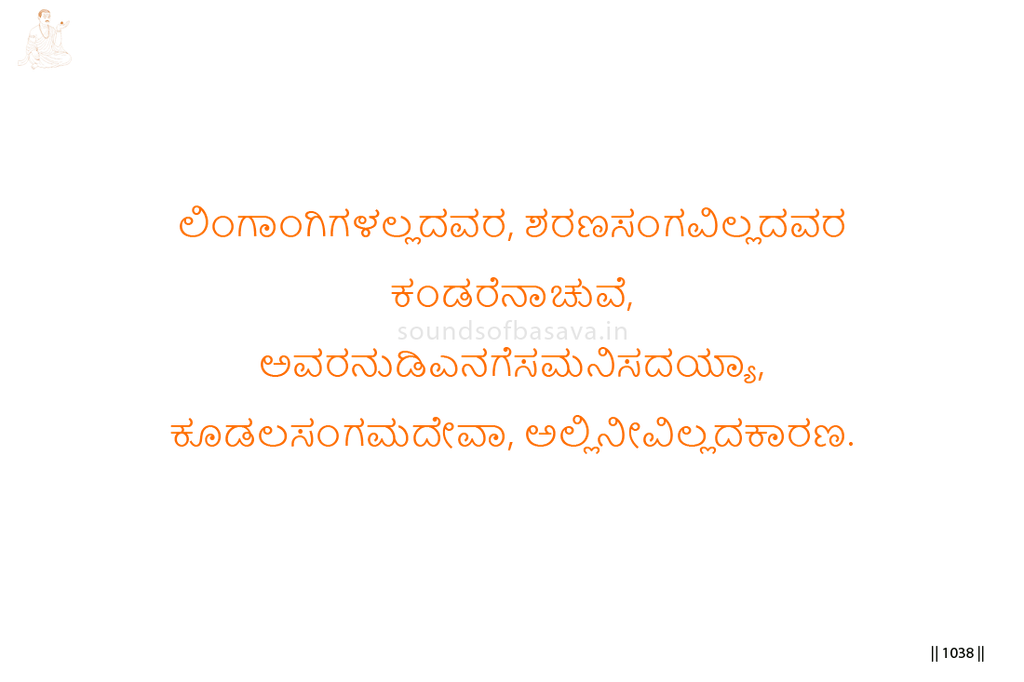
Basavanna speaks of those who are not Linga-embodied and who do not live in the company of the Sharanas. When he sees such persons, he withdraws inwardly.
The withdrawal is not presented as hatred or social pride. The concern is spiritual discernment. Where Linga has not entered life and where Sharana-company is absent, the speech that arises from such a condition does not become acceptable to him.
The final line gives the reason: Kudalasangama Deva is not there. The meaning is that the Lord is not consciously alive in that speech and presence. Therefore Basavanna refuses to let such words enter his inner field.
Imagery & Symbolic Relevance
The first image is “those who are not Linga-embodied.” This does not point merely to the absence of an outer sign. It points to a life in which Linga has not entered body, speech, thought, and awareness.
The second image is “those without Sharana-sanga.” Sharana-company is not casual association. It is the living fellowship in which sacred orientation is reinforced, corrected, and sustained.
The act of seeing such persons is the next movement. Basavanna does not speak abstractly. The test arises when such presence is actually encountered.
The response “I withdraw” gives the central discipline. He does not attack, argue, or claim superiority. He refuses inward participation in a condition not aligned to Linga and Sharana-sanga.
The speech of such persons is then named. Words are not treated as neutral sound. Speech carries the state from which it arises.
The line “their words do not become acceptable to me” shows guarded reception. Basavanna does not allow every word to enter simply because it is spoken. Speech must arise from aligned being to be received inwardly.
The final image is the absence of Kudalasangama Deva. This should not be read as a claim that the Divine is absolutely absent from existence. In the movement of the vachana, it means that Kudalasangama Deva is not revealed there as conscious presence, living alignment, or sacred speech.
Together, the images show discernment: Linga must enter life, Sharana-company must shape one’s field, speech must arise from alignment, and the seeker must not receive words where Kudalasangama Deva is not livingly present.
Lingayoga
In Lingayoga, this vachana teaches guarded association and guarded hearing. The practitioner must discern whether speech arises from Linga-aligned life or from divided consciousness.
The practice-point is direct: do not receive every word into the inner field. Where Linga is not embodied and Sharana-sanga is absent, speech may disturb rather than nourish.
This vachana also protects the seeker from false tolerance of misalignment. Basavanna does not command contempt toward persons; he shows non-participation in speech and presence where Kudalasangama Deva is not consciously alive.
Editorial Commentary
This vachana should be read as a teaching on discernment, not exclusion. The key images are Linga-embodiment, Sharana-company, seeing, withdrawal, speech, and the absence of Kudalasangama Deva’s living presence. Basavanna’s concern is not social rejection but inner preservation. The words that enter the seeker must come from a life aligned with Linga and sustained by Sharana-sanga.
Related Vachana
Supporting Vachana
Sharana Sthala Vachana 450 — The Trembling Servant and the Loosened Tongue
Sharana Vachana 450 supports this Aikya vachana by warning against company where sacred instruction is heard but not assimilated. There, Basavanna contrasts full listening and servant-like humility with the loosened mouth that later speaks carelessly. Aikya Vachana 454 carries the same discernment further: the seeker no longer allows words from unaligned life to enter, because Kudalasangama Deva is not consciously alive there.
Advancing Vachana
Aikya Sthala Vachana 1235 — The Symphony of the Integrated Self
Aikya Vachana 1235 advances this teaching by showing the fulfilled state where speech and conduct reveal one another. In Vachana 454, Basavanna withdraws from words arising where Linga-embodiment and Sharana-sanga are absent. In Vachana 1235, the opposite condition is shown: conduct reveals the beauty of speech, speech reveals the beauty of conduct, and those complete without inner division are honored. Thus the guarded refusal of unaligned speech in Vachana 454 advances into the Aikya state where speech, conduct, and realized being stand together before Kudalasangama Deva.
