

Summary
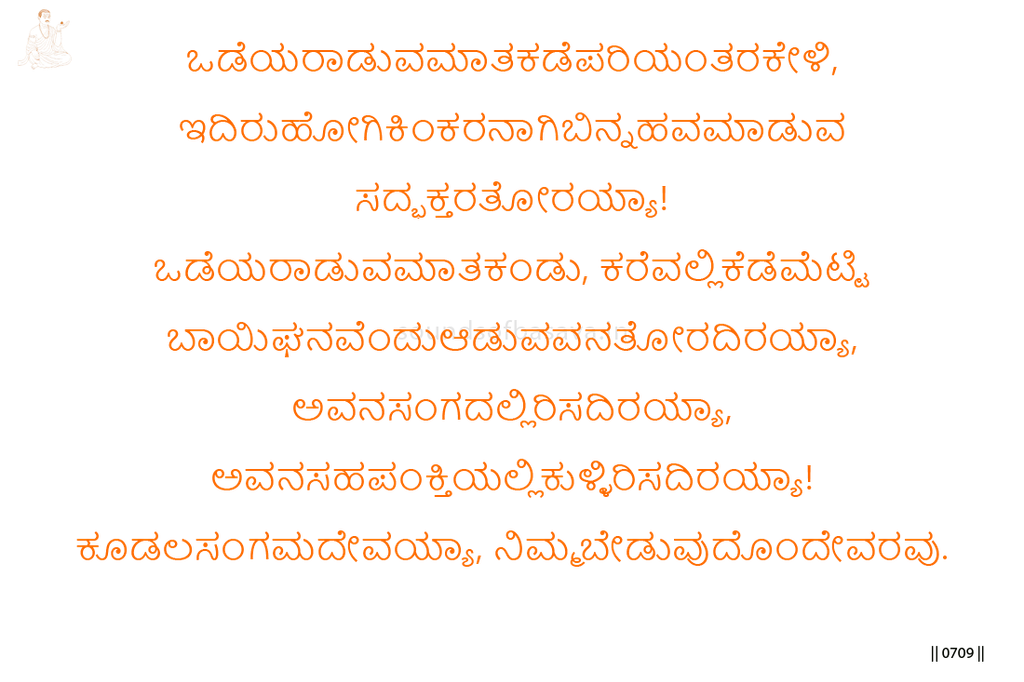
In this vachana, Basavanna asks Kudalasangama Deva to show him the true bhakta who listens to the word of the great one until the end, stands before it as a trembling servant, and makes humble petition.
He then asks not to be shown the one who hears that word but later, elsewhere, loosens his mouth and speaks without steadiness. Such a person may appear reverent in the moment of listening, but the heard truth has not remained in speech and conduct.
Basavanna’s prayer is protective: do not place me in his company, and do not seat me in his fellowship. The teaching is direct: hearing truth is not enough; what is heard must become lived steadiness.
Imagery & Symbolic Relevance
Listening to the word until the end is the first image. It shows complete attention before sacred instruction, not partial or hurried hearing.
Standing as a trembling servant gives the next image. The true listener does not stand as claimant or performer, but with humility before the word.
The humble petition marks the inward posture of the sadbhakta. Such a person receives the word with seriousness and does not separate listening from surrender.
The loosened mouth is the central warning image. One may hear the word in a sacred setting, but later speech may become careless, divided, or unassimilated. The tongue reveals whether the word has entered the being.
Company and fellowship form the final images. Basavanna asks not to be placed with such a person or seated in his shared company. Association is treated as spiritually formative and must be guarded.
The imagery therefore moves from true hearing, to servant-humility, to loose speech, to the protection of right company.
Lingayoga
In Lingayoga, this vachana teaches continuity after hearing.
The practice-point is direct: listen fully, receive humbly, and let speech remain aligned after the moment of instruction has passed. Do not speak in a way that contradicts what you have truly understood.
For Sharana Sthala, this is discernment of true sanga. The Sharana seeks company where truth is lived after it is heard, not where reverence appears briefly and then collapses into divided speech.
Editorial Commentary
The strongest contrast in this vachana is between the trembling servant and the loosened tongue. Basavanna does not ask only for good instruction; he asks to be protected from company where instruction is heard but not assimilated. The final prayer should remain central: not to be shown such a person, not to be kept in his company, and not to be seated in his fellowship.
Related Vachana
Supporting Vachana
Pranalingi Sthala Vachana 925 — The Weight of Words
Pranalingi Vachana 925 supports this teaching by warning that speech does not become reality merely by being spoken. There, words that are separated from lived truth add to the burden of bhava instead of producing transformation. Vachana 450 carries this into Sharana Sthala: one may hear the word with outward humility, but if the mouth later becomes loose and unsteady, the word has not become lived truth before Kudalasangama Deva.
Advancing Vachana
Aikya Sthala Vachana 454 — Where You Are Not There
Aikya Vachana 454 advances this teaching by showing the mature discipline of not allowing words from unaligned consciousness to enter. There, those who are not Linga-embodied and do not live in Sharana-sanga are not inwardly received, because Kudalasangama Deva is not consciously alive there. Vachana 450 asks not to be placed in the fellowship of the loosened tongue; Aikya Vachana 454 carries this into Aikya, where divided speech no longer enters the sanctum of awareness.
