

Summary
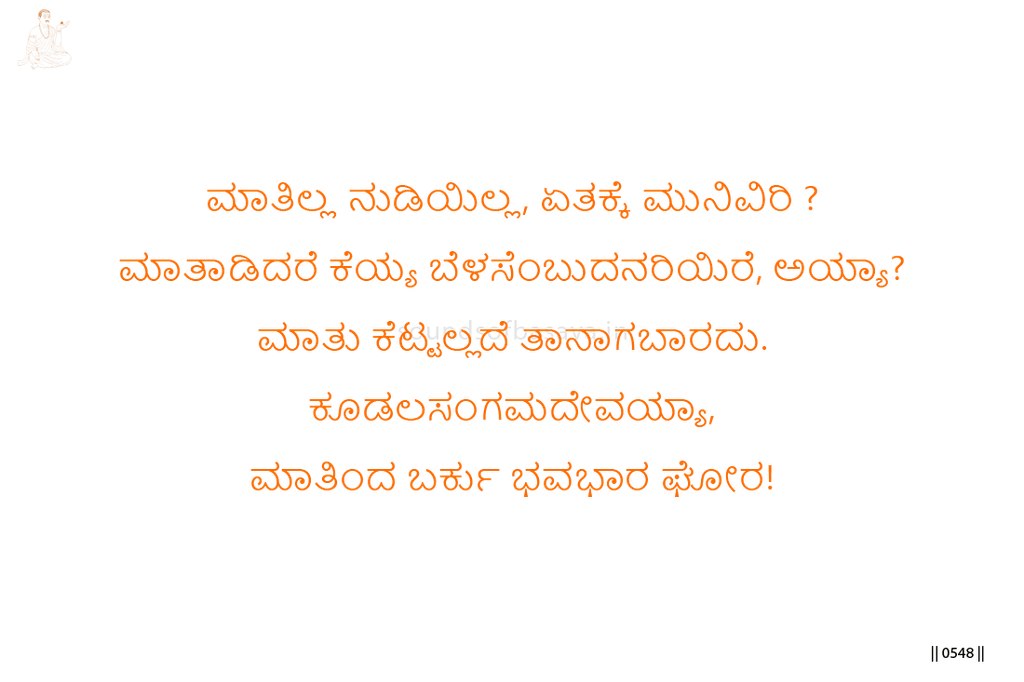
In this vachana, Basavanna questions the use of speech when it does not become lived reality. If there is no true speech and no meaningful utterance, why become agitated or offended?
He then asks whether merely speaking can make the hand fruitful. Words by themselves do not produce what must come into being. Speech must be joined to actual transformation.
Basavanna warns that words alone do not make one become what is spoken. If speech becomes separated from lived truth, it does not lighten the path; it adds to the burden.
The spiritual concern placed before Kudalasangama Deva is therefore the dreadful weight of bhava-burden created by words. The seeker must not mistake utterance for realization, or speech for accomplishment.
Imagery & Symbolic Relevance
The first image is speech and utterance. Basavanna begins by questioning speech itself when it lacks living force. Words may be present, but they may still fail to carry truth.
The second image is agitation or anger. The vachana asks why one becomes disturbed over speech when speech itself has not become real. This turns the seeker away from verbal reaction and toward inward examination.
The third image is the hand becoming fruitful. The hand represents actual result, action, and visible transformation. Basavanna asks whether speech alone can make the hand bear fruit.
The fourth image is words that do not become reality. Speech may declare, promise, argue, or claim, but unless it becomes lived, it remains incomplete.
The final image is the bhava-burden made dreadful through words. Words can become part of worldly bondage when they create claim, disturbance, and unreality instead of truth.
Lingayoga
In Lingayoga, this vachana teaches that speech must be joined to lived awareness. Words are not rejected, but they must not become substitutes for actual inner change.
For Pranalingi Sthala, the point is precise. Awareness must become living and active, not merely spoken. The seeker must not let speech scatter life into claims, arguments, and verbal burden.
The practice-point is clear: speak only what can be lived. Do not rely on words to create fruit where inward transformation has not occurred. Let speech become light before Kudalasangama Deva, not another form of bhava-burden.
Editorial Commentary
The vachana is not a rejection of speech itself. Basavanna is warning against speech that does not become lived truth. The phrase “bhava-bhāra” should remain central: words may increase the burden of becoming when they are separated from action, sincerity, and realization.
Related Vachana
Supporting Vachana
Prasadi Sthala Vachana 849 — The Fragrance of Truth is Known Only By Living It
Prasadi Vachana 849 supports this teaching by showing that truth must be directly tasted and lived. When taste touches the tongue, the mind itself becomes witness; one does not need borrowed proof. Basavanna also asks whether merely showing Agama can be called Achara.
Vachana 925 carries this same concern into Pranalingi Sthala. Words alone do not make the hand fruitful, and speech that is not lived becomes another burden of bhava. Prasadi 849 prepares this teaching by showing that sacred truth is fulfilled only when it becomes lived conduct, not when it remains display, explanation, or utterance.
Advancing Vachana
Sharana Sthala Vachana 1165 — Without Achara, Nothing Sacred Remains
Sharana Vachana 1165 advances this teaching by making Achara the measure of all sacred forms. Without Kriyachara, initiation cannot be received, Linga cannot be rightly worshipped, Jangama cannot be recognized, and Padodaka and Prasada cannot be truly received.
In Vachana 925, Basavanna warns that words alone do not produce reality and may increase the burden of becoming. In Vachana 1165, this matures into Sharana Sthala as the uncompromising rule that sacred speech, sacred forms, and sacred receiving must be grounded in lived Achara before Kudalasangama Deva.
