

Summary
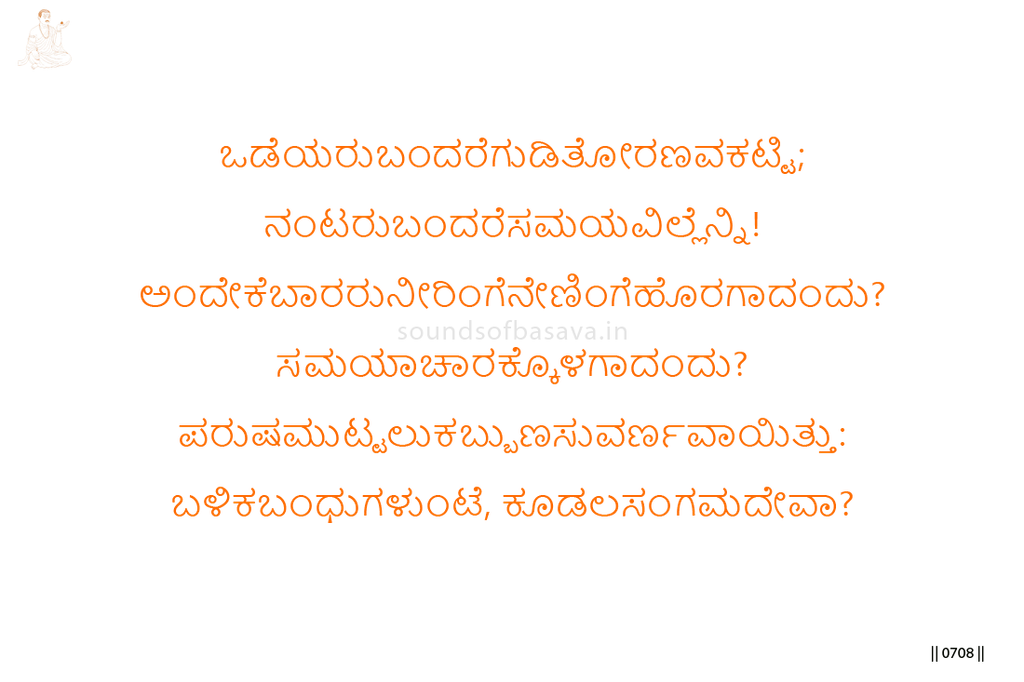
In this vachana, Basavanna contrasts ordinary hospitality with failure to recognize true spiritual kinship. When others arrive, the doorway is decorated and attention is given; but when those who are truly one’s own arrive, the excuse of “no time” is made.
The vachana then turns from social relation to spiritual transformation. External thread, inherited identity, or outward relation cannot define the seeker after the touch of Linga. When parasu touches iron, iron becomes gold.
Basavanna ends by asking whether relatives remain after such transformation. The teaching is direct: true kinship is not determined by birth, custom, or social identity, but by transformation through Kudalasangama Deva and belonging with His Sharanas.
Imagery & Symbolic Relevance
The decorated doorway is the first image. It shows care given to ordinary or socially expected arrivals. Basavanna uses this image to expose misplaced attention.
The neglected true kin form the second image. Those who should be received as one’s own are not welcomed. The problem is not absence of hospitality, but failure to recognize who truly belongs.
The thread and outer mark point to inherited or external religious identity. Such signs cannot replace transformation.
Samayachara refers to the disciplined way of living and conduct aligned with the spiritual path. It gives the inward corrective. The concern is not outer thread alone, but whether one has entered the proper conduct and living discipline of the path.
The touch of parasu upon iron is the central image of transformation. Iron does not remain iron after true transforming contact. In the same way, the seeker touched by Linga is no longer defined by old social measure.
Gold is the transformed state. The image shows change in condition, not surface ornament.
The final question about relatives completes the vachana. After the Linga’s transforming touch, worldly kinship no longer remains the highest measure of belonging.
Lingayoga
In Lingayoga, this vachana teaches that spiritual identity is formed through transformation, not inherited status.
The practice-point is direct: do not give greater weight to outer relation, social custom, or inherited symbols than to the living transformation brought by Linga. Receive the Sharanas as true kin, and let belonging be determined by awakened relation to Kudalasangama Deva.
For Sharana Sthala, this is kinship rebuilt through realization. The Sharana’s deepest family is not merely biological or social; it is the community formed through Linga-touch and shared truth.
Editorial Commentary
The iron-to-gold image should remain central. Basavanna does not speak only of rejecting family or custom; he shows that transformation changes the basis of identity itself. After Linga-touch, the seeker cannot be measured only by birth, thread, social relation, or inherited belonging.
Related Vachana
Supporting Vachana
Pranalingi Sthala Vachana 568 — The Alchemy of Inner Transformation
Pranalingi Vachana 568 supports this teaching by asking whether Bhakti and knowledge have caste-boundary, and by using the same decisive image of iron becoming gold through the touch of parasu. There, Basavanna teaches that true spiritual life is transformation, not inherited status, argument, blame, or verbal display. Vachana 449 carries this into Sharana Sthala: when Linga-touch transforms iron into gold, worldly measures of kinship and identity lose their final authority before Kudalasangama Deva.
Advancing Vachana
Aikya Sthala Vachana 714 — The True Kinship
Aikya Vachana 714 advances this teaching by declaring that brothers, lineage, and family ties have no final worth if they are not joined to Linga. Those who are not joined in Linga are not truly one’s own, while kinship rooted in Kudalasangama Deva becomes the real bond. Vachana 449 asks what relatives remain after transformation by Linga-touch; Aikya Vachana 714 carries this into Aikya, where all authentic kinship is fulfilled only through shared abidance in Linga.
