

Summary
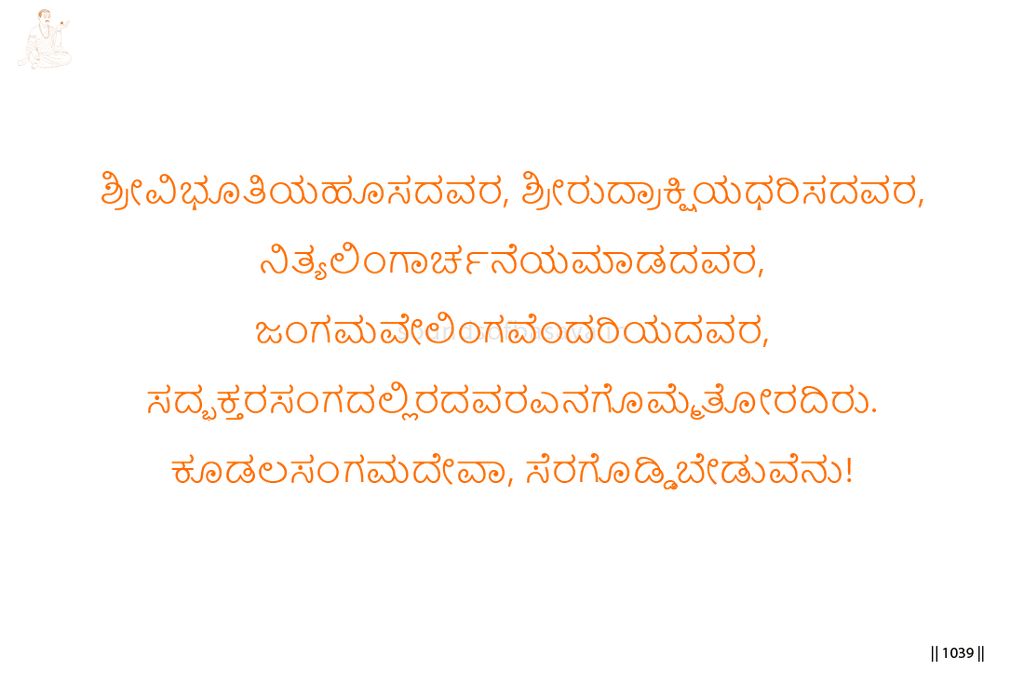
Basavanna lists five absences: those who do not apply Shri Vibhuti, those who do not wear Shri Rudrakshi, those who do not perform daily Linga worship, those who do not know Jangama itself as Linga, and those who do not remain in the company of true devotees.
The prayer is not built on social rejection. It is a plea for the seeker not to be drawn toward conditions where sacred signs, daily worship, Jangama-recognition, and true devotional company are absent.
The final line gives the mood of the whole vachana. Basavanna asks Kudalasangama Deva with humility. The strength of his refusal is held within folded reverence, not pride.
Imagery & Symbolic Relevance
Shri Vibhuti is the first image. Basavanna does not treat it as a decorative mark. Its absence is named first because the sacred sign itself marks belonging and remembrance.
Shri Rudrakshi is the second image. Together with Vibhuti, it forms the visible field of sacred orientation. One who does not bear it stands outside the signs Basavanna names here.
Daily Linga worship is the third image. The concern now moves from sacred sign to repeated practice. Basavanna does not speak of occasional worship, but of nitya Linga-archane, the daily turning toward Linga.
Knowing Jangama itself as Linga is the fourth and central recognition. The Jangama is not to be treated as separate from Linga. Without this recognition, worship remains incomplete, because the living sacred presence has not been understood.
The company of true devotees is the fifth image. Sacred life is not sustained by isolated claim alone. It requires the fellowship of those whose devotion is true.
The command “do not show them to me” gathers these five absences. Basavanna does not ask to avoid persons because of outward difference alone. He asks not to be shown the condition where Vibhuti, Rudrakshi, daily Linga worship, Jangama-as-Linga recognition, and true devotee-company are missing.
The final image is folded humility. Basavanna asks with reverence before Kudalasangama Deva. This protects the vachana from becoming a statement of superiority. Discernment is joined to humility.
Lingayoga
In Lingayoga, this vachana teaches that the path must not be broken into disconnected parts. Sacred sign, daily worship, Jangama-recognition, and true company must remain joined.
The practice-point is direct: do not let Vibhuti become separated from worship; do not let Rudrakshi become separated from recognition; do not let Linga worship become separated from Jangama; do not let devotion become separated from the company of true devotees.
The seeker’s prayer is also practical. One must guard the field of sight, association, and inward influence. Basavanna asks Kudalasangama Deva not to show him a condition that would draw awareness away from integrated sacred life.
Editorial Commentary
This vachana should be read as disciplined discernment held in humility. Basavanna’s list is precise and should not be softened into general piety. Vibhuti, Rudrakshi, daily Linga worship, Jangama-as-Linga recognition, and true devotee-company are all named as necessary signs of sacred continuity. Yet the final posture is not arrogance; he asks with folded humility before Kudalasangama Deva.
Related Vachana
Supporting Vachana
Sharana Sthala Vachana 88 — The Recognition of Authenticity
Sharana Vachana 88 supports this Aikya vachana by showing how Vibhuti and Rudraksha become signs through which the Sharana is recognized. There, Basavanna’s mind trusts, is pleased, and does not doubt when he sees the Sharana bearing these marks. Aikya Vachana 455 carries this recognition further: it does not speak only of the presence of Vibhuti and Rudrakshi, but also joins them to daily Linga worship, Jangama-as-Linga recognition, and the company of true devotees.
Advancing Vachana
Aikya Sthala Vachana 1214 — The Radiance of the Tenfold Padodaka
Aikya Vachana 1214 advances this teaching by gathering the sacred elements into a complete field: Guru, Linga, Jangama, Padodaka, Prasada, Vibhuti, Rudrakshi, Panchakshari, sacred vow, and steadfast conduct. In Vachana 455, Basavanna asks not to be shown those in whom key signs and recognitions are absent. In Vachana 1214, those signs and recognitions are no longer listed as absences to avoid; they shine together as integrated sacred completeness before Kudalasangama Deva.
