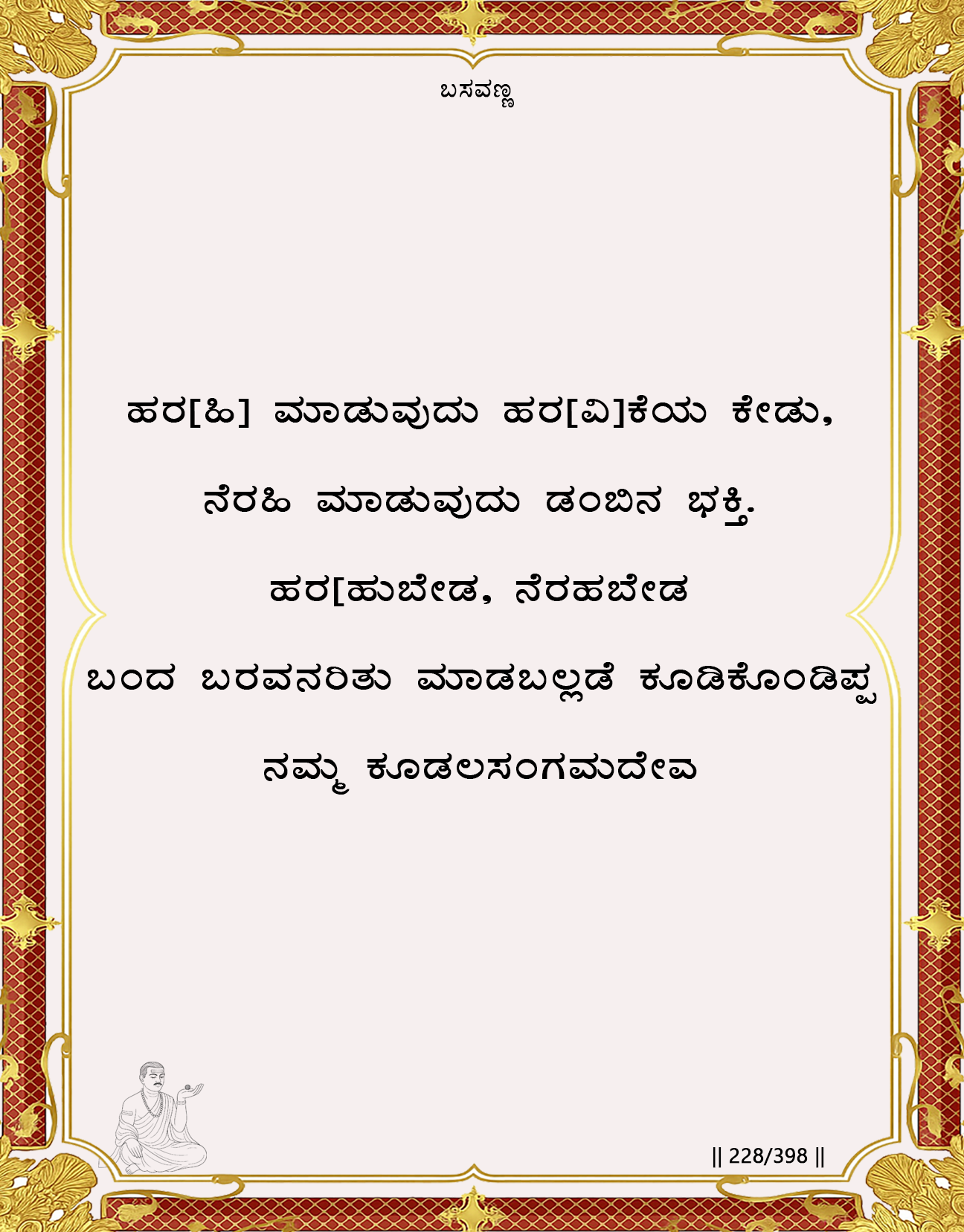
Poetic Rendering
What is gathered with pomp,
and offered with pomp,
is nothing but a debt to illusion.
What is earned in falsehood,
and spent in display,
becomes a burden the soul cannot carry.
Let not your devotion exceed
the truth of your heart.
Let not your offerings rise above your capacity.
Do not call crowds, do not stage a ritual
to prove a faith you do not feel.
Offer only what has genuinely arisen within you,
from the stillness given by the Eternal Source.
That alone becomes true worship,
true gathering,
true merging
with my Lord Kudalasangamadeva.
Basavanna exposes the spiritual danger of ritual performed for display. Any wealth, offering, or act of worship that is sourced from ego whether accumulated through unjust means or presented in pomp creates a spiritual debt. It binds the soul rather than liberating it. The core message: Devotion must never exceed what is real within. Pretension whether in wealth, ritual, or spiritual gesture screates an “illusion-debt,” where the seeker becomes enslaved to the very image they try to uphold. This is not true bhakti; it is performance. Instead: Offer only what truly arises from inner experience (anubhava). Share what the Eternal has given, without show. Let the offering flow to the Jangama and to life itself with authenticity. In such simplicity, Basavanna says, lies the true merger with Kudalasangamadeva. No display. No pretense. Only the quiet truth of the heart.
Spiritual Context
Core Spiritual Principle: Authenticity (satya) is the non-negotiable currency of the spirit. Any transaction with the Divine using counterfeit currencyperformative ritual, pomp sourced in ego, or displays exceeding inner realitycreates a karmic debt (rna). This debt binds rather than liberates. True offering is the spontaneous overflow of a truthful heart.
Cosmic Reality Perspective: In Shivayoga, the Linga is reality itself (sat). To offer illusion (maya) or pretense (dambha) to the Real is a metaphysical contradiction. It reinforces the veil of separation. Only an offering that is itself realsourced in the stillness of pure consciousness (shiva-tattva)can merge with the Real. The “debt” is the karmic consequence of strengthening unreality.
Historical Reality (Anubhava Mantapa Context): This vachana was a direct critique of the ostentatious temple rituals and public yajnas of 12th-century priestly orthodoxy, where scale and show were mistaken for piety. The Anubhava Mantapa countered with the ideal of antara puja (inner worship) and simple, community-focused dasoha. It protected the movement from the spiritual materialism that afflicts successful religious communities, ensuring leadership was based on authentic experience, not ritual expertise or fundraising prowess.
Interpretation
1.”What is gathered with pomp, and offered with pomp, is nothing but a debt to illusion.” This identifies a double fault: the source (arjana) and the expenditure (vyaya) are both contaminated by ahamkara (ego). “Pomp” is the inflation of the act to serve the actor’s social or spiritual image. The “debt” is the binding karmic obligation (prarabdha) to maintain that illusory image, which drains spiritual energy.
2.”What is earned in falsehood, and spent in display, becomes a burden the soul cannot carry.” This specifies the contamination. “Falsehood” (anrita) could be unjust wealth, plagiarized wisdom, or borrowed devotion. “Display” (pradarshana) is its misuse. The soul, as the carrier of karma, is weighed down by this specific burdenthe burden of living a lie before the Truth.
3.”Let not your devotion exceed the truth of your heart… Offer only what has genuinely arisen within you, from the stillness given by the Eternal Source.” This prescribes the antidote: the economy of exact correspondence. The outer expression must be a 1:1 map of the inner state.
The “stillness” (shanti) is the inner void (shunya) from which genuine creativity (devotion as lila) arises spontaneously, free from the calculative mind. Practical Implications: One must perform a regular “authenticity audit.” Before any act of worship, philanthropy, or spiritual teaching, ask: “Does this match what I genuinely feel and know at this moment? Am I trying to prove something to others or to myself?” If the answer is unclear, simplify or remain silent.
The Cosmic Reality
Anga (Human Dimension): The human as a living ledger. On one side of the ledger are entries of authentic experience and capacity; on the other, entries of expression and offering. Spiritual health requires these columns to balance. “Debt” occurs when the offerings column is filled with entries not backed by the assets in the experience column.
Linga (Divine Principle): Koodalasangamadeva as the Great Auditor and the Standard of Value. The Linga accepts only the currency of truth. It cannot be deceived by pomp; it recognizes only the genuine “stillness” within as legal tender for the transaction of union.
Jangama (Dynamic Interaction): The authentic transaction itself. It is the moment when a genuine inner movement (bhava) finds its perfect, proportionate outer form (kriya), and in that seamless movement, a connection is made. This is the “true gathering”not a static event, but a dynamic congruence.
Shata Sthala
Primary Sthala: BHAKTA. This vachana is foundational for the Bhakta, who is learning the forms of devotion. The grave warning is that mastering the form without filling it with authentic feeling creates negative progressa “debt.” The Bhakta must learn that a single tear of genuine longing is worth more than a thousand flawlessly recited hymns performed for acclaim.
Supporting Sthala: MAHESHWARA. The Maheshwara’s work is the destruction of impurities (mala). The “debt of illusion” is a primary impurity the complex web of self-deception and hypocrisy. The vachana gives the Maheshwara the tool for this purification: ruthless self-honesty and the dismantling of any spiritual persona.
Practical Integration
Arivu (Awareness Practices): Practice “bare attention” meditation on your own motivations. Before acting, pause to see the subtle layers: the genuine impulse, the desire for recognition, the fear of judgment. Choose to act only from the deepest, most authentic layer you can access.
Achara (Personal Discipline): Embrace holy simplicity. In your spiritual practice, do less, but do it with total, undistracted presence. If your mind is agitated, offer that agitation honestly (“Here is my restlessness, O Lord”) rather than forcing a serene chant you don’t feel.
Kayaka (Sacred Action): Let your work be an expression of your actual skills, not an imagined persona. A humble, honest craft offered truly is greater Kayaka than a grandiose, poorly executed project done for prestige.
Dasoha (Communal Offering): Give from your genuine surplus, not from calculated image-building. Anonymous giving, or giving without requirement of thanks, is a powerful practice to purify the offering of the stain of “display.”
Modern Application
The Economy of Perception. Social media spirituality, where curated enlightenment and performative activism create “debts of illusion” on a mass scale. The pressure to display a perfect spiritual journey, a mindful lifestyle, or a virtuous identity leads to epidemic inauthenticity, anxiety, and communal distrust.
Cultivate private spirituality. Engage in practices no one will ever see or praise. Keep a spiritual journal without the intent to publish. Share struggles as openly as successes. Support creators and teachers who show their process, not just their polished product. Reject the “influencer” model in spiritual life. Find communities that value vulnerable sharing over inspirational performance.
Essence
The grand display, the borrowed prayer,
Builds a palace of debt on empty air.
The heart’s true measure, humble and plain,
Though just a whisper, breaks the chain.
For God keeps accounts in truth’s pure light,
Not by the show, but the inner sight.
Offer the stone, if that’s your all,
But offer it true, and watch the wall
Of illusion fall.
This vachana describes the information theory of consciousness. The Linga is the source of pure signal (truth, sat). The Anga is a receiver-transmitter. Spiritual practice is the process of reducing “noise” in the system to receive and retransmit this signal clearly. Performative devotion adds enormous noiseit is the transmitter broadcasting its own amplification and embellishment of a weak or absent signal. This creates metaphysical interference: a chaotic energy signature that carries no liberating information but consumes bandwidth and creates entanglement (debt). True offering occurs at the point of signal fidelity, where the output perfectly corresponds to the genuine input from the Source.
Imagine your soul is a radio. The Divine is the broadcasting station. Your prayer is the music you play back. If you turn up the volume to impress the neighbors but the station is barely tuned in, you’re just broadcasting loud static. Basavanna says: don’t worry about the volume knob (pomp). Focus on tuning the dial perfectly to the station (authentic inner stillness). Even if the music plays softly from a small speaker (a humble, true offering), it is real music. The loud static is a “debt” it annoys everyone (your soul included) and drowns out any chance of hearing the real song.
We are social creatures wired for approval, and spirituality can become the ultimate arena for seeking that approval. This vachana speaks to the profound loneliness of wearing a spiritual mask the exhausting effort to maintain a pretense that, deep down, we fear is seen through by the Divine. The liberation it offers is the immense relief of taking off the mask. It is permission to be a beginner, to be doubtful, to be small, and to offer that small, true self without shame. In that radical honesty, the first real connection is made not to an ideal we aspire to, but to the Reality that meets us exactly where we are.

Views: 7