

Summary
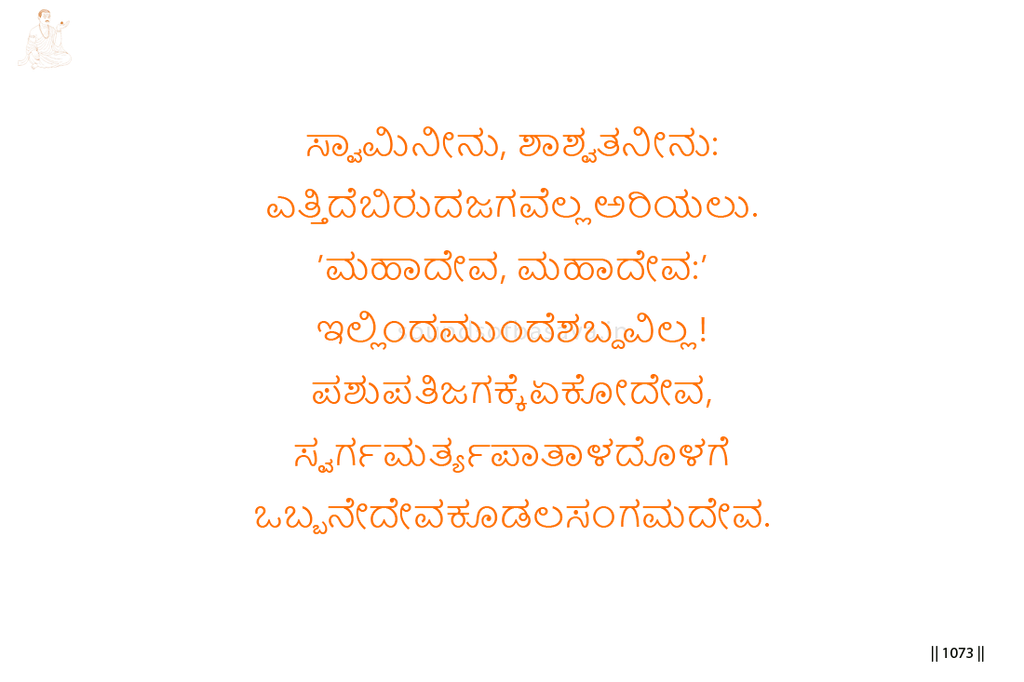
Basavanna addresses Kudalasangama Deva as the Master and the Eternal One through whom the vast world has unfolded.
He repeats, “Mahadeva, Mahadeva,” and says that beyond this no further word remains. Pashupati alone is God of the world.
Whether in heaven, the mortal world, or the netherworld, Kudalasangama Deva alone is God.
Imagery & Symbolic Relevance
The address “You are the Master” places all authority in Kudalasangama Deva. No other power is named beside Him.
The declaration “You are Eternal” shows that His being is not limited by the changing world.
The reference to the vast, unfolded world places the whole field of existence before Him. The world in all its extension bears relation to the one Eternal Master.
The repeated cry “Mahadeva, Mahadeva” is the centre of the vachana. Basavanna does not continue through explanation or argument. The Divine Name itself becomes the sufficient utterance.
The statement “beyond this there is no word” marks the limit of description. After naming Mahadeva, speech has nothing further to add.
The name Pashupati identifies the Lord as the sovereign of living beings. Basavanna then asks what need the world has for another god.
The three realms—heaven, the mortal world, and the netherworld—express the completeness of the declaration. No realm is excluded, and no second Divine authority is admitted within them.
The final naming of Kudalasangama Deva seals the vachana: the Master, the Eternal, Mahadeva, Pashupati, and the one God of the three realms are not separate references; they all point to Kudalasangama Deva.
Lingayoga
In Lingayoga, the seeker must not divide inward allegiance among competing centres.
The Linga is to be recognized as the one governing presence through every condition and realm. This recognition gathers devotion into a single orientation.
The repeated invocation of Mahadeva also shows the limit of conceptual speech. The seeker may name and remember the Lord, but should not imagine that argument or description can exceed the Name.
The practice-point is direct: remain established in Kudalasangama Deva as the sole Divine centre, without divided refuge.
Editorial Commentary
The line “beyond this there is no word” should remain close to the Kannada. It indicates that speech reaches its limit after the invocation “Mahadeva, Mahadeva.” It need not be expanded into a separate doctrine of absolute silence.
The declaration of one God across the three realms is explicit. It should not be weakened into mere preference for one deity, nor expanded beyond what the vachana states.
Related Vachana
Supporting Vachana
Sharana Sthala Vachana 210 — Devotion Beyond Words
Sharana Vachana 210 asks whether repeated speech alone can be called devotion. Unless body, mind, and wealth are wholly given to Kudalasangama Deva, words remain incomplete.
This prepares Vachana 527. In Sharana Vachana 210, devotion must pass beyond verbal claim into total surrender. In Vachana 527, speech itself reaches its limit in the invocation “Mahadeva, Mahadeva,” and Kudalasangama Deva alone remains as the one God of all realms.
Advancing Vachana
Aikya Sthala Vachana 528 — Beyond Śruti, Beyond Form
Vachana 527 directly declares Kudalasangama Deva as the one God in heaven, earth, and the netherworld.
Vachana 528 deepens this certainty through the declaration that Shiva alone is God and that Rudra has no second. What Vachana 527 proclaims through direct invocation and recognition, Vachana 528 confirms through Śruti.
Thus, the one Divine presence declared across all realms in Vachana 527 advances into the explicit affirmation that there is no second in Vachana 528.
