

Summary
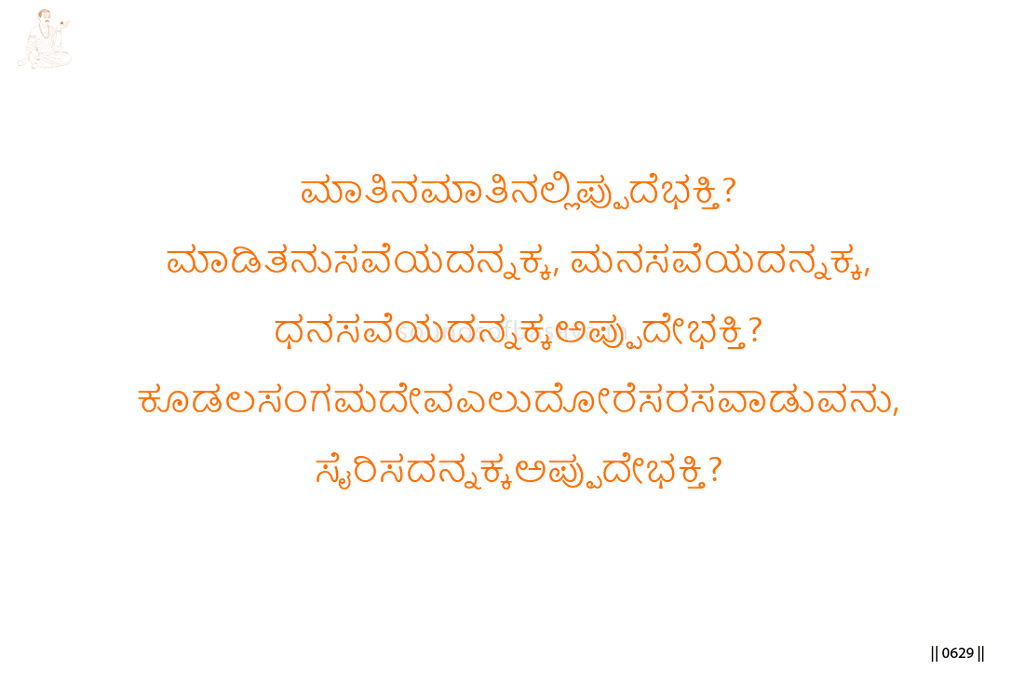
In this vachana, Basavanna asks whether bhakti is merely speech upon speech. A person may speak of devotion, name devotion, and use devotional language, but that does not make the life devotional.
The test is direct: if the body is not given, if the mind is not given, if wealth is not given, can this be called bhakti? Basavanna places the whole human field under examination. Devotion is not complete while any part remains held back.
The final correction concerns dealing with Kudalasangama Deva as though devotion were a transaction. If one approaches the Lord to gain, secure, or bargain, the offering has not become surrender. True bhakti begins where speech ends, holding back ends, and bargaining ends.
Imagery & Symbolic Relevance
In this vachana, Basavanna asks whether bhakti is merely speech upon speech. A person may speak of devotion, name devotion, and use devotional language, but that does not make the life devotional.
The test is direct: if the body is not given, if the mind is not given, if wealth is not given, can this be called bhakti? Basavanna places the whole human field under examination. Devotion is not complete while any part remains held back.
The final correction concerns dealing with Kudalasangama Deva as though devotion were a transaction. If one approaches the Lord to gain, secure, or bargain, the offering has not become surrender. True bhakti begins where speech ends, holding back ends, and bargaining ends.
Lingayoga
In Lingayoga, this vachana clarifies that devotion must pass from speech into offering. The Anga cannot approach Linga through words alone while retaining body, mind, and wealth for itself.
The practice-point is direct: do not speak devotion while preserving ownership. Let action, intention, and possession be offered.
For Sharana Sthala, the teaching is total giving. The Sharana does not bargain with Kudalasangama Deva. The Sharana gives without keeping a hidden claim of return, security, or gain.
Editorial Commentary
This vachana should remain in the form of a test. Basavanna asks repeatedly whether what is being called bhakti is truly bhakti. The answer is implied: speech without giving is not bhakti; partial offering is not bhakti; bargaining before Kudalasangama Deva is not bhakti.
Related Vachana
Supporting Vachana
Pranalingi Sthala Vachana 340 — The Vigilance of the True Sharanas
Pranalingi Vachana 340 supports this teaching by showing true Sharanas as those who move above the rule of body, mind, and wealth, and who know life-force itself as belonging to Kudalasangama Deva. Vachana 210 asks whether there can be bhakti when body, mind, and wealth are not given. Vachana 340 shows the matured correction: these three no longer govern the seeker, remembrance is guarded, and life belongs to the Lord.
Advancing Vachana
Aikya Sthala Vachana 216 — The Rightful Harmony of Body, Mind, and Wealth
Aikya Vachana 216 advances this teaching by showing body, mind, and wealth crossed and brought into rightful harmony. In Vachana 210, Basavanna demands that these three be spent and refuses transactional devotion. In Aikya Vachana 216, they are no longer held as possessions or used for bargaining; they become rightly ordered instruments. Thus the Sharana-stage demand for total giving advances into Aikya as freedom from identification and complete harmony before Kudalasangama Deva.
