

Summary
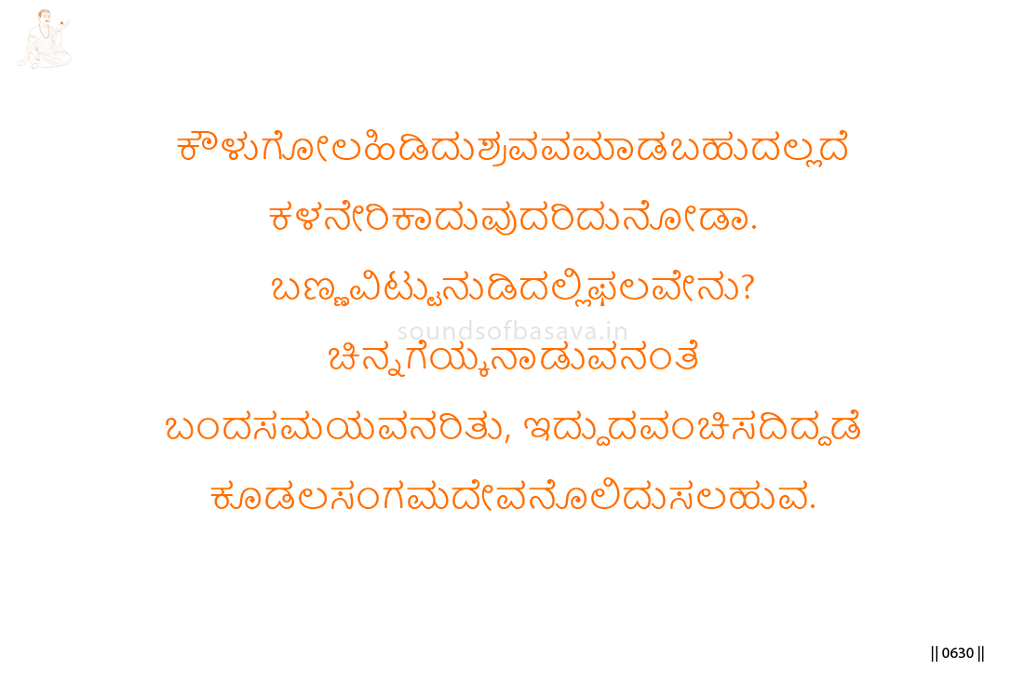
In this vachana, Basavanna distinguishes between practice, speech, and actual realization. One may hold the staff, practise discipline, and appear prepared, but that does not mean one knows the field where the test must be faced.
He then turns to speech. Ornate or coloured words do not produce fruit by themselves. A goldsmith may speak of gold, but speech about gold is not the same as working the metal.
The final teaching is positive. If one understands the occasion or purpose for which one has come, and does not betray what is present within, Kudalasangama Deva will stand by and protect. The path is therefore not completed by rehearsal or speech, but by faithful alignment with inner truth.
Imagery & Symbolic Relevance
The staff is the first image. It suggests practice, preparation, and discipline. Basavanna does not reject practice, but he shows its limit. Holding the staff does not by itself prove that one can stand in the field of real testing.
The battle-field is the second image. It is the place where preparation is tested. One may rehearse outside the field, but actual courage and steadiness are known only when one enters the situation itself.
The coloured or refined word is the third image. Basavanna asks what fruit comes from speech that is only well-shaped. Speech may be pleasing, skilful, or polished, yet it remains incomplete if it does not carry lived truth.
The goldsmith gives the image its sharper meaning. A goldsmith who merely talks of gold produces nothing. Gold must be worked, shaped, and made real through actual skill. In the same way, spiritual truth must be lived, not only described.
Knowing the occasion or purpose is the turning point. Basavanna asks the seeker to know why he has come and what must be done. This is not general curiosity; it is recognition of one’s spiritual responsibility.
Not betraying what is within is the final inward test. The seeker may prepare outwardly and speak well, but if the inner truth is betrayed, the path has not been kept.
Together, the images teach that realization must pass from rehearsal to engagement, and from speech to lived fidelity. Kudalasangama Deva stands by the one who does not abandon the truth within.
Lingayoga
In Lingayoga, this vachana clarifies that practice and speech must become direct participation. Discipline is useful only when it prepares the seeker to stand in the actual field of life.
The practice-point is direct: do not remain satisfied with preparation or explanation. Enter the work. Let speech become lived truth.
For Sharana Sthala, the teaching is inner fidelity. The Sharana is not one who merely speaks well or practises visibly, but one who knows the purpose of embodied life and does not betray the truth within before Kudalasangama Deva.
Editorial Commentary
This vachana should not be expanded into a general criticism of practice or speech. Basavanna’s correction is precise. Practice without engagement is incomplete; speech without realization is fruitless; inward truth must not be betrayed. The goldsmith image should remain practical: talking of gold is not the same as working gold.
Related Vachana
Supporting Vachana
Pranalingi Sthala Vachana 979 — Without Experience, Nothing Ripens
Pranalingi Vachana 979 supports this teaching by saying that Bhakti, Linga, Prasada, knowledge, and even Sharana-sanga remain incomplete without Anubhava. It also warns that Divine Anubhava cannot be reduced to the churning of words. Vachana 215 teaches the same concern through the warrior and goldsmith: practice and speech do not bear fruit unless they become direct engagement and lived truth. Pranalingi Vachana 979 therefore supports the Sharana teaching that realization must ripen through experience, not remain in rehearsal or verbal display.
Advancing Vachana
Aikya Sthala Vachana 1010 — The End of Division, the Ocean of Bliss
Aikya Vachana 1010 advances this teaching by showing the fulfilled state in which direct knowing has ripened, division has ended, and speech falls silent before realization. In Vachana 215, Basavanna asks the seeker to know the purpose for which he has come and not betray what is within. In Aikya Vachana 1010, that inward fidelity reaches completion: vision becomes steady, speech loses its central role, karmic division is removed, and Kudalasangama Deva enters within. Thus the Sharana-stage demand for lived engagement advances into Aikya as uninterrupted realization before Kudalasangama Deva.
