

Summary
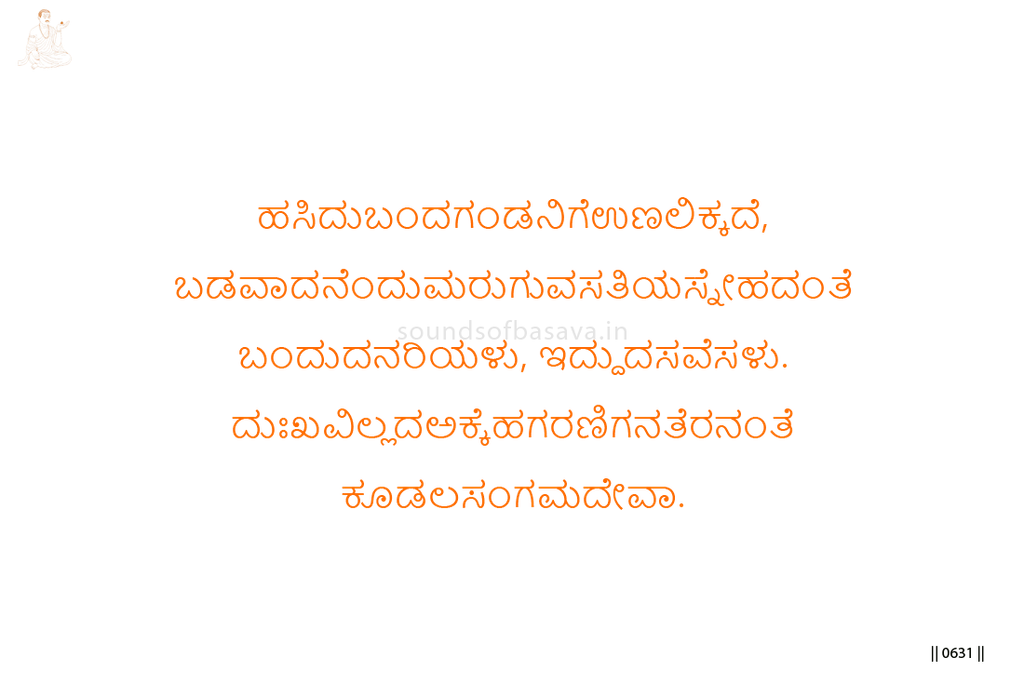
In this vachana, Basavanna exposes love that remains only in expression and does not become action. A hungry one comes, but food is not given. Instead, the person says, “I am poor,” and grieves aloud.
The contradiction is direct. Need is visible, and yet response is withheld. Words of sorrow or helplessness cannot become love when nourishment is refused.
The hired mourner completes the teaching. Such a mourner may cry loudly, but the grief is not inwardly true. In the same way, compassion that does not feed becomes performance before Kudalasangama Deva.
Imagery & Symbolic Relevance
The hungry one is the first image. Hunger is immediate and concrete. It does not ask for explanation, display, or emotion; it asks for food.
The refusal to feed is the central action. Basavanna’s concern is not poverty itself, but the contradiction between seeing need and withholding response.
The cry “I am poor” gives the vachana its sharpness. If the statement is used to avoid giving when something can be given, it becomes an excuse rather than truth.
The image of affection or love is tested through action. Love is not proved by grieving words. It is proved by feeding the one who has come hungry.
The hired mourner is the final comparison. A hired mourner performs sorrow without real inner participation. Basavanna uses this image to show that emotional display without response is not compassion.
Together, the images teach that love must become substantive action. Where hunger is seen, feeding is the measure. Where only grief is shown, the act remains hollow.
Lingayoga
In Lingayoga, this vachana brings devotion into conduct. Feeling, speech, and sorrow do not complete the path unless they become living response.
The practice-point is simple: when need stands before the seeker, respond. Do not replace giving with self-pity, explanation, or performed concern.
For Sharana Sthala, the teaching is practical compassion. The Sharana does not dramatize love while withholding nourishment. Love becomes true when it is given.
Editorial Commentary
This vachana should not be expanded beyond its actual images. Basavanna is not giving a general essay on sorrow; he is correcting a specific failure: seeing hunger and not feeding. The hired mourner image should remain central, because it shows the difference between real compassion and performed emotion.
Related Vachana
Supporting Vachana
Prasadi Sthala Vachana 197 — The Offering That Fulfills
Prasadi Vachana 197 teaches that when Jangama is nourished, Linga is satisfied, and that offering becomes complete when it reaches the living field of reception. Vachana 218 gives the negative form of the same principle: when the hungry one comes and food is withheld, love remains only performance. Prasadi Vachana 197 therefore supports the teaching by showing why nourishment is not secondary to devotion, but the field where offering becomes fulfilled before Kudalasangama Deva.
Advancing Vachana
Aikya Sthala Vachana 1162 — The Giver and the Receiver Are Kudalasanga
Aikya Vachana 1162 advances this teaching by removing the final self-claim from the act of giving. In Vachana 218, Basavanna corrects the failure to feed and the performance of compassion. In Aikya Vachana 1162, the act of giving is purified further: the giver is Kudalasanga, the receiver is Kudalasanga, and Kudalasangayya alone gives to the three worlds. Thus the Sharana-stage demand for real feeding advances into Aikya as giving without pride, where compassion acts but does not claim ownership before Kudalasangama Deva.
