

Summary
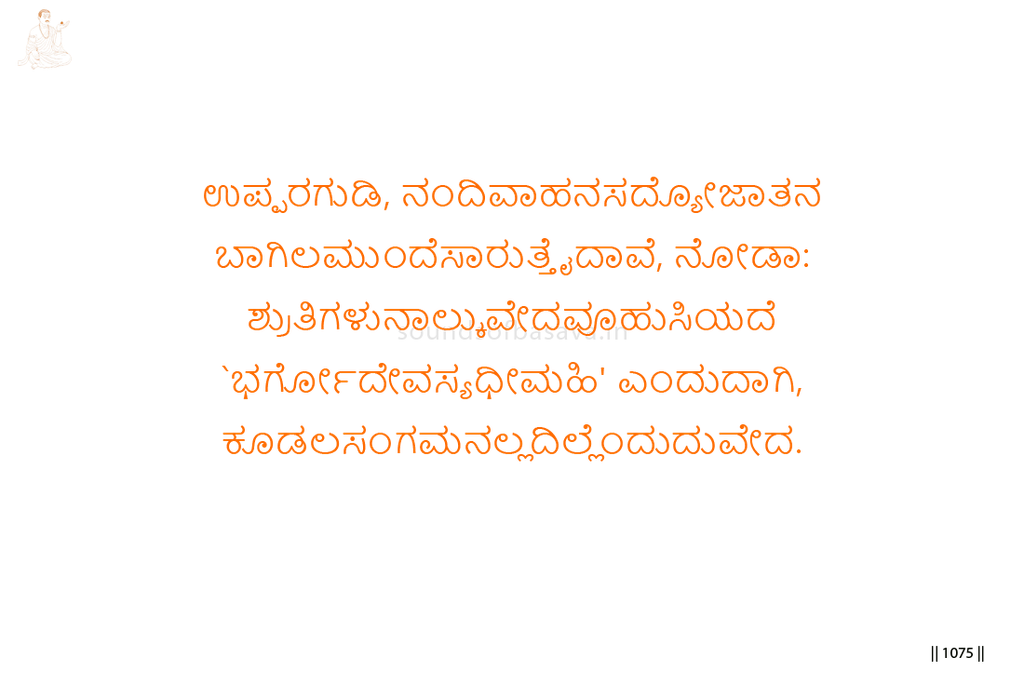
Before the elevated shrine, with Nandi as the sacred vehicle and at the doorway associated with Sadyojata, a proclamation is being made.
Basavanna asks us to observe what is proclaimed there. The Śrutis and the four Vedas declare without falsehood:
“Bhargo Devasya Dhīmahi” — “We meditate upon the Divine Radiance.”
For Basavanna, the full meaning of that Vedic declaration is clear: there is nothing apart from Kudalasangama Deva.
The Vachana does not reject the Vedas. It receives their testimony and recognises Kudalasangama Deva as the Divine Radiance they proclaim. The Aikya movement lies in this certainty: sacred form, scriptural utterance, meditation, and the radiance meditated upon find their fulfilment in Kudalasangama Deva alone.
Imagery & Symbolic Relevance
The Elevated Shrine
The Vachana opens within a visible sacred setting.
The elevated shrine gives the proclamation a formal and public location. The teaching is not presented as a hidden private opinion. It is declared at a recognised place of worship.
The height of the shrine may indicate dignity and sacred prominence, but the Vachana does not make architectural elevation its final concern. Basavanna immediately turns attention from the structure to the truth being proclaimed there.
The shrine provides the setting; the Vedic declaration provides the meaning.
Nandi, the Sacred Vehicle
Nandi appears as the vehicle of Shiva and as the devoted presence before the sacred doorway.
His presence signifies steadfast orientation toward Shiva. He faces the Lord without distraction and embodies unwavering devotion.
Within this Vachana, Nandi belongs to the sacred arrangement surrounding the proclamation. He should not be treated as an obstacle or unnecessary intermediary. His presence contributes to the atmosphere of Shiva-centred worship in which the Vedic words are being uttered.
The Doorway of Sadyojata
The proclamation occurs before the doorway associated with Sadyojata.
Sadyojata is one of the sacred names or aspects of Shiva. The doorway marks an entrance into the field of Divine recognition.
The imagery therefore joins:
the sacred structure;
Nandi’s unwavering orientation;
the doorway of Shiva;
the proclamation of Śruti and Veda.
Basavanna’s concern is not to dismiss these elements, but to reveal the One toward whom they point.
“See”
The word “see” gives the Vachana its directness.
Basavanna asks the listener not merely to hear the recitation, but to recognise its meaning. Sacred words must be understood in relation to the Divine Reality they proclaim.
The movement is from hearing to seeing, and from recitation to recognition.
The Śrutis and the Four Vedas
Basavanna names both the Śrutis and the four Vedas.
Their testimony is not dismissed as empty or false. On the contrary, he says that they declare this truth without falsehood.
This is essential. The authority of the Vedas is invoked positively. The Vedas themselves proclaim the Divine Radiance, and Basavanna identifies the truth of that radiance with Kudalasangama Deva.
The tension in the Vachana is therefore not between Basavanna and the Vedas. It is between merely repeating their words and recognising what those words reveal.
“Without Falsehood”
The phrase affirming that the Śrutis and Vedas speak without falsehood gives weight to their declaration.
Basavanna does not accuse scripture of misleading the seeker. He treats its central proclamation as true.
What is required is right recognition. The words of scripture must not remain disconnected from Kudalasangama Deva, whom Basavanna knows as their living truth.
“Bhargo Devasya Dhīmahi”
The quoted Vedic words mean:
“We meditate upon the Divine Radiance.”
Bharga or Bhargo signifies radiant, purifying Divine brilliance.
Devasya means “of the Divine.”
Dhīmahi means “we meditate upon” or “we hold in contemplative awareness.”
The phrase therefore joins Divine radiance with meditation. The radiance is not merely described; it is to be contemplated and inwardly known.
Basavanna takes this declaration seriously. If the Vedas call the seeker to meditate upon Divine radiance, that radiance must be recognised in the Lord who has become the sole ground of his life.
Kudalasangama Deva as the Vedic Radiance
The final movement identifies Kudalasangama Deva with the truth proclaimed by the Vedas.
Basavanna does not leave Bhargo Devasya Dhīmahi as an unnamed or distant principle. For him, Kudalasangama Deva is the living Divine Reality of that proclamation.
The Vedic phrase and Basavanna’s direct recognition are therefore brought together:
the Vedas proclaim Divine radiance;
meditation is directed toward that radiance;
Basavanna recognises Kudalasangama Deva alone as its truth.
Nothing Apart from Kudalasangama Deva
The concluding declaration is the heart of the Vachana.
There is nothing apart from Kudalasangama Deva.
This is more than saying that Kudalasangama Deva is one deity among others. The phrase removes the possibility of a second, independent sacred ground.
The shrine cannot stand apart from Him.
Nandi cannot stand apart from Him.
Sadyojata cannot stand apart from Him.
The Vedas cannot stand apart from Him.
The radiance they proclaim cannot stand apart from Him.
The awareness that meditates cannot stand apart from Him.
All are understood within Kudalasangama Deva.
The Aikya Movement
The Aikya state expressed here is the ending of separation between scriptural proclamation and realised recognition.
The Vedas speak of Divine radiance. Basavanna does not merely accept the words intellectually; he knows Kudalasangama Deva as that radiance and as the Reality outside whom nothing remains.
Scripture is thus fulfilled in Anubhava. The spoken declaration becomes the settled ground of lived awareness.
Lingayoga
In Lingayoga, scriptural knowledge must lead toward direct relation with Linga.
The practitioner may hear sacred recitation, learn mantras, enter places of worship, and honour established forms. Yet each must deepen recognition of Kudalasangama Deva rather than remain an external accomplishment.
The quoted phrase provides a clear contemplative movement: awareness is gathered toward Divine radiance. For Basavanna, that meditation becomes one-pointed because no sacred centre remains apart from Kudalasangama Deva.
The practical discipline is therefore not the rejection of form or scripture. It is their inward fulfilment:
hear the sacred word;
understand what it proclaims;
meditate upon the Divine radiance;
recognise that radiance in the Linga;
live without establishing another centre apart from Kudalasangama Deva.
When the Vedic word, meditation, Linga-awareness, and lived conduct share one centre, scriptural knowledge becomes Anubhava.
Editorial Commentary
Śruti refers to revealed sacred teaching. The four Vedas belong to this authoritative scriptural field.
Bhargo Devasya Dhīmahi is a Vedic declaration meaning, “We meditate upon the Divine Radiance.”
Bhargo signifies luminous and purifying Divine brilliance.
Dhīmahi indicates contemplative meditation or the inward holding of that radiance in awareness.
Sadyojata is a sacred name or aspect of Shiva associated with the doorway named in the Vachana.
The fixed title, The Radiance Within, is retained. The word “within” should be understood as realised and inwardly assimilated Divine presence. It should not be used to claim that the Vachana rejects temples, Nandi, sacred doorways, or the Vedas.
The Kannada gives the Vedas positive authority: they speak without falsehood. Basavanna’s decisive statement is that the Divine radiance they proclaim is not apart from Kudalasangama Deva.
Related Vachana
Supporting Vachana
Sharana Sthala Vachana 521 — I Lost the World, I Was Born Anew
Sharana Vachana 521 describes Basavanna’s transformation through worshipping and touching Kudalasangama Deva. Shame, caste-measure, inherited custom, and the former worldly identity lose their authority, and he declares that he has been born anew through Divine contact.
This prepares Vachana 529 by establishing that sacred truth must transform the ground of identity.
In Vachana 521, direct contact with Kudalasangama Deva frees Basavanna from inherited social measures. In Vachana 529, that transformed awareness receives the Śrutis and Vedas through the same direct Divine centre.
What begins as rebirth through worship and touch matures into the Aikya recognition that the Divine radiance proclaimed by scripture is not apart from Kudalasangama Deva.
Advancing Vachana
Aikya Sthala Vachana 1362 — Kudalasangama Deva Alone
Vachana 529 receives the Vedic declaration “Bhargo Devasya Dhīmahi” and recognises that nothing exists apart from Kudalasangama Deva.
Vachana 1362 advances this recognition by giving the Vedas’ testimony greater completeness. The Vedas declare Shiva to be the Lord of all worlds and the cause of their arising, sustaining, and dissolution. Basavanna then identifies Kudalasangama Deva alone as that One God proclaimed by the Vedas.
The movement is precise:
Vachana 529 identifies Kudalasangama Deva with the Divine radiance contemplated in the Vedic declaration.
Vachana 1362 identifies Him with the One whom the Vedas proclaim as Lord, source, sustainer, and dissolver of all existence.
Scriptural radiance deepens into complete scriptural and realised certainty.
Thus the Divine light of Vachana 529 advances into the recognition of Kudalasangama Deva alone as the source and governing ground of all worlds.
