

Summary
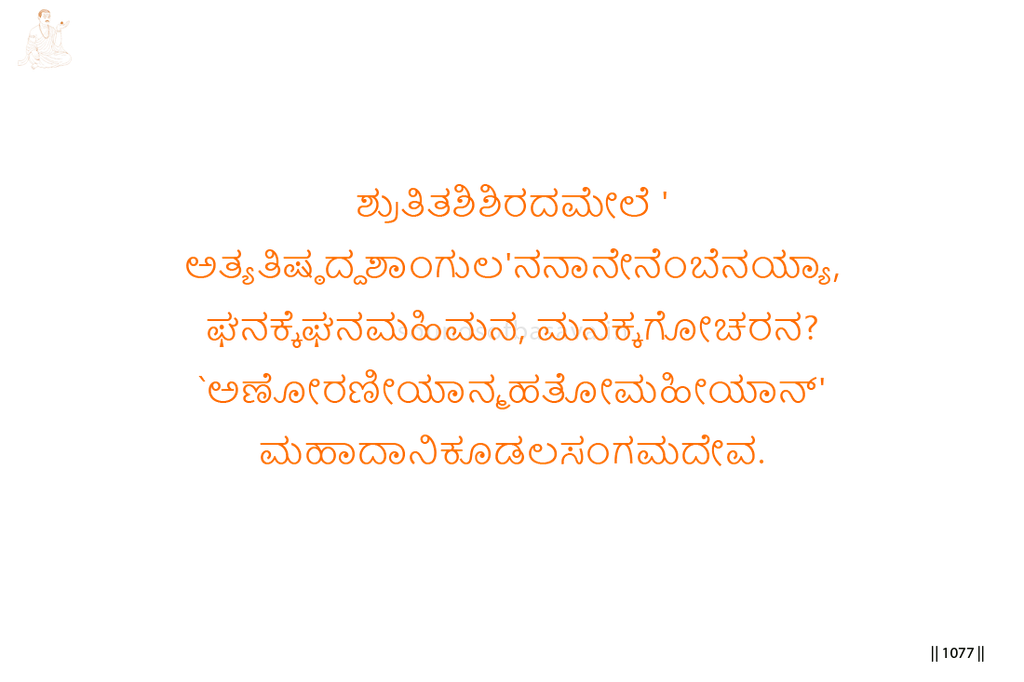
Basavanna stands before the highest declaration of Śruti and asks what more he can say.
Kudalasangama Deva possesses a greatness beyond the greatest and remains beyond the mind’s grasp. Yet Śruti also declares Him to be smaller than the smallest.
The vachana removes ordinary measurement. Neither speech, thought, smallness, nor greatness can contain the Great Giver, Kudalasangama Deva.
Imagery & Symbolic Relevance
The summit of Śruti gives the opening position. Basavanna turns to the highest point reached by revealed speech.
The quoted expression “atyatiṣṭhad daśāṅgulam” indicates that the Divine stands beyond what is manifested and measured. Even Śruti points beyond the field it describes.
Basavanna’s question, “What can I say?”, marks the limit of his own speech. After Śruti has reached its highest declaration, personal explanation cannot add an adequate measure.
The phrase “greater in glory than the great” removes comparison with anything regarded as vast, powerful, or exalted. Kudalasangama Deva’s greatness cannot be established by placing Him beside another greatness.
The statement “beyond the mind’s grasp” gives the next limit. The mind works through distinction and comparison, but the Lord cannot be enclosed within such thought.
The Śruti declaration “smaller than the smallest, greater than the greatest” brings opposite measures together. Kudalasangama Deva is not confined either to subtlety or vastness.
The name Mahādāni, the Great Giver, closes the vachana. The One beyond scale and mental grasp is still addressed through a direct devotional relationship as Kudalasangama Deva.
Lingayoga
In Lingayoga, the seeker must recognize the limit of conceptual measurement.
The Linga cannot be grasped as an object that is merely large, small, near, distant, subtle, or vast. Such categories may point, but they cannot contain Kudalasangama Deva.
The seeker should therefore approach Śruti with humility. Its words guide awareness toward the Lord, but they do not make Him an object possessed by the mind.
The practice-point is direct: allow scriptural understanding to lead beyond comparison and mental grasp, without turning knowledge into self-claim.
Editorial Commentary
The two Sanskrit expressions should remain connected to their function in the Kannada. The first indicates Divine transcendence beyond the manifested measure; the second removes the opposition between smallest and greatest.
The statement that Kudalasangama Deva is beyond the mind does not mean that the vachana rejects understanding. It rejects the claim that thought can fully contain or measure Him.
The closing name Mahādāni preserves devotion within this recognition. The Lord is immeasurable, yet He is addressed as the Great Giver.
Related Vachana
Supporting Vachana
Sharana Sthala Vachana 1311 — Come Having Won Through the Weapon of Divine Feeling
Sharana Vachana 1311 says that the excessively clever mind cannot seize the boundless Bayalu. The seeker must overcome the urge to grasp through intellect and approach through living Bhava.
This directly prepares Vachana 531. In Sharana, the calculating mind is shown to be incapable of capturing Divine Vastness. In Aikya, Kudalasangama Deva is explicitly declared beyond mental grasp and beyond the measures of small and great.
Advancing Vachana
Aikya Sthala Vachana 1312 — The Secret of Dissolution and the One Reality
Vachana 531 removes the measures through which the mind tries to define Kudalasangama Deva.
Vachana 1312 carries this further by showing differentiated levels and categories dissolving into their source, while the One Reality remains.
Thus, the failure of measurement in Vachana 531 advances into the dissolution of the measuring distinctions themselves in Vachana 1312.
