

Summary
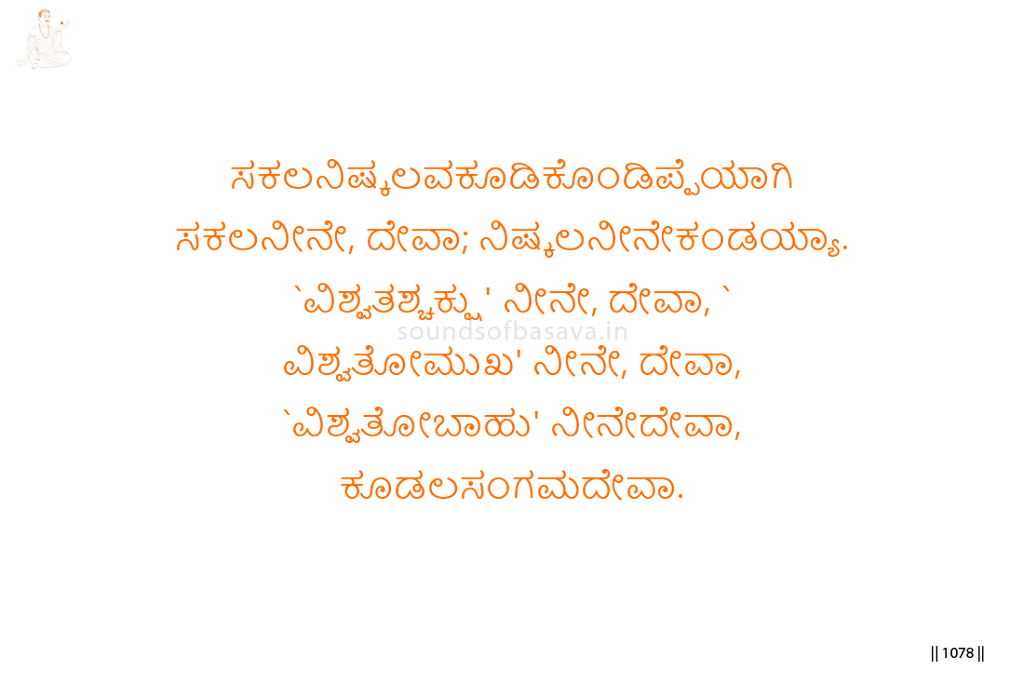
Basavanna declares that Kudalasangama Deva holds Sakala and Niṣkala together. He alone is the manifest, and He alone is the formless.
The Śruti expressions that follow present Him as the eye of the whole, the face of the whole, and the arms of the whole.
The vachana therefore recognizes no separation between the Divine beyond form and the Divine present throughout seeing, presence, and action.
Imagery & Symbolic Relevance
The joining of Sakala and Niṣkala gives the opening movement. Basavanna does not place them as two opposing realities.
Sakala indicates that which appears with form, quality, and manifestation. Basavanna says that Kudalasangama Deva Himself is this manifest presence.
Niṣkala indicates that which is beyond division and form. This too is not another reality; Kudalasangama Deva Himself is Niṣkala.
The expression “Viśvataś-cakṣuḥ” presents the Lord as the eye turned everywhere. No field of seeing stands outside His presence.
“Viśvato-mukhaḥ” presents Him as the face turned everywhere. Divine presence is not confined to one location, direction, or visible form.
“Viśvato-bāhuḥ” presents Him as the arms extended everywhere. The image places action, reach, and sustaining power within the same all-pervading presence.
The repeated declaration “You alone are the Deva” joins all three expressions directly to Kudalasangama Deva.
The vachana moves from the unity of form and formlessness to the recognition of Divine presence throughout seeing, manifestation, and action.
Lingayoga
In Lingayoga, the seeker must not divide Linga into an outer formed presence and a separate formless reality.
Sakala and Niṣkala must be held together. The Linga received in form does not exclude the boundless presence beyond form, and the formless must not be used to deny the manifest.
The three Śruti expressions extend this recognition into life. Seeing, embodied presence, and action must not be treated as fields outside Kudalasangama Deva.
The practice-point is direct: do not choose between form and formlessness; recognize the one Linga through both.
Editorial Commentary
The vachana does not merely say that Sakala and Niṣkala coexist. The opening phrase says that they are held together in Kudalasangama Deva.
The three Sanskrit expressions should remain close to their actual images: universal eye, universal face, and universal arms.
The emphatic “kandaiyya” gives the force of recognition or beholding. The teaching is presented as something to be seen, not merely discussed.
Related Vachana
Supporting Vachana
Sharana Sthala Vachana 1375 — The Fitness for Linga-Aikya
Sharana Vachana 1375 asks how one who is not inwardly present to Sakala can become true in Niṣkala. It rejects the attempt to claim the formless while neglecting the all-pervading manifest field.
This directly prepares Vachana 532. In Sharana, the seeker is required to remain true to Sakala before claiming Niṣkala. In Aikya, the distinction is resolved: Kudalasangama Deva Himself is both Sakala and Niṣkala.
Advancing Vachana
Aikya Sthala Vachana 941 — See the Sahaja Sharana
Vachana 532 recognizes Sakala and Niṣkala as held together in Kudalasangama Deva.
Vachana 941 carries this recognition into the living Sharana. There, form and formlessness are seen together, while the Sharana neither deceives embodied life nor abandons the work at hand, but abides continuously in Sahaja.
Thus, the Divine unity declared in Vachana 532 advances into an embodied state where form and formlessness no longer divide life or conduct.
