

Summary
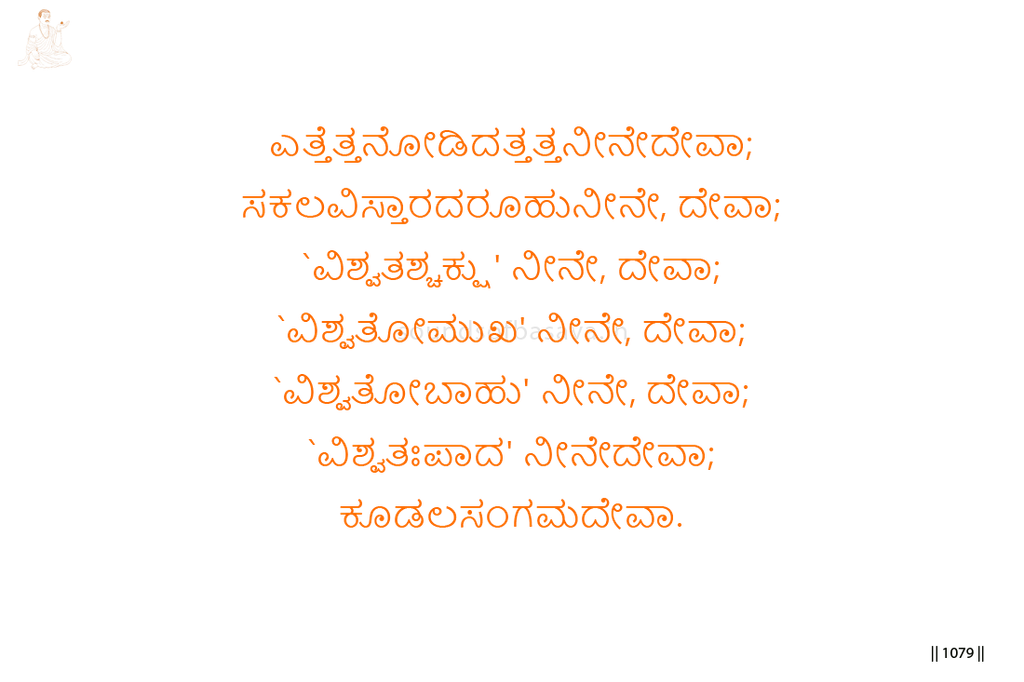
Basavanna declares that wherever he looks, Kudalasangama Deva alone is present. The Lord is the form of the entire manifested expanse.
He then identifies Him through the Śruti expressions: the eye turned everywhere, the face turned everywhere, the arms extended everywhere, and the feet present everywhere.
The vachana presents seeing, presence, action, and movement as occurring within the all-pervading presence of Kudalasangama Deva.
Imagery & Symbolic Relevance
The opening statement, “wherever I look, there You are,” gives the central recognition. No direction or visible field is outside Kudalasangama Deva’s presence.
The phrase “the form of the entire expanse” gathers the spread of manifested existence into Him. Basavanna does not place the world on one side and the Lord on another.
“Viśvataś-cakṣuḥ” presents Kudalasangama Deva as the eye turned everywhere. Seeing is not confined to one observer or direction.
“Viśvato-mukhaḥ” presents Him as the face turned everywhere. Presence appears in every direction without being limited to one visible form.
“Viśvato-bāhuḥ” presents Him as the arms extended everywhere. Action, reach, and sustaining activity are included within the Divine expanse.
“Viśvataḥ-pādaḥ” presents Him as the feet present everywhere. No place of standing, movement, or approach lies outside Him.
The repeated statement “You are the Deva” joins each expression to Kudalasangama Deva. The eye, face, arms, and feet are not separate powers; they reveal one all-pervading Lord.
Lingayoga
In Lingayoga, the seeker must learn to recognize Linga-presence throughout the field of experience.
Seeing should not reinforce separation between observer, world, and Linga. Action and movement should likewise not be treated as occurring outside Kudalasangama Deva.
The four expressions give a practical orientation: perception, presence, activity, and movement must all remain Linga-centred.
The practice-point is direct: wherever awareness turns, recognize Kudalasangama Deva rather than constructing a second field apart from Him.
Editorial Commentary
The vachana itself does not develop an elaborate anatomy of a cosmic person; it gives four precise Śruti expressions and repeatedly identifies each with Kudalasangama Deva.
The word “everywhere” governs all four images. Their force lies in the removal of spatial limitation, not in describing separate Divine organs.
The statement that the Lord is the form of the whole expanse should therefore remain close to the Kannada and not be extended into unsupported cosmological doctrine.
Related Vachana
Supporting Vachana
Sharana Sthala Vachana 138 — The Mark Beyond All Marks
Sharana Vachana 138 declares that the devotee’s body is Kudalasangama Deva’s own body. It removes the habit of measuring the Linga-bearing person through clan, status, or external marks.
This prepares Vachana 533 by establishing embodied life as a field of Divine presence. What Sharana Vachana 138 recognizes in the devotee’s body is expanded in Aikya Vachana 533 to the whole manifested expanse: wherever one looks, the eye, face, arms, and feet are Kudalasangama Deva’s.
Advancing Vachana
Aikya Sthala Vachana 534 — Within the Great House
Vachana 533 recognizes Kudalasangama Deva throughout the visible expanse through the universal eye, face, arms, and feet.
Vachana 534 carries this recognition further by gathering the foundations, worlds, oceans, cosmic origin, and Divine functions within Kudalasangama Deva’s Great House.
Thus, the all-pervading presence seen throughout manifestation in Vachana 533 advances into the recognition that the whole cosmic order abides within Him.
