Poetic Rendering

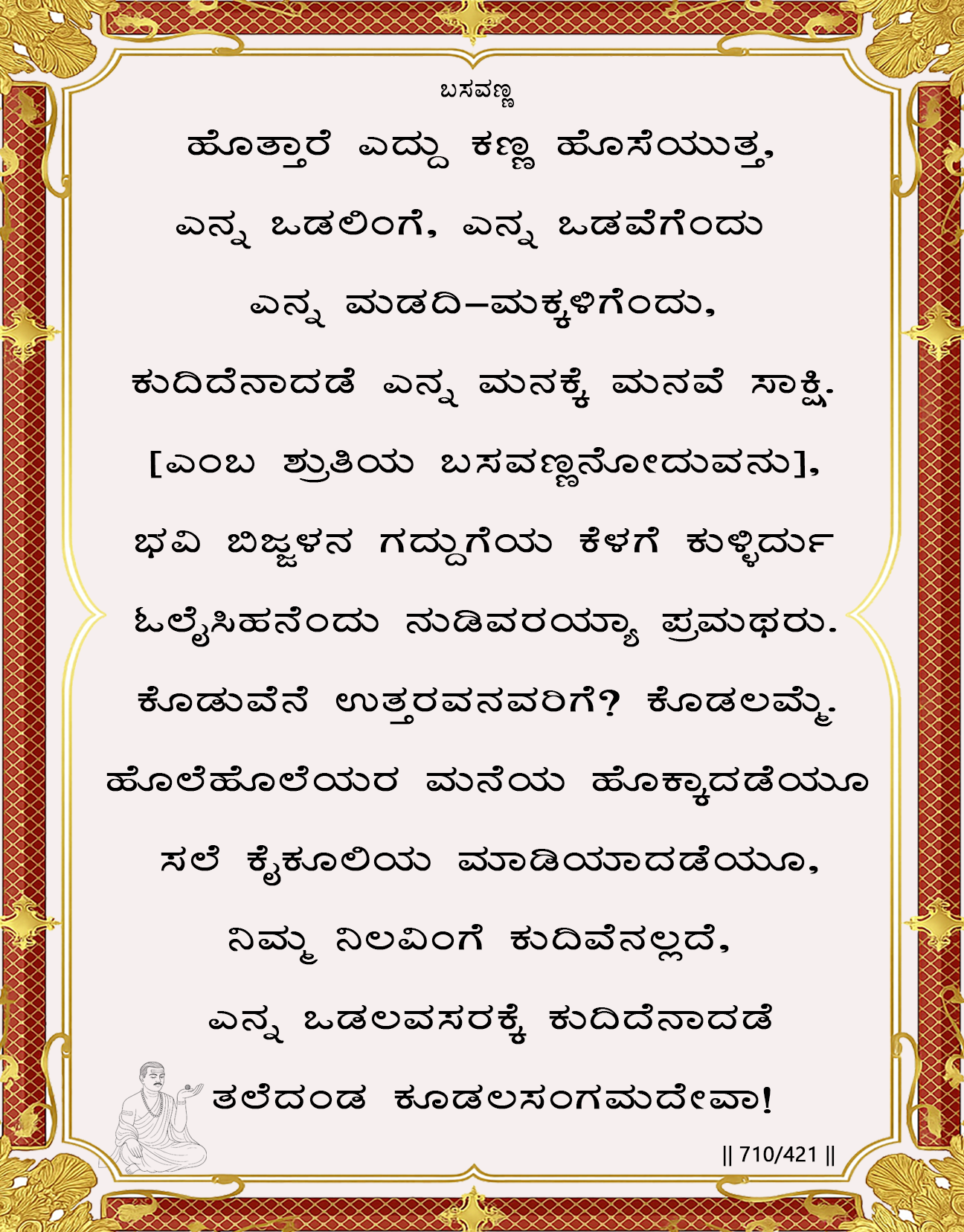
At dawn I rise
not for You, but to serve body,
wealth, wife, and child;
my own mind knows this truth.
One tied only to household cares
is but a paid servant in a king’s court.
Will empty praise reach the Primal One?
Will hollow prayer move the Divine?
Better to labor humbly and walk toward You
even if kings mock me beneath their thrones.
For work done for You is gain;
done for myself, ruin
Kudalasangamadeva.
Basavanna exposes how human life drifts into unconscious servitude not to God, but to the body, possessions, and family. Such devotion to the transient makes one a servant of worldly systems rather than a seeker of truth. Empty ritual and lip-service cannot reach the Divine. The remedy is a reorientation of life through sincere awareness and purposeful action: living, working, and serving in a way aligned with the Divine. Work rooted in devotion is upliftment; work rooted only in ego is bondage. The vachana calls for a return to the true center of life God as the underlying purpose of all actions.
Spiritual Context
Core Spiritual Principle: Karya-Karana Sankalpa – The Doctrine of Intent in Action. The spiritual value of an action is determined not by its external form (ritual, labor, prayer) but by the fundamental intent (sankalpa) behind it: is it for the sustenance of the limited self (ahamkara) or as an offering to the limitless Divine (Linga)?
Cosmic Reality Perspective: In Shiva-Shakti dynamics, Shakti is the power of action (kriya-shakti). When this power is contracted and identified solely with maintaining the individual organism and its social extensions (family, wealth), it reinforces duality. When the same power is recognized as an expression of Shiva and consciously redirected toward its source, it becomes the path of union. The energy is the same; the direction defines bondage or freedom.
Historical Reality (Anubhava Mantapa Context): This vachana is the philosophical foundation of Kayaka (sacred labor) as social revolution. It dismantles the Brahmanical hierarchy that separated “sacred” ritual from “profane” work. For Basavanna, a blacksmith at his forge with divine intent is spiritually superior to a priest performing empty rituals for a fee. It created a dignity of labor rooted in inner orientation.
Interpretation
The “fourfold” servitude (body, wealth, wife, child) represents the complete circle of worldly attachment (samsara), from personal survival to social extension. The “paid servant in a king’s court” is a devastating metaphor: one who performs all duties for a meager, transient reward (pleasure, security, status) while believing themselves to be free. “Empty praise” and “hollow prayer” represent the failure of the religious path when devoid of this sincere reorientation of intent. “Better to labor humbly” establishes Kayaka as the superior sadhana concrete action infused with right intent.
Practical Implications: One must perform a constant audit of intention. Before any significant action, ask: “Who is the ultimate beneficiary of this labor my small self or the Divine within?” This transforms mundane tasks into spiritual practice and exposes religious ritual that is performed for social approval or personal gain.
The Cosmic Reality
Anga (Human Dimension): The complex of attachments and identities (“my body, my wealth, my family”). It is a state of constant, anxious labor to maintain and protect these transient formations, mistaking this maintenance for the purpose of life.
Linga (Divine Principle): Koodalasangamadeva as the “Primal One,” the fundamental source and end of all energy and action. It is the silent center that gives meaning to all motion. Action not referenced to this center is spiritually chaotic.
Jangama (Dynamic Interaction): The Jangama is the moment of conscious choice and re-channeling. It is the will that takes the same energy used to earn money for the family and dedicates its essence to the Divine. It is the bridge where worldly action (vyavahara) is infused with spiritual purpose (paramartha).
Shata Sthala
Primary Sthala: Bhakta. This is the core curriculum of the Bhakta. True devotion (bhakti) is tested not by emotion but by the direction of one’s life energy. The Bhakta must practice turning every action into an offering, transforming servitude to the world into service to the Divine.
Supporting Sthala: Sharana. To perform this reorientation consistently is to live as a Sharana one who has taken total refuge. Refuge is not passive hiding; it is the active re-dedication of all one’s capacities (labor, love, responsibility) to the feet of the Linga.
Practical Integration
Arivu (Awareness Practices): Cultivate “intention awareness.” At the start of each day or task, silently dedicate the energy and fruits of your action to the Divine principle within. When feeling stressed or bound by duty, inquire: “To which of the four masters am I currently a servant? Can I offer this same service to the One?”
Achara (Personal Discipline): Simplify your life to reduce compulsive service to “wealth” and “body.” Let your discipline be the conscious maintenance of the body as a tool for Divine service, not as an end in itself. Fulfill family duties as a sacred trust, not a possession.
Kayaka (Sacred Action): This vachana is the doctrine of Kayaka. Perform your profession or daily chores with excellence, but internally frame it as worship. The quality of your attention and integrity becomes the offering, regardless of the world’s praise or mockery.
Dasoha (Communal Offering): Build economic and social communities where work is organized around principles of shared sustenance and divine purpose, not just profit and accumulation. Honor those whose labor is simple but offered with sincerity.
Modern Application
We are hyper-efficient “paid servants” in the global court of consumer capitalism. Our “fourfold path” is servicing our health (body), career and debt (wealth), relationships (wife/husband), and children’s future often with a deep sense of burnout and existential emptiness. Spiritual life becomes another item on the to-do list (“hollow prayer”), performed for stress relief rather than radical reorientation.
This vachana liberates by reframing your entire life’s workload. You don’t need to quit your job or abandon your family. You need to change the inner address to which you send the energy. The pressure to succeed transforms into the grace of offering. Your work, even if mocked or deemed humble, gains cosmic dignity. It solves burnout by providing an inexhaustible “why.”
Essence
The same hands that build and earn,
The same heart where passions burn,
Can serve a cage, or serve the Sun.
The deed itself is never done
For good or ill the choice is one:
Who owns the wish before it’s won?
Redirect the river’s run.
This vachana describes spiritual vector calculus. Every action has a magnitude (energy expended) and a direction (intent). Most lives are the sum of vectors pointing toward the four coordinates of worldly security, resulting in net spiritual displacement zero (bondage within samsara). Basava yoga is the operation of recalculating each vector’s direction toward the singular coordinate of the Linga. The magnitude (the work) remains the same, but the resultant force now moves the individual toward liberation.
Life is like driving a delivery truck. You can spend all your fuel making deliveries for “Me & Mine Inc.” (a draining, endless job), or you can drive for “The Universe Express” (the same roads, the same truck, but every delivery feels part of a meaningful whole). The vachana says: change the company you work for in your heart.
We fear that dedicating our life to the Divine means neglecting our practical responsibilities. This vachana reveals the opposite: it is only by dedicating our responsibilities to the Divine that we perform them with true love, freedom, and sanity, without being enslaved by them. Purpose is not a separate activity; it is the direction you give to your existing energy.

Views: 11