Poetic Rendering

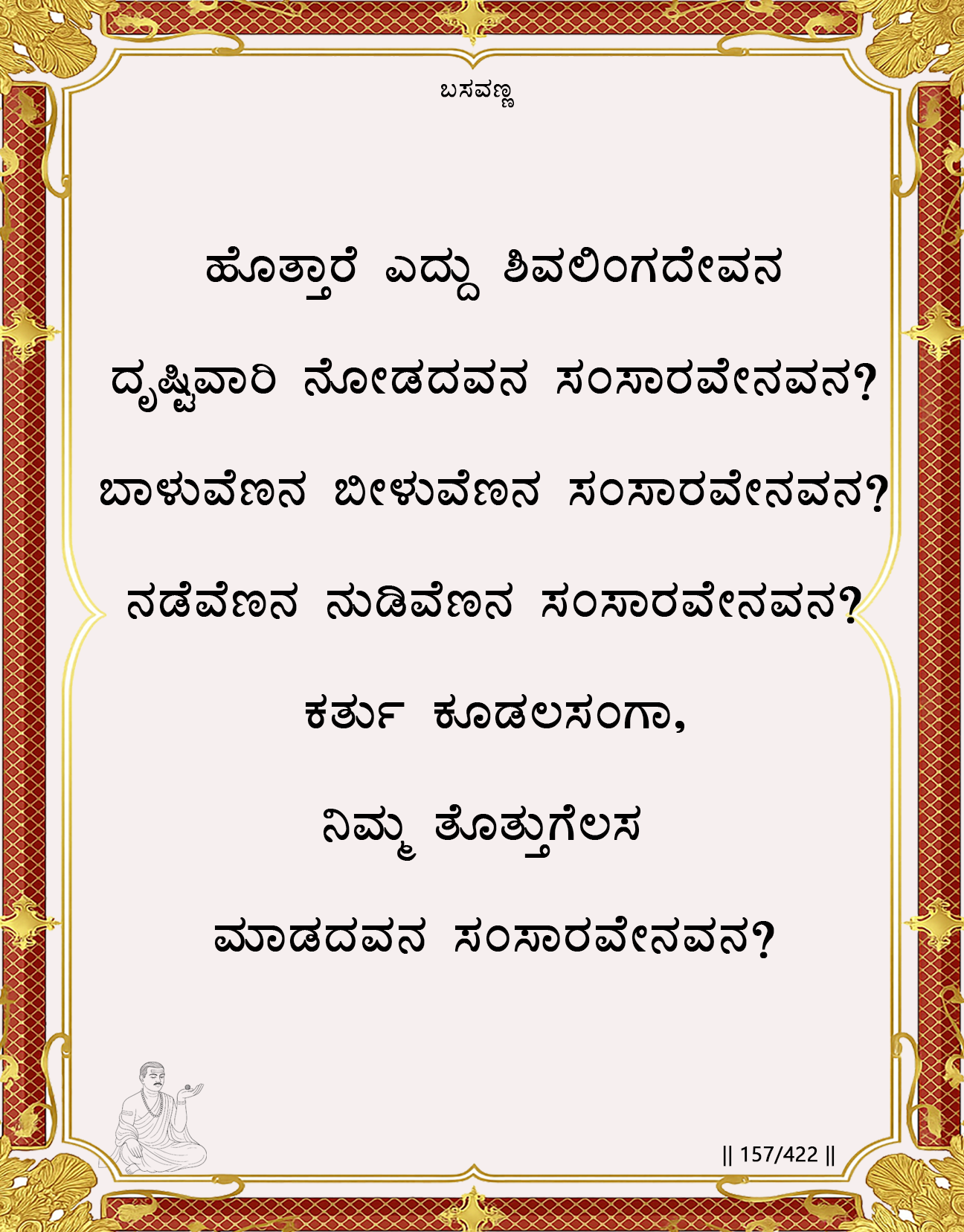
At dawn, if not for the Linga’s worship,
what use is the morning sight?
If life is lived only for food,
if sleep is all one seeks,
if one drags through days like the dead
what worth is such an existence?
O Kudalasangama,
a life has meaning only
when devoted to Your eternal service.
Basavanna confronts the seeker with a stark question of purpose. Mere survival eating, sleeping, and going through the motions of life is not life at all. Similarly, external accomplishments or ritual acts devoid of heartfelt devotion to the Linga are empty. Core Principle: The value of life is measured by its orientation toward the eternal. The morning light, the body, the breathall are meaningful only when employed in the service of God. A human existence without this conscious purpose is equivalent to living like the dead. True life is awakened through devotion, service, and continuous remembrance of the Divine.
Spiritual Context
Core Spiritual Principle: Karana-Samarpana – The Principle of Consecrating the Instruments. The senses, the body, and the cycles of time are mere instruments (karana). Their true utility and worth are realized only when consciously surrendered and dedicated to the Divine. Life is not for using the Divine to enhance worldly experience, but for using worldly experience to realize the Divine.
Cosmic Reality Perspective: In the non-dual view, Shiva is pure Consciousness and Shakti is its expressive power (shakti) manifesting as all activities (seeing, eating, moving). When these activities are performed with identification to the limited body-mind, Shakti is trapped in illusion (maya). When performed as service to Shiva-consciousness, the same Shakti reveals its true nature as divine play (lila), unifying the actor and the act.
Historical Reality (Anubhava Mantapa Context): This vachana served as a wake-up call to the community, preventing the revolutionary Basava yoga path from decaying into another set of empty routines. It reminded Sharanas that their rejection of Vedic ritual was pointless if their daily lives became another unconscious ritual of survival. It infused the quotidian with urgent spiritual significance.
Interpretation
“Morning sight” represents the first and most fundamental faculty awareness itself. Basavanna asks: to what is your primary awareness attached? “Food” and “sleep” symbolize the entire cycle of desire and replenishment that sustains the body-identity. “Dragging through days like the dead” is the ultimate consequence of a life without a unifying spiritual center it is motion without direction, a living death (jivan-mukta in the negative sense). The final question implies its own answer: the “use” and “worth” of anything is solely defined by its role in “Your eternal service.”
Practical Implications: Every daily act must be re-contextualized. Upon waking, first acknowledge the source of awareness. Before eating, offer the act of nourishment. See sleep as a surrender to regain strength for service. This is not about adding rituals, but changing the inner referent of all existing actions.
The Cosmic Reality
Anga (Human Dimension): The bio-psychic apparatus functioning in its minimal, maintenance mode. It is life-force (prana) constrained to sustaining the physical vessel, devoid of higher intentionality. It is potential without purpose.
Linga (Divine Principle): Koodalasangamadeva as the ultimate “for-the-sake-of-which” (artha). It is the meaning that animates form, the purpose that transforms function into worship. It is the living center that calls the periphery into conscious relationship.
Jangama (Dynamic Interaction): The Jangama is the vector of devotion that connects the two. It is the active choice to use the “morning sight” to perceive the divine in all things, to make the act of eating a prasada, and to turn daily labor into kayaka. It is the life-force consciously redirected from maintenance to communion.
Shata Sthala
Primary Sthala: Bhakta. This vachana defines the essence of the Bhakta stage: the devotee is one for whom every faculty and moment becomes an occasion for devotion. It is the stage where the seeker moves from unconscious living to living for the Divine.
Supporting Sthala: Maheshwara. The vachana describes a fallen, mechanical version of Maheshwara performing the duties of the body and social life with ritualistic regularity but without the animating spirit of bhakti. True Maheshwara is when these duties are performed as a conscious offering, which then becomes the foundation for Bhakta.
Practical Integration
Arivu (Awareness Practices): Begin the day with a moment of stillness, asking: “For whom is this sight? For whom is this day?” Use mealtimes, bedtime, and transitions as “mindfulness bells” to re-establish the devotional orientation. Practice seeing your environment as an expression of the Linga.
Achara (Personal Discipline): Establish a simple, consistent practice of morning remembrance (Linga puja, meditation, or silent offering of the day). Let this be the non-negotiable first action that sets the tone, making you the master of your faculties rather than their servant.
Kayaka (Sacred Action): Infuse your work with this sense of service. See your labor as a direct offering to the divine principle inherent in the community and the world. Let the quality of your attention be your primary offering.
Dasoha (Communal Offering): Create community rhythms that reinforce this principle shared meals begun with gratitude, work undertaken collectively for communal benefit, reminding each other that service is the antidote to existential drift.
Modern Application
We live in an age of high-functioning automation: we wake to screens, consume optimized food, follow sleep trackers, and navigate packed schedules, all while experiencing profound existential numbness” dragging through days.” We are efficient biological units lacking a coherent purpose, mistaking productivity for meaning.
This vachana liberates by providing a single, powerful criterion for evaluating life: “Is this act, this day, oriented toward the Eternal?” It cuts through the complexity of modern life. You don’t need to abandon your world; you need to consecrate it. Your morning coffee, your commute, your work performed with the awareness of service to the deeper reality become a continuous worship that resurrects you from the living death of aimlessness.
Essence
The eye that opens on the dawn
But sees no Source from which it’s drawn,
The hand that feeds a hungry heart
But knows not Love as its true art
Is but a clockwork, set to start,
A beating drum without a song.
To live, is to whom you belong.
This vachana describes the metaphysics of coherence versus entropy. An unoriented life is a system tending toward spiritual entropy energy (life-force) dissipating into random, meaningless activities (eating, sleeping, drifting). Worship is the act of applying a coherent field (the Linga as organizing principle) that aligns all these random vectors, creating a laser-like focus of life energy. This focused energy (tapas) then has the power to penetrate reality, moving the system from chaos to order, from death-in-life to life-in-immortality.
A room of tuning forks ringing randomly is noise (a life of mere eating/sleeping). But when a note of the correct frequency is played, they all fall into resonance, creating a powerful, unified sound (a life of devoted service). The vachana says: tune your life to the fundamental frequency of the Divine.
We secretly fear our lives are trivial and forgettable. We combat this with achievements and distractions, but the fear remains. This vachana addresses that fear directly: your life is trivial only if it is not consciously linked to the non-trivial, the Eternal. The linkage is not a grand achievement, but a simple, moment-to-moment orientation of your attention and intention. Meaning is not found; it is assigned by your devotional gaze.

Views: 16