Poetic Rendering

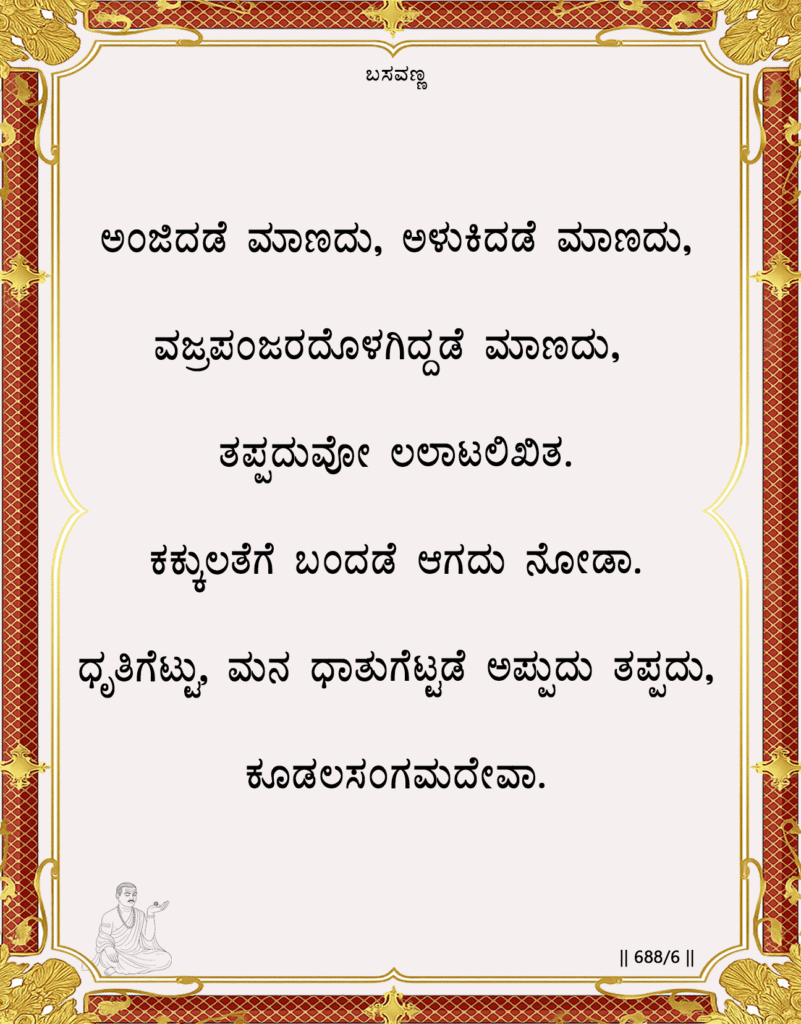
Fear cannot save, nor trembling preserve;
Not even a diamond fortress can protect.
What is written upon
the brow cannot be erased.
Wit may strive,
cunning may scheme yet all in vain.
When courage fails and the mind collapses,
The destined blow falls unfailingly,
O Kudalasangamadeva.
Basavanna teaches that fear or retreat cannot save us from what is destined. Even if one were to imprison oneself within a fortress made of diamond, fate cannot be avoided what is written on the brow must come to pass. Kudalasangamadeva does not seek your fear; he seeks your steadfastness in principle. If one abandons dharma and right conduct, no amount of protection or cunning can avert the consequences. The divine law is inevitable, and true refuge lies only in righteousness, not in fear.
Spiritual Context
Core Spiritual Principle: The cosmic law of Karma is inexorable. Attempts to evade the consequences of one’s actions through fear, cunning, or external safeguards are spiritually futile. The only true “fortress” is righteous living and the courageous acceptance of one’s destiny.
Cosmic Reality Perspective: The universe is a field of perfect cause and effect (Rta/Dharma). Kudalasangama Deva is not a capricious deity to be appeased but the embodiment of this cosmic order. To resist this order is to suffer; to accept it is to align with the Divine will.
Historical Reality (Anubhava Mantapa context): This vachana challenges the superstitious beliefs in ritualistic protection and the caste-based notion that privilege can avert karma. It establishes a radical, democratic principle: everyone is equally subject to the law of cause and effect, and integrity is the only real security.
Interpretation
1. “Fear cannot save, nor trembling preserve…”: Internal states of panic and weakness are useless against the unfolding of karma. They are symptoms of the ego’s resistance, not solutions.
2. “Not even a diamond fortress can protect.”: External, material power and security wealth, status, physical strength are ultimately fragile and meaningless against the subtle and powerful tide of one’s own past actions.
3. “What is written upon the brow cannot be erased.”: “Written on the brow” is a metaphor for Prarabdha Karma the portion of one’s destiny that is to be experienced in this lifetime. It is fixed and must be lived through.
4. “Wit may strive, cunning may scheme yet all in vain.”: The intellectual ego, believing it can outsmart cosmic law, is also doomed to fail. Deceit and cleverness only create more negative karma.
5. “When courage fails and the mind collapses, The destined blow falls unfailingly…”: This is the core mechanism. The “destined blow” is the consequence. It strikes with full force precisely when one abandons the posture of Dharma (courage, integrity) and collapses into a state of fear and self-preservation. The consequence is inseparable from the inner state of avoidance.
Practical Implications: The seeker must focus on acting rightly in the present moment, without attachment to success or fear of failure. One should embrace life’s challenges with courage, understanding them as the just and perfect working out of divine law, and thus transform fate into conscious experience.
The Cosmic Reality
Anga (Human Dimension): The human as a bundle of fears, desires, and cunning strategies. The untransformed Anga tries to build “diamond fortresses” of egoic defense, which are illusory.
Linga (Divine Principle): Kudalasangama Deva as the immutable principle of Dharma and Karma. The Linga is the ultimate reality that governs all action and consequence, demanding alignment, not appeasement.
Jangama (Dynamic Interaction): The dynamic is the unfolding of karma itself. The Jangama is the inevitable “destined blow” the life experience that serves as the perfect teacher to correct the Anga’s misalignment and bring it back to the truth of the Linga (Dharma).
Shata Sthala
Primary Sthala: Maheshwara. This vachana calls for the courage and steadfastness of the Maheshwara, who faces destiny without flinching. It is the stage of developing the inner fortitude to meet one’s karma head-on, without resorting to fear or deceit.
Supporting Sthala: Prasadi. To accept one’s destiny, especially when it is challenging, is to receive it as Prasada (grace). This stage involves the understanding that all experiences, pleasant or unpleasant, are gifts meant for one’s learning and ultimate liberation.
Practical Integration
Arivu (Awareness): Practice witnessing your impulses of fear, desire for security, and schemes to avoid discomfort. See them as the “futile fortress” and remember the inevitability of Dharma.
Achara (Personal Discipline): The core discipline is integrity. Do not lie, cheat, or manipulate to avoid consequences. Face the results of your actions with honesty and courage.
Kayaka (Sacred Action): Perform your duty without anxiety about the outcome. Understand that your right is only to the work, not to its fruits. The consequence is in the hands of Divine Law.
Dasoha (Communal Offering): Build a community based on accountability and support, not on blame and evasion. Help others face their challenges with courage, sharing the understanding that righteousness is the only true safety net.
Modern Application
We live in a culture of avoidance and anxiety. We build “diamond fortresses” of insurance policies, social media personas, and strategic networking to insulate ourselves from failure, criticism, and pain. We are terrified of consequences and spend immense energy on control and image management, which leads to chronic stress and in authenticity.
This vachana liberates by teaching surrender to cosmic law. It invites us to relinquish the exhausting project of controlling every outcome. By focusing on righteous action and accepting results with equanimity, we find true fearlessness and peace. It replaces anxiety with trust in a universe that is just, even in its harshness.
Essence
Build no fortress, weave no clever lie,
From the fruit of action, you cannot fly.
Stand with courage, meet the destined hour,
For in righteous acceptance lies true power.
Metaphysically, this vachana describes the interplay between Purusha (the conscious witness) and Prakriti (the field of cause and effect). The “diamond fortress” is a construct of Prakriti. The “destined blow” is the unfolding of Karma within Prakriti. Liberation lies when the Purusha (the true Self) stops identifying with the fortress-building ego and simply witnesses the play of karma with courage and equanimity, thus exhausting its momentum.
The only thing we truly control is our response to life. Investing in fear and evasion weakens us, while embracing reality with courage and integrity makes us unassailable. Our destiny is not a prison if we have the courage to walk through its open door.

Views: 19