

Summary
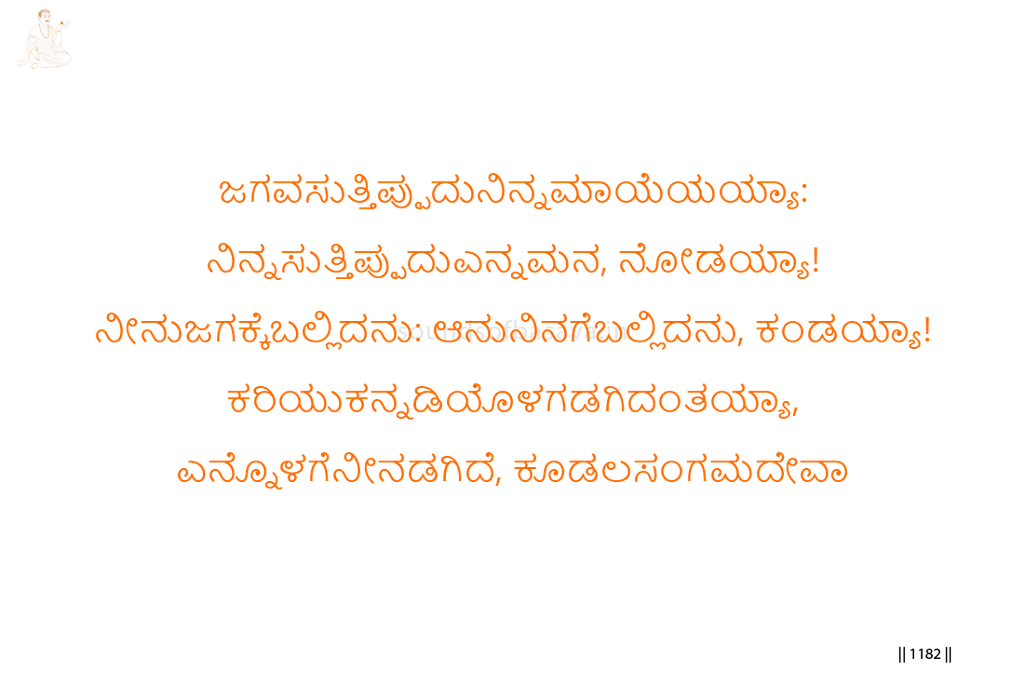
Basavanna distinguishes two movements. The world circles within Kudalasangama Deva’s Māyā, while his own mind circles around the Lord.
He then states the relation of knowing: Kudalasangama Deva knows the world, and Basavanna knows Him. The movement turns from the vast world toward direct inward recognition.
The concluding image makes this recognition concrete. Just as an elephant appears hidden within a mirror, Kudalasangama Deva remains hidden within Basavanna.
Imagery & Symbolic Relevance
The circling world forms the opening image. Basavanna says that the world’s movement belongs to the Lord’s Māyā.
The world is not described as moving independently. Its continual turning, change, and outward activity remain within the field of Kudalasangama Deva’s Māyā.
The next line brings the movement inward. Basavanna’s mind does not circle the world; it circles Kudalasangama Deva.
The repeated circling creates a deliberate contrast. The world turns within Māyā, but the mind turns toward the Lord. The same movement of circling therefore has two different centres.
The statement “You know the world” places the world within Kudalasangama Deva’s knowledge. Nothing in its movement lies outside Him.
Basavanna then says, “I know You.” He does not claim to know the whole world as the Lord knows it. His knowing is relational and devotional: amid the world’s movement, he knows Kudalasangama Deva.
The elephant and mirror form the central concluding image. The elephant is vast, solid, and externally visible. The mirror is comparatively small, yet the entire elephant appears within it.
The elephant does not physically enter the mirror. Its complete image is present there without the mirror becoming the elephant or acquiring its physical size.
Basavanna applies this directly to Kudalasangama Deva. The Lord who knows the world is hidden within him, just as the great elephant is seen within the mirror.
The image holds vastness and inward presence together. What appears too great to be contained outwardly becomes visible within a small reflecting surface.
The word “hidden” is important. Kudalasangama Deva is inwardly present, but that presence must be recognized. The Lord has not newly entered Basavanna; He is discovered as already concealed within.
The sequence is exact: the world circles in Māyā, the mind circles the Lord, the Lord knows the world, Basavanna knows the Lord, and the vast Divine presence is hidden within him like an elephant within a mirror.
Lingayoga
In Lingayoga, the mind must examine what it continually circles. If it revolves around the changing world, it remains governed by the movements of Māyā. Its centre must become Linga.
The vachana does not require withdrawal from the world. It requires a change in inward orientation: while the world continues its movement, the mind remains turned toward Kudalasangama Deva.
The mirror image also gives a restrained practice-relevance. The practitioner does not create the Divine presence within. Through steadied attention and Linga-centred awareness, what is already inwardly present becomes recognizable.
Editorial Commentary
Kariyu means the elephant. The concrete comparison must remain intact: a large elephant appears contained within a relatively small mirror. In the same way, Kudalasangama Deva is hidden within Basavanna.
The mirror should not be expanded into a separate doctrine of witness-consciousness. Its source-bound function is to show how a vast visible form can appear inwardly contained without physically entering the reflecting surface.
The two statements of knowing should also remain relationally distinct: Kudalasangama Deva knows the world, while Basavanna knows Kudalasangama Deva.
Related Vachana
Supporting Vachana
Sharana Sthala Vachana 833 — Who Revealed This Path?
Sharana Vachana 833 recognizes that the mind which reveals the paths of Guru, Linga, Jangama, Padodaka, and Prasada is Kudalasangama Deva Himself.
It prepares Vachana 904, where the mind no longer turns as an independent faculty but circles the Lord and discovers Him hidden within.
Advancing Vachana
Aikya Sthala Vachana 906 — The Precious Witness
Vachana 906 carries inward recognition further through the image of the single jewel over which the pure self and the Supreme appear to contend.
Thus the Lord hidden within in Vachana 904 deepens into recognition that the apparent division between the inward self and the Supreme cannot divide the one precious reality.
