

Summary
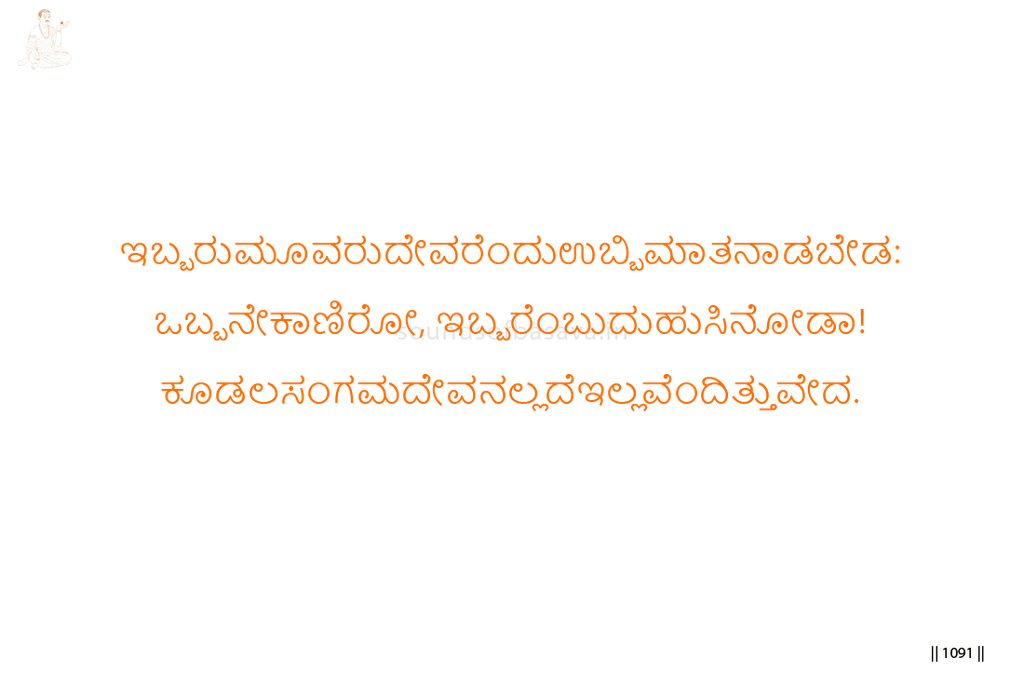
Basavanna warns against speaking with pride of two or three gods. Divine plurality must not become a boastful assertion.
He commands the listener to see the One. To declare that there are two is false.
The Veda itself is then brought forward as confirmation: none exists apart from Kudalasangama Deva.
Imagery & Symbolic Relevance
The opening words, “Do not speak proudly,” identify the first error. The problem is not speech alone, but speech swollen with certainty and self-importance.
The expressions “two gods” and “three gods” introduce numerical division into the Divine. Basavanna refuses this multiplication.
The command “See the One” changes the movement from speaking to seeing. He does not ask the listener merely to repeat another doctrine; he asks for direct recognition.
The next statement is severe: “To say two is false.” The vachana does not leave two as an acceptable alternative beside one. It names the second Divine centre as false.
The word “look” reinforces the demand for discernment. Basavanna directs attention toward what must be recognized rather than merely debated.
The final line invokes the Veda. Scriptural testimony is made to confirm the same recognition already demanded through seeing.
The declaration “There is none apart from Kudalasangama Deva” completes the vachana. The One is not left unnamed or abstract; the sole Divine reality is identified directly as Kudalasangama Deva.
Lingayoga
In Lingayoga, the seeker must not divide refuge between separate Divine centres.
Speech, thought, worship, and inward dependence must be gathered into Kudalasangama Deva. To outwardly profess one Lord while inwardly relying upon many would leave the practice divided.
The command to see is especially important. Single refuge must become direct awareness, not merely a statement preserved in memory.
The practical direction is clear: cease multiplying the Divine through speech and recognize Kudalasangama Deva as the One without another.
Editorial Commentary
The Kannada speaks directly of two, three, and one. These numerical terms should not be dissolved into an unrelated general discussion of social or psychological fragmentation.
The vachana also does not merely say that Kudalasangama Deva is the greatest among several independent gods. It says that the claim of two is false and that none exists apart from Him.
The appeal to the Veda strengthens the declaration but does not replace direct seeing. Basavanna first says “See the One” and then brings scriptural testimony into agreement with that recognition.
Related Vachana
Sharana Sthala Vachana 751 — The Hollow Drum
Sharana Vachana 751 concludes with the direct instruction not to say that another deity exists apart from Kudalasangama Deva. Its image of rice placed upon a drum shows that religious action and offering become misplaced when directed away from the true refuge.
This prepares Vachana 546 precisely. In Sharana, undivided refuge is established as spiritual discipline: devotion must not be scattered toward another deity. In Aikya, that discipline becomes direct recognition: there is One, the assertion of “two” is false, and none exists apart from Kudalasangama Deva.
Advancing Vachana
Aikya Sthala Vachana 549 — The Many Names Converging into One
Vachana 546 rejects the claim of two or three independent gods and commands the listener to behold the One.
Vachana 549 carries this recognition into the field of many spoken names—Nārāyaṇa, Vīrāyaṇa, Bomma, and Imma. Yet when poison burns and severe ordeal arises, all cry “Śaraṇu” to Kudalasangayya.
The numerical unity declared in Vachana 546 therefore advances into lived single refuge in Vachana 549. Many names may be spoken, but at the decisive moment all divided dependence falls away and refuge rests in Kudalasangama Deva alone.
