

Summary
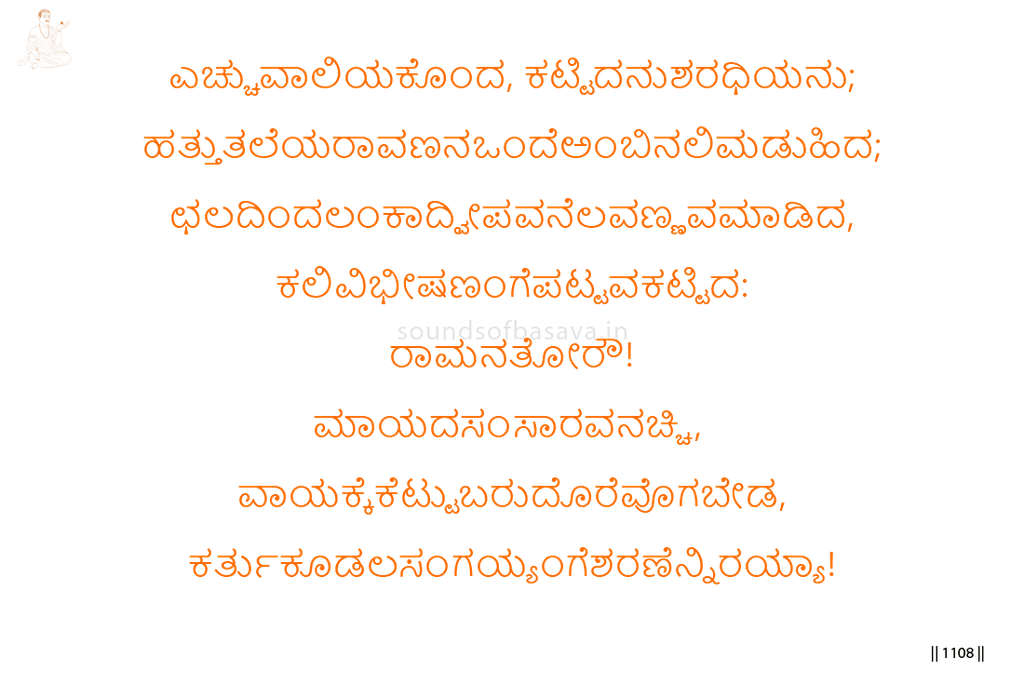
Basavanna recalls a sequence of extraordinary deeds: Vāli was killed, the ocean was bridged, ten-headed Rāvaṇa was brought down with a single arrow, Lanka was devastated, and Vibhīṣaṇa was crowned.
These achievements changed rulers, kingdoms, and outward conditions, yet they remained within Māyā-bound samsara.
Basavanna therefore warns against becoming attached to this passing field and being ruined within it. His final direction is to take refuge in the Creator, Kudalasangama Deva.
Imagery & Symbolic Relevance
The killing of Vāli begins the sequence. One known for formidable strength is overcome, showing that even great power can be brought to an end.
The bridging of the ocean presents an immense undertaking. A natural barrier is crossed through determined action.
The ten-headed Rāvaṇa falling to one arrow gathers enormous power and sudden defeat into one image. The many heads and the single arrow sharpen the reversal.
The devastation of Lanka extends the consequence from one ruler to an entire kingdom. The seat of authority and splendour is brought down.
The crowning of Vibhīṣaṇa follows destruction with succession. One ruler falls and another receives the throne.
The sequence therefore contains victory, defeat, destruction, and replacement. Basavanna names these events before giving his warning.
The phrase “Māyā-bound samsara” gives the governing judgment. Even remarkable deeds, conquered obstacles, fallen enemies, and newly bestowed crowns remain within the world of change and entanglement.
The warning against trusting or becoming attached to it concerns fascination with this field. The seeker may be drawn toward power, achievement, and the rearrangement of worldly position.
The words concerning being ruined while wandering give the consequence of that attachment. The danger lies in allowing the mind to be carried through samsara by its displays of triumph and loss.
The final instruction—“Take refuge in the Creator, Kudalasangama”—changes the direction completely. Refuge is placed neither in the victor, the victory, the kingdom, nor the crown, but in Kudalasangama Deva.
Lingayoga
In Lingayoga, great action and visible achievement do not by themselves establish freedom.
The seeker may overcome obstacles, gain influence, defeat opposition, or receive honour. These remain within samsara when the mind becomes attached to them.
The vachana directs attention from the changing results of action to the Linga in whom refuge rests. Action may continue, but conquest, success, and status cease to govern inward dependence.
The practical direction is clear: perform what must be done without making victory, authority, or succession the ground of spiritual fulfilment. Let refuge remain in Kudalasangama Deva.
Editorial Commentary
The Kannada presents a sequence of events associated with Rāma’s campaign and then warns against attachment to Māyā-bound samsara.
The ocean-image concerns its bridging or restraint. The Lanka-image concerns devastation, while Vibhīṣaṇa’s coronation shows the transfer of rule after Rāvaṇa’s fall.
The title emphasizes conquest and passing power. The Kannada’s final concern is more exact: attachment to the samsaric field of victory, destruction, and succession leads to ruin.
The closing word Kartṛ, the Creator or Doer, identifies Kudalasangama Deva as the one in whom refuge rests after the instability of worldly action has been seen.
Related Vachana
Supporting Vachana
Sharana Sthala Vachana 625 — The Fall of Kingdoms — The Cost of Forgetting the Eternal
Sharana Vachana 625 declares that rule, wealth, and pleasure are not lasting. It points to Kalyana becoming ruined and to Chalukya authority passing away, finally placing royal power before Kudalasangama Deva’s humble bowl.
This prepares Vachana 623 precisely. In Sharana, worldly authority, prosperity, and public greatness are recognized as unstable. In Aikya Vachana 623, that recognition is shown through Vāli’s fall, Rāvaṇa’s death, Lanka’s devastation, and Vibhīṣaṇa’s coronation.
The Sharana teaching removes trust in the permanence of kingdoms; the Aikya teaching redirects the seeker from the entire spectacle of victory and succession toward refuge in Kudalasangama Deva.
Advancing Vachana
Aikya Sthala Vachana 1220 — The Wonder Beyond Separation
Vachana 623 warns the seeker against being carried away by Māyā-bound samsara and ends with the command to take refuge in Kudalasangama Deva.
Vachana 1220 carries that refuge into complete inward union. Basavanna says that he remains at the Lord’s sacred feet without division and that, upon beholding those feet, worldly becoming ceased for him.
The refuge commanded in Vachana 623 therefore deepens in Vachana 1220 into freedom from the samsaric movement itself. Victory, defeat, kingdom, and succession no longer determine awareness because the seeker abides without separation at Kudalasangama Deva’s feet.
