
Summary
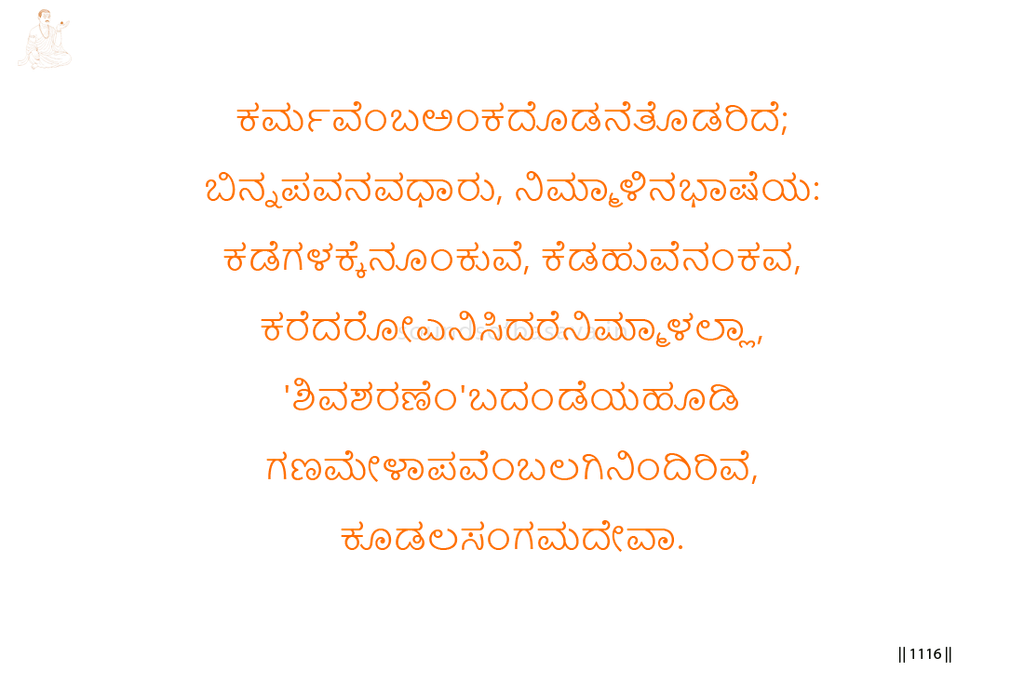
Basavanna says that he is entangled with the mark called karma, yet he turns to Kudalasangama Deva with a direct appeal.
The Lord’s language becomes the force that redirects him. If he does not respond when called, he cannot claim to belong to the Lord.
He therefore places himself within the army called Shiva-Sharana and stands armed with the blade of virtue. The movement is from karmic entanglement to response, discipline, and active belonging among the Sharanas.
Imagery & Symbolic Relevance
The mark called karma is the opening image. Karma is presented as something that attaches itself to the speaker and keeps him entangled. It is not treated as a distant theory, but as a condition already affecting his movement.
The appeal for attention follows immediately. Basavanna does not conceal the entanglement or attempt to overcome it through self-confidence. He places the condition before Kudalasangama Deva.
The Lord’s language forms the turning point. Language here is not speech for explanation alone. It carries direction, command, and summons. What karma entangles, the Lord’s word redirects.
The movement toward the edges and the bringing down of the karmic mark indicate resistance to the condition that has bound him. Basavanna does not accept karma as his final identity. Under the Lord’s direction, he seeks to displace its hold.
The statement concerning the call gives the measure of belonging. If the servant does not move when summoned, his claim to be the Lord’s own becomes empty. Response verifies relation.
The army called Shiva-Sharana is the central communal image. Basavanna does not stand alone against karmic entanglement. He joins the disciplined company of those who belong to Shiva.
The blade of virtue gives the final image. The weapon carried in this army is not anger, violence, or personal power. It is guna—the quality and disciplined integrity appropriate to the Sharana.
The sequence is therefore exact: karma marks and entangles; the seeker appeals; the Lord’s language redirects; the call demands response; the Shiva-Sharana company is joined; and virtue becomes the blade through which the seeker stands.
Lingayoga
In Lingayoga, hearing must become response. The seeker cannot claim relation to Linga while remaining unmoved by its summons.
Karmic entanglement is answered through alignment with the Lord’s word, the fellowship of the Sharanas, and conduct shaped by virtue.
The blade-image gives the practical discipline: what cuts through entanglement is not self-assertion, but integrity formed within Shiva-Sharana belonging.
Editorial Commentary
The Lord’s “language” should be understood through its action in the vachana: it summons, redirects, and demands response. It is not introduced as an abstract doctrine of language.
The army and blade imagery expresses disciplined Sharana belonging. The weapon is identified with virtue and should not be expanded into hostility toward persons.
The vachana does not deny karma’s binding force. It refuses to treat that force as final when the call of Kudalasangama Deva has been heard.
Related Vachana
Supporting Vachana
Sharana Sthala Vachana 1231 — The Sword of Silence and the Discipline of Jangama
Sharana Vachana 1231 distinguishes between two weapons. The true weapon for meditation is silence, but Basavanna confesses that he grasped the sharp sword of ego and was inwardly ruined. When the Jangama-Linga vow becomes overturned, he asks the disciplining weapon called Jangama to strike, cut, and protect him.
This prepares Vachana 700 by establishing the need for correction before right spiritual action becomes possible. Vachana 1231 exposes the false weapon of ego and submits it to Jangama-discipline. Vachana 700 shows the corrected movement: the seeker responds to the Lord’s summons, joins the Shiva-Sharana army, and stands with the blade of virtue.
What is confessed in Sharana as spiritual inversion matures in Aikya into disciplined belonging. The wrong weapon is relinquished, and the seeker stands within the Lord’s company under the governance of guna.
Advancing Vachana
Aikya Sthala Vachana 724 — All Within Your Domain
Vachana 700 shows the seeker entangled in karma yet redirected through Kudalasangama Deva’s summons. He responds by entering the disciplined company of the Shiva-Sharanas.
Vachana 724 deepens this recognition by placing action, authority, danger, body, mind, and wealth within Kudalasangama Deva’s domain. The seeker no longer treats movement as independently governed or possessed.
The movement is precise: Vachana 700 responds to the Divine call within karmic entanglement; Vachana 724 recognizes that even the field in which action and testing occur already belongs to Kudalasangama Deva. Response to the summons matures into surrender of independent control.
