

Summary
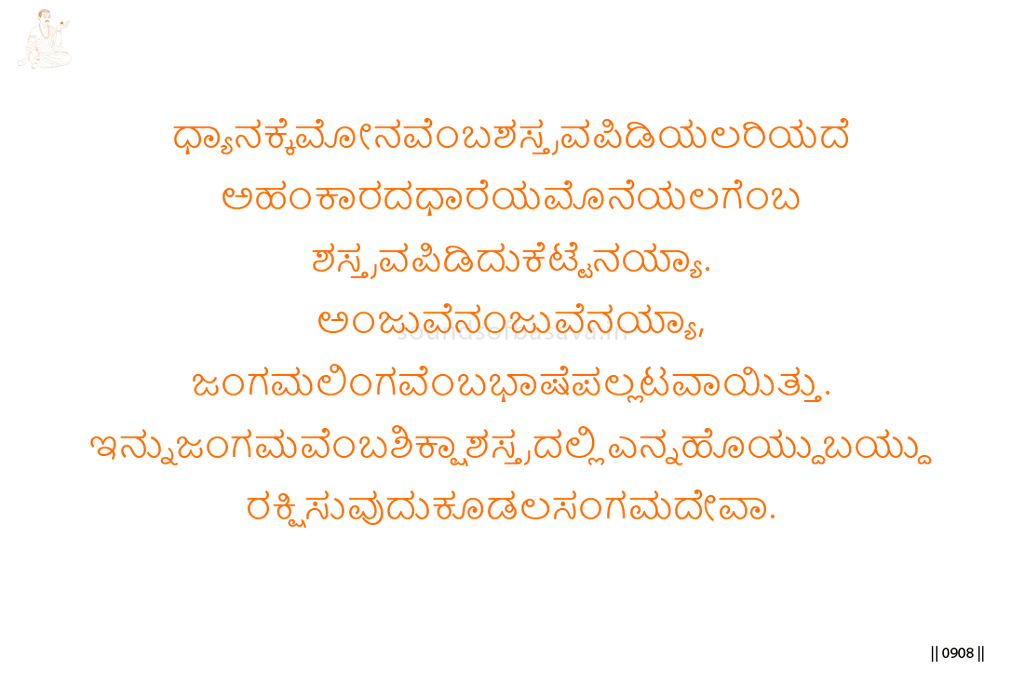
Basavanna confesses that he failed in the very field of meditation. For dhyana, the proper weapon is silence. But not knowing how to wield that weapon, he grasped instead the sharp sword of ego and was ruined.
The fault is subtle. He did not fall by abandoning the path, but by mishandling the path through ahankara. Meditation itself became dangerous when ego took hold of it.
He trembles because he sees that the vow called Jangama-Linga has become overturned within him. What should have been living union of movement and presence has been inverted by self-assertion.
The prayer is therefore severe: within the disciplining weapon called Jangama, the living realized presence that corrects and purifies, strike me, cut me, and protect me. Basavanna does not ask to be spared correction. He asks to be saved through the cutting that removes ego before Kudalasangama Deva.
Imagery & Symbolic Relevance
The first image is the weapon called silence. Silence here is not mere absence of speech. It is the inward stillness required for true meditation, where egoic movement does not occupy the center.
The second image is the sword of ego. Ego is also a weapon, but a destructive one. It cuts wrongly. It divides the seeker from the path, turns discipline into self-importance, and makes spiritual practice serve the one who should have been dissolved.
The confession “I was ruined” gives the vachana its seriousness. Basavanna is not speaking of ordinary failure. He is naming the inward ruin that happens when spiritual means are seized by ahankara.
The repeated trembling shows awakened recognition. He trembles not because of an outer enemy, but because he has seen how deeply ego can enter meditation, vow, and sacred identity.
The phrase “Jangama-Linga” is central. Jangama is the living moving presence; Linga is the abiding sacred presence. Their union should stabilize the seeker. But when ego intervenes, that vow becomes overturned.
The final image is the disciplining weapon called Jangama. Jangama does not appear here as comfort alone. It becomes the living corrective force that strikes, cuts, and protects.
The sequence is exact: the seeker failed to wield silence, grasped ego’s sword, saw the vow overturned, trembled, and then surrendered to the Jangama’s cutting discipline. Protection comes through correction, not apart from it.
Lingayoga
In Lingayoga, this vachana teaches vigilance within practice itself. Meditation, silence, vow, and sacred identity can all be corrupted if ego becomes the hidden wielder.
For Sharana Sthala, the practice-point is direct: do not seek refuge from correction. Seek refuge in the correction that removes ego. Let the Jangama strike what must be struck and cut what must be cut.
The true weapon of meditation is mauna, inward silence. The false weapon is ahankara. The seeker must learn the difference before Kudalasangama Deva, otherwise even spiritual practice becomes inverted.
Editorial Commentary
The cutting imagery should not be softened. Basavanna is not asking for gentle reassurance. The vachana’s force lies in the prayer, “strike me, cut me, and protect me.” The Jangama protects by disciplining; the wound is not destruction, but the removal of ego’s false weapon.
Related Vachana
Supporting Vachana
Pranalingi Sthala Vachana 725 — The Untied Knot
Pranalingi Vachana 725 supports this teaching through the image of a child grasping a blade before readiness. There, Basavanna warns that a powerful means becomes harmful when handled without ripeness; outer mastery cannot untie the inner knot, and disturbed perception cannot see depth clearly. This prepares Vachana 1231 directly. In Vachana 725, the unripe hand is wounded by the blade; in Vachana 1231, Basavanna confesses that he grasped the sharp sword of ego instead of the weapon of silence and now seeks the Jangama’s cutting correction before Kudalasangama Deva.
Advancing Vachana
Aikya Sthala Vachana 1012 — Where the Unknowable Became Silence
Aikya Vachana 1012 advances this teaching by revealing the fulfilled silence that Vachana 1231 has not yet mastered. There, unknowing beyond knowing takes hold, name and measure disappear, attention rests in the ungraspable, restlessness ends, and speech itself falls silent in Kudalasangama Deva. This is the natural Aikya fulfillment of Vachana 1231. In Sharana Vachana 1231, Basavanna fails to wield the weapon of silence and asks to be cut by Jangama; in Aikya Vachana 1012, the false wielder has disappeared, restlessness has ended, and silence stands fulfilled as direct abiding in Kudalasangama Deva.
