

Summary
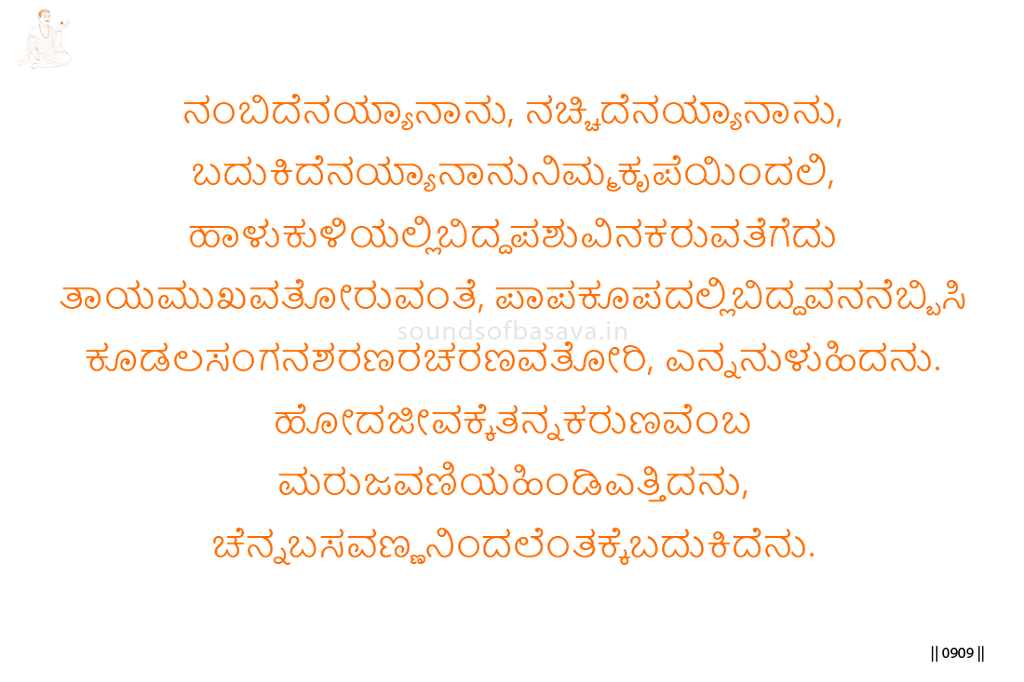
Basavanna begins with trust, belief, and survival through grace. He does not say that he lived through strength, merit, or self-effort. He says he lived only through the grace of Kudalasangama Deva.
The central image is a calf fallen into a muddy pit, lifted out and shown the face of its mother. The calf cannot rescue itself. Its life is restored by being brought back to the source of nourishment, belonging, and protection.
Basavanna applies this to himself. Fallen into the pit of sin, he was lifted and shown the feet of the Sharanas of Kudala Sangama. The Lord did not merely remove him from danger; He restored him to living refuge.
The fading life was revived by the healing herb of compassion. The final confession makes Chennabasavanna central: it is because of Chennabasavanna that Basavanna lived. The vachana is therefore not a claim of attainment, but gratitude for rescue, restoration, and life received through grace.
Imagery & Symbolic Relevance
The first image is trust. “I trusted, I believed” is not a boast. It is the speech of one who knows that even trust itself has been sustained by grace.
The second image is life through grace. Basavanna does not describe life as self-possessed. His very survival is received from Kudalasangama Deva.
The calf in the muddy pit is the image of helplessness. The calf is young, trapped, and unable to lift itself. It represents the seeker fallen into confusion, sin, and separation.
The mother’s face is the image of restoration. Rescue is not complete merely when the calf is taken out of the pit. It must be shown the mother again. In the same way, Basavanna is not only lifted from sin; he is shown the feet of the Sharanas.
The feet of the Sharanas are the living refuge. The Lord restores Basavanna not into isolation, but into the presence of those through whom the path becomes visible and life-giving.
The healing herb of compassion is a tender and precise image. Compassion is not abstract kindness. It is applied like medicine to a fading life. It binds, heals, revives, and raises.
Chennabasavanna is the final humanly named source of restoration. Basavanna does not reduce him to a teacher in general terms. He says directly that he lived because of Chennabasavanna.
Lingayoga
In Lingayoga, this vachana teaches that the seeker is lifted before he can claim to rise by himself. Grace comes first; the feet of the Sharanas become refuge; compassion becomes medicine.
For Sharana Sthala, the practice-point is direct: do not mistake survival for self-strength. Remember the pit, remember the lifting, remember the mother’s face, and remain at the feet of the Sharanas.
Chennabasavanna’s role should remain central. The path is not only inward experience; it is restored through living Sharana-presence. Basavanna’s life is revived through compassion embodied and transmitted.
Editorial Commentary
The calf image should remain simple and source-bound. The calf does not climb out; it is lifted. It is not merely rescued from mud; it is shown the mother’s face. Likewise, Basavanna is lifted from the pit of sin and restored to the feet of the Sharanas. The final line should also remain strong: Basavanna lives because of Chennabasavanna, not because of his own merit.
Related Vachana
Supporting Vachana
Pranalingi Sthala Vachana 1004 — Chennabasavanna Revealed the Hidden Fire
Pranalingi Vachana 1004 supports this teaching by showing Chennabasavanna as the revealer, establisher, and protector of Basavanna’s inner life. There, Chennabasavanna brings forth the hidden fire, reveals Sujñāna-Linga within true life-force, establishes it throughout the whole being, and gives meaning to Basavanna’s coming into the mortal world. This prepares Vachana 1232 directly. In Vachana 1004, Chennabasavanna awakens and protects the living Linga within; in Vachana 1232, Basavanna confesses that his fading life was lifted, healed by compassion, and sustained because of Chennabasavanna.
Advancing Vachana
Aikya Sthala Vachana 1154 — The Revelation of Linga-Aikya
Aikya Vachana 1154 advances this teaching by showing Chennabasavanna’s saving compassion in its fulfilled form. There, Chennabasavanna descends for the supreme purpose, establishes the Fivefold Achara, makes firm the experiential path of Shatsthala, reveals the mystery of Prana-Linga and Linga-Prana, removes the veil of delusion, and shows Linga-Aikya. This is the natural Aikya fulfillment of Vachana 1232. In Sharana Vachana 1232, Basavanna is lifted from the pit, shown the feet of the Sharanas, and revived through compassion; in Aikya Vachana 1154, that rescue ripens into the removal of delusion and the direct revelation of Linga-Aikya through Chennabasavanna before Kudalasangama Deva.
