

Summary
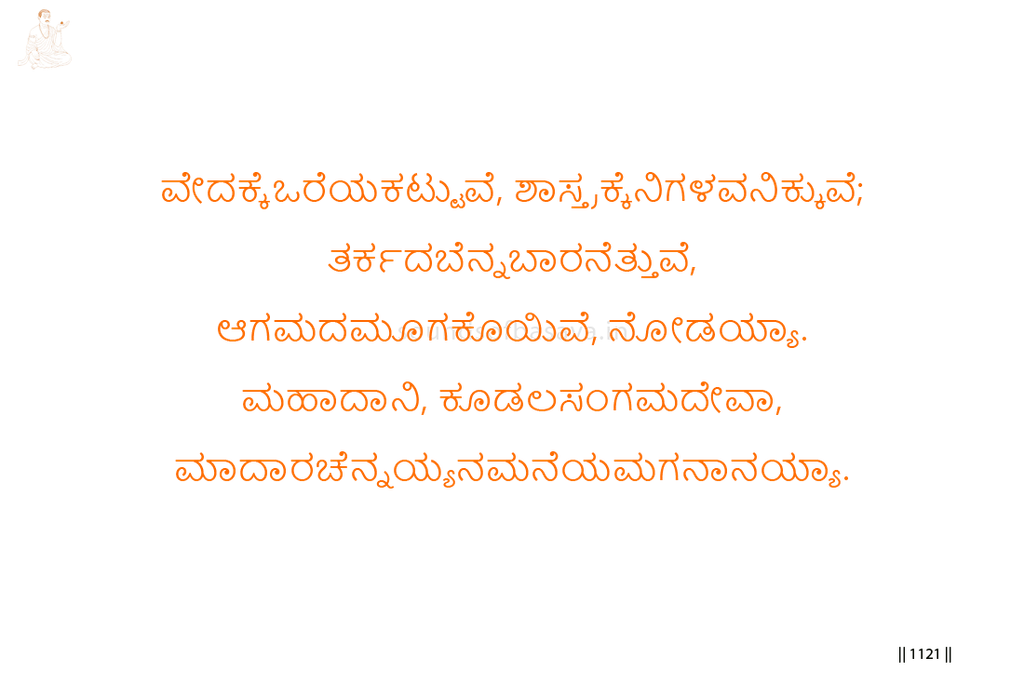
Basavanna declares that he will bind the Veda, shackle the Shastra, break the back of Tarka, and cut the nose of Agama. These established authorities cannot retain supremacy when they stand apart from living realization.
He then identifies himself not through scholarship, inherited ritual status, or scriptural authority, but as a son of Madara Chennayya’s house.
The vachana therefore joins spiritual and social reversal. Veda, Shastra, argument, and ritual tradition are subordinated to the realized Sharana-life represented by Chennayya. True authority is carried through lived belonging before Kudalasangama Deva.
Imagery & Symbolic Relevance
Binding the Veda is the first image. The Veda, ordinarily received as sacred authority, is gathered and restrained. It is no longer permitted to stand as the unrestricted final measure.
Shackling the Shastra gives the second image. Shastra organizes teaching, rule, and interpretation, but Basavanna places it under restraint when it claims authority beyond lived truth.
Breaking the back of Tarka intensifies the movement. Argument depends upon its ability to stand, oppose, prove, and refute. By breaking its back, Basavanna removes its power to dominate spiritual recognition through reasoning alone.
Cutting the nose of Agama is the sharpest image. The nose carries dignity, identity, and public standing. Agama, as inherited ritual and sacred method, is deprived of honour when it presents itself without living realization.
The command “Look” turns these declarations into something to be witnessed. Basavanna does not present a private opinion. He openly places the authority of these systems beneath the truth revealed through the Sharana.
The address “Mahādāni Kudalasangama Deva” brings the declaration before the great Giver. Basavanna’s authority is not self-created; it rests in his belonging before Kudalasangama Deva.
The final statement—“I am a son of Madara Chennayya’s house”—provides the ground of the entire vachana. Basavanna does not replace scriptural authority with personal intellectual authority. He places himself within Chennayya’s household and realized Sharana-lineage.
“Son of the house” expresses more than admiration. It signifies accepted belonging, formation, and spiritual descent. Basavanna receives identity from Madara Chennayya rather than from inherited caste, scholarship, or ritual privilege.
The movement is therefore from the restraint of Veda and Shastra, through the defeat of argument and ritual authority, to the declaration of living sonship in Madara Chennayya’s house.
Lingayoga
In Lingayoga, scripture, doctrine, reasoning, and ritual method must serve living Linga-relation; they cannot replace it.
The practitioner must examine whether learning has entered conduct and whether sacred speech has matured into Sharana-sambandha. Knowledge that remains outside lived relation cannot claim final authority.
Basavanna’s chosen sonship places spiritual origin in the realized household of Madara Chennayya. Belonging to the Sharana becomes more decisive than inherited rank, learning, or ritual qualification.
Editorial Commentary
The verbs—bind, shackle, break, and cut—are deliberately forceful. They remove the supremacy of religious authorities that stand apart from realization. They are not instructions to damage books or persons.
The four authorities are treated separately and should not be collapsed into one general category. Veda represents sacred revelation; Shastra, codified teaching; Tarka, argumentative reasoning; and Agama, transmitted ritual method.
The phrase “son of Madara Chennayya’s house” must remain central. The vachana does not end with a general claim that experience is higher than scripture. It identifies the living Sharana-household through which spiritual authority is recognized.
Related Vachana
Supporting Vachana
Sharana Sthala Vachana 953 — Beyond Veda, Shastra, and Argument: The Source Alone
Sharana Vachana 953 shows the limits of the same four authorities. The Veda cannot penetrate the Linga, the Shastra cannot accomplish it, Tarka cannot grasp it, and Agama cannot reach it. Each names the Linga from the boundary of its own capacity, while Kudalasangama Deva’s Sharana knows the true measure through lived relation.
This directly prepares Vachana 717. Vachana 953 establishes that Veda, Shastra, Tarka, and Agama cannot contain the Linga. Vachana 717 gives this limitation a fiercer expression by binding, shackling, breaking, and dishonouring their claim to supremacy.
What Sharana Vachana 953 identifies as the boundary of mediated knowledge becomes in Aikya Vachana 717 a complete transfer of authority to living Sharana-lineage—the house of Madara Chennayya.
Advancing Vachana
Aikya Sthala Vachana 1348 — All Are the Children of Chennayya
Vachana 717 ends with Basavanna declaring himself a son of Madara Chennayya’s house. This chosen sonship replaces authority based upon scripture, scholarship, ritual status, and inherited rank.
Vachana 1348 expands that sonship universally. Worlds and their beings, Brahma, Vishnu, Rudra, ancient sages, celestial beings, inner beings, and those called “I” and “you” are all declared children of Chennayya.
The continuation is precise: Vachana 717 establishes Basavanna’s personal belonging to Chennayya’s house; Vachana 1348 removes every remaining hierarchy by placing all beings within that parenthood. The living lineage that overturns textual and ritual supremacy becomes universal kinship before Kudalasangama Deva.
