

Summary
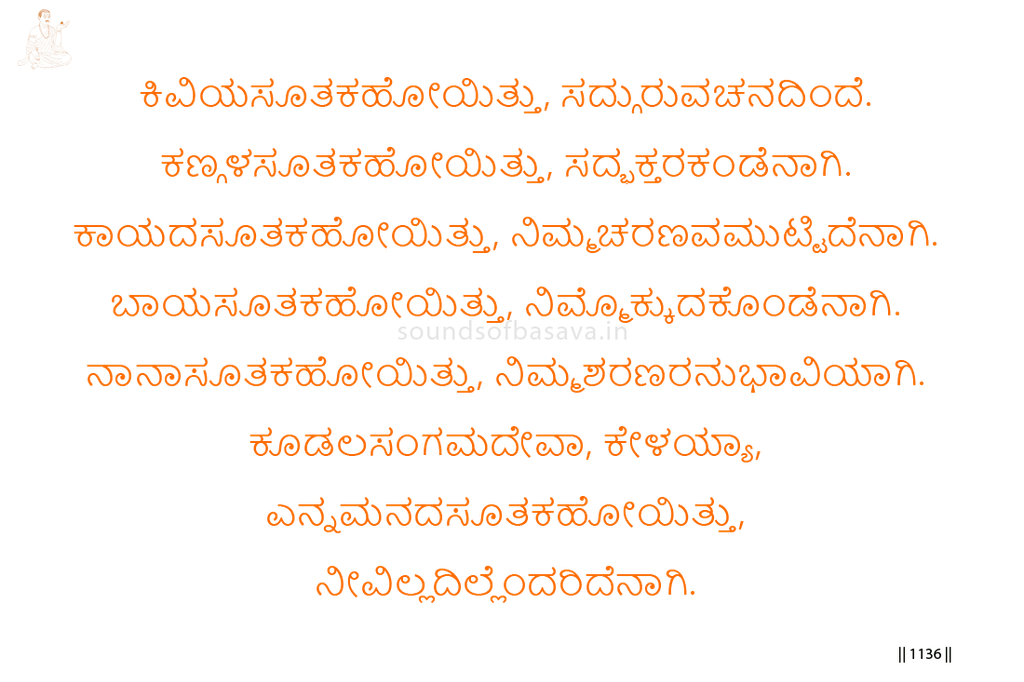
Basavanna describes purification passing through six fields of his being. The impurity of the ear ends through the Sadguru’s word; the impurity of the eyes ends through seeing the true Bhaktas; the impurity of the body ends through touching Kudalasangama Deva’s feet; and the impurity of the mouth ends through sacred receiving from the Lord.
The varied impurities of life fall away through becoming an Anubhavi of the Lord’s Sharanas. Their realized experience does not remain external information; it enters and transforms the seeker.
The final purification occurs in the mind. Its impurity ends when Basavanna realizes that there is none other than Kudalasangama Deva. Hearing, seeing, bodily contact, receiving, and Sharana-Anubhava culminate in undivided Divine recognition.
Imagery & Symbolic Relevance
The impurity of the ear forms the first field. The ear is purified through the Sadguru’s vachana. Hearing becomes sacred when it receives the word that gives true direction.
The Guru’s word is not presented as mere sound. It removes the impurity that arises when hearing is occupied by falsehood, distraction, or speech that does not lead toward the Divine.
The impurity of the eyes forms the second field. It disappears when Basavanna sees the Sadbhaktas—the true devotees.
The line gives sacred importance to seeing living devotion. The eyes are purified not by closing themselves to the world, but by beholding those in whom Bhakti has become conduct.
The impurity of the body forms the third field. It ends when Basavanna touches the Lord’s feet.
The feet represent the place of surrender and refuge. The body that formerly moved according to its own claim is brought into humility through direct contact with the sacred feet.
The impurity of the mouth forms the fourth field. It ends when Basavanna receives what comes from Kudalasangama Deva.
The mouth is therefore purified through sacred receiving rather than through appetite or private possession. What is received from the Lord is not treated as ordinary consumption.
The phrase “many impurities” widens the purification beyond a single faculty. Basavanna does not attempt to list every remaining stain separately. They disappear through becoming an Anubhavi of Kudalasangama Deva’s Sharanas.
Sharana-Anubhava is therefore central. Merely seeing the devotees purifies the eyes, but inwardly participating in their lived experience removes the wider field of impurity.
The mind forms the sixth and culminating field. Basavanna asks Kudalasangama Deva to hear him and declares that the mind’s impurity has ended.
The cause of this final purification is precise: he has realized that there is none other than Kudalasangama Deva. The mind is purified when it no longer establishes another final refuge, power, or Divine centre.
The sequence moves progressively inward. The ear hears the Guru; the eyes see the true Bhaktas; the body touches the feet; the mouth receives from the Lord; the person becomes an Anubhavi of the Sharanas; and the mind realizes that none exists apart from Kudalasangama Deva.
Lingayoga
In Lingayoga, purification must enter hearing, seeing, bodily conduct, receiving, lived experience, and mind.
The Guru’s word gives direction; the sight of true Bhaktas gives a living measure; contact with the sacred feet grounds the body in surrender; and sacred receiving removes self-centred possession.
These movements become complete only when Sharana-Anubhava enters inwardly and the mind ceases to seek another final centre apart from Kudalasangama Deva.
Editorial Commentary
Sutaka is repeated across all six movements. It should not be restricted here to conventional birth- or death-related ritual pollution. Basavanna applies it to the impurity affecting ear, eye, body, mouth, the wider life, and mind.
The purification of the mouth arises through receiving what comes from Kudalasangama Deva. The line should not be enlarged into a general theory of purified speech when the stated action is sacred receiving.
Becoming an Anubhavi of the Sharanas is deeper than keeping their company outwardly. It indicates participation in, and inward understanding of, their lived realization.
The final Kannada states that the mind’s impurity ended when Basavanna realized that there is none other than Kudalasangama Deva.
Related Vachana
Supporting Vachana
Sharana Sthala Vachana 780 — The Stillness of True Company
Sharana Vachana 780 describes Basavanna’s mind swelling with joy on seeing the true and noble Sharanas. By holding the feet of the Sri Guru, he becomes purified, and through Padodaka-Prasada the bondage of becoming is cut away.
This prepares Vachana 781 directly. Both vachanas bring together the sight of true Sharanas, the Guru’s feet, purification, and sacred receiving. Vachana 780 establishes their transforming force within Sharana Sthala.
Vachana 781 expands that transformation across the whole person. Guru-vachana purifies the ear, the devotees purify sight, the feet purify the body, sacred receiving purifies the mouth, and Sharana-Anubhava removes varied impurities.
What appears in Sharana as purification and release through true company, Guru-refuge, and Padodaka-Prasada matures in Aikya into sixfold purification culminating in the recognition that there is none other than Kudalasangama Deva.
Advancing Vachana
Aikya Sthala Vachana 1054 — Where No Division Remains
Vachana 781 ends with the purification of the mind through the realization that none exists apart from Kudalasangama Deva. The former divisions of hearing, seeing, bodily identity, receiving, and mental allegiance have been brought into one Divine direction.
Vachana 1054 carries this recognition into settled abidance. Anguish subsides, longing becomes quiet, intention falls silent, and the self is found. Basavanna knows what is within and without and remains without separation from Kudalasangama Deva through the Lord’s compassion.
The continuation is precise: Vachana 781 describes the successive removal of impurity until the mind knows no other; Vachana 1054 shows the fulfilled condition in which the movements sustained by division have fallen silent and no separation remains.
Sixfold purification thus deepens into undisturbed abidance in Kudalasangama Deva.
