
Summary
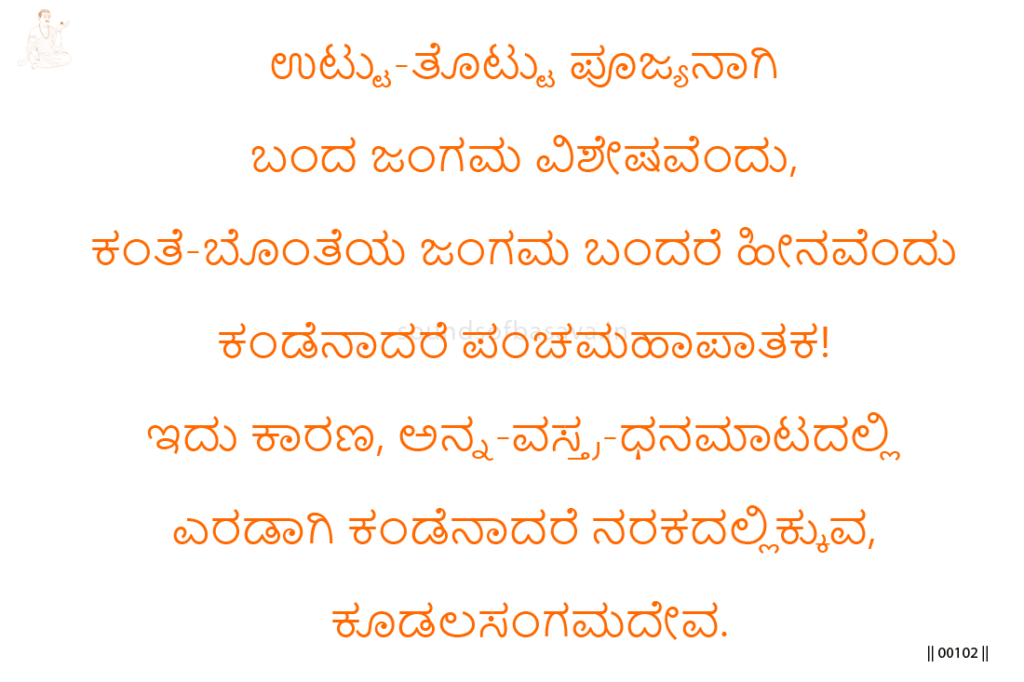
In this vachana, Basavanna warns against judging the Jangama by outer appearance.
If one Jangama comes clothed, honored, and visibly dignified, and another comes in worn or patched cloth, the seeker must not call one special and the other inferior.
To see such difference is a grave fall. Food, clothing, wealth, and visible condition must not become the measure of sacred presence. The vachana teaches that Jangama-bhakti requires an undivided eye before Kudalasangama Deva.
Imagery & Symbolic Relevance
The well-clothed Jangama is the first image. Outer dignity, good clothing, and visible honor can easily attract reverence.
The Jangama in worn cloth is the second image. Poverty of appearance may cause the ordinary eye to reduce the person’s worth.
Basavanna exposes this as a serious spiritual error. The Jangama is not made higher by adornment or lower by poor clothing.
Food, clothing, wealth, and visible condition are the common measures of worldly judgment. When these enter devotion, sacred seeing becomes divided.
The warning of great sin and hell gives the vachana its severity. To divide Jangama by appearance is not a minor social fault; it breaks the eye of reverence itself.
The seeker must learn to see Kudalasangama Deva’s presence without splitting it into high and low.
Lingayoga
In Lingayoga, the Anga must purify perception.
The eye may bow before beauty, order, wealth, and dignity, while recoiling from poverty, roughness, or simplicity. This is not true Jangama recognition.
Jangama-bhakti requires seeing beyond covering. Clothing and condition belong to the outer field; sacred presence must be received without such division.
Practice matures when reverence becomes steady before both the adorned and the poor, the honored and the unnoticed.
Editorial Commentary
This vachana disciplines the eye of devotion.
Basavanna shows that the Jangama must not be measured by dress, wealth, food, or visible status.
Related Vachana
Supporting Vachana
Vachana 411 — Divinity Knocks
Vachana 411 warns against honoring the Jangama from afar while neglecting the Jangama already present nearby. Vachana 412 continues by rejecting another divided vision: honoring the adorned Jangama while lowering the one who comes in worn cloth.
Advancing Vachana
Maheshwara Vachana 577 — In the Name of Sacrifice
Vachana 412 teaches that the eye must not divide Jangama by outer condition. Maheshwara Vachana 577 advances this into the undivided gaze, where perception itself must become whole before Kudalasangama Deva.
